


We begin the day remembering that in Peru it is still night and we count the topics with the delay imposed by time zones. After three days of crowds, we have criticism of inflated figures. The Pope appeared on the balcony of the Apostolic Nunciature in Lima at seven in the morning, began speaking in Italian and corrected himself mid-sentence, and the Holy See printed it in its own bulletin. Today’s story, therefore, is Friday, which was the first Chiclayo day, because the coronation day has not yet begun when this is published. With Friday’s day come the only sentence he has said about his health, a Golden Rose that no one has counted, a public reproach from a victims’ organization, a compilation of his phrases with one altered, and an Italian journalist’s calculator applied to Lima’s three million. A very intense day with more than fifty links in the text that allow the topics to be expanded. Good reading.
“Sorry, I’m speaking Italian”
The balcony greeting is the only event of the entire trip that did not appear in the official program, which does not contemplate any balcony appearance on any day. The Bollettino records it at seven in the morning on Friday, before the departure for Chiclayo. He began in Italian—“a brief greeting, before leaving for the next stage of this apostolic journey”—and realized it halfway through.
The Holy See publishes it with the note “Original text: Spanish”: “Sorry, I’m speaking Italian; here at home we speak Italian”. And then, “now I’m going to Chiclayo.” After a week of official texts that do not match what was heard, the day the Pope corrects himself is news.
Mass at the pampas of Pimentel after a drive in an open car through the wasteland. At the end, the bishop of Chiclayo, Edinson Edgardo Farfán Córdova, gave thanks, who succeeded Prevost although not directly, transferred from the prelature of Chuquibambilla. The homily opens with “what joy to return to Chiclayo; it is a blessing for me to be with you again.”
And in that same homily is the only sentence the Pope has said about his health on the entire trip: “thank you for your affection, your support, your prayers, especially for my health in these moments of trial which, with God’s help, I am overcoming”. There is no new medical report nor a single entry in the bulletin about health throughout the Peruvian leg. The word “trial” is his, and the clinical reading some have placed on it is nowhere to be found.
The figures from Chiclayo
We have been dealing with the figures for a week and on Friday they turned around. The Bollettino of the 13th gives the numbers and says whose they are: nearly a million people along the streets of Chiclayo and about five hundred thousand in the pampas of Pimentel, according to local authorities. Later, six thousand inside the university and about fifty thousand on the route. Attributed, bounded and with formula. An Italian Catholic daily published the two figures without attributing them to anyone and headlined one and a half million, which is the sum of both and a figure that its own body text never writes. It is the mechanism of the three million that L’Osservatore put on the front page on Thursday. And a Vaticanist site contradicts itself within the same article, with five hundred thousand attributed to the authorities and “nearly a million” without an owner for the same event, lowering the route to fifty thousand in its afternoon piece. Yesterday the problem was the Holy See; on Friday the Holy See began to do it right by citing the source.
Three million in twelve kilometers
The missing calculation has been done by an Italian journalist, and we have checked it. Giorgio Meletti, in his newsletter “Preferisco i giorni feriali,” takes the three million from the Lima airport to downtown route and applies a calculator to them. Twelve kilometers of journey: three million works out to two hundred fifty thousand people per kilometer, one hundred twenty-five thousand per side. At four people per square meter, which is already tight—the normal calculation is three—that requires a strip of people thirty-one meters deep on each side and for the entire twelve kilometers. Seventy-two hectares, almost one hundred soccer fields. His conclusion is that Lima would need sidewalks thirty meters wide, and his reasonable estimate, two hundred thousand people. The arithmetic holds. The attribution, less so: he loads the three million onto the Sala Stampa, and what we documented was a front page of L’Osservatore Romano, which is not the Sala Stampa, and the difference is exactly what we have been making all week.
Where his piece falls apart is in the closing. He maintains that the Lima enthusiasm is strange because Prevost was bishop in Chiclayo, more than seven hundred fifty kilometers away, and compares it to Milanese celebrating a pope who had been bishop of Naples. The Bollettino of April 15, 2020 refutes it: that day he was named apostolic administrator sede vacante of the diocese of Callao, after the resignation of José Luis del Palacio y Pérez-Medel. Administrator, not bishop, and temporarily, but Callao is the port of Lima and is where the airport is from which the route he measures begins. He governed the diocese in which his own calculation begins. His best observation remains, which is not about figures: looking at a photograph from El Comercio he says the crowd seems more of curious onlookers than of faithful, judging by the phones held high.
The chapel of St. Óscar Romero and the Golden Rose
The visit to the chapel was planned and the Bollettino records that he blessed several sick people and unveiled a plaque. It is a chapel of the parish of San José Obrero, in El Bosque, district of La Victoria, a quarter of an hour from downtown: the community built it with what it had, it deteriorated until it became unsafe, it was demolished and rebuilt with funds from foreign benefactors. Prevost, as bishop and later as cardinal, promoted the project and donated. There they gave him a fragment of the alb that Romero was wearing when he was killed in 1980. The headline says “thanks for the prayers for my health”: they prayed for him and he thanks them. And in the same act the opposite occurred, because it was he who blessed the sick.
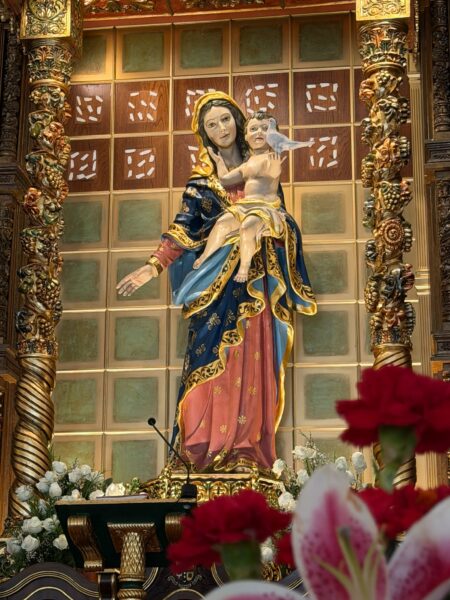
In the afternoon, at the sanctuary of Our Lady of Peace, there were two gestures that the bulletin records and almost no one has counted. A pause before the Blessed Sacrament with the presentation of the Golden Rose, and the blessing of a liturgical bell made in France. The Golden Rose is the oldest surviving pontifical distinction and is granted to Marian shrines. That it is presented and that no one makes it a headline says a lot about how this trip is being covered.
The meeting at that event was with bishops, priests, religious, seminarians, synodal teams and pastoral councils, and from it come the phrases about the laity, whose participation is not a concession but an expression of their baptismal dignity, and about how easy it is to talk about synodality and how difficult it is to practice it. What is circulating is an Italian translation of an original Spanish text, so we give them in indirect speech: quoting them in Spanish would be re-translating the Pope into his own language.
SNAP, the nuncio and the Sodalicio decree
In Chiclayo there was a public reproach that is not minor. Victim organizations identified as SNAP questioned the Pope for not having removed in time priests denounced in 2022, when he was bishop of that diocese. It was not a demonstration or a street incident: it was a claim made publicly while he was there, and no one has answered it.
From the Thursday meeting in Lima there is finally an attribution, and from a single agency. EFE maintains that it was the nuncio in Lima, Paolo Rocco Gualtieri, who privately convened the six victims. Neither Reuters nor the French agency nor Vatican News corroborate it. And convening is not explaining the criterion, which remains unrecorded. One of the six has identified herself on her own, Camila Bustamante, a Chilean journalist and former member of the Servants of God’s Plan, which incidentally dismantles whoever wrote that they were six Peruvians. José Enrique Escardó adds that he was vetoed for being “an inconvenient victim”, and no one has responded to him since we reported it on Wednesday.
We have been writing for days that the decree suppressing the Sodalicio was signed by Pope Francis. The communiqué from the Dicastery for Institutes of Consecrated Life says something else: the decrees were issued by the dicastery and the Pope confirmed them in specific form, and the signature of April 14, 2025, before Prefect Simona Brambilla, was that of the superior general accepting the suppression. The same act suppressed the Marian Fraternity of Reconciliation and, as associations of the faithful, the Servants of God’s Plan and the Christian Life Movement. The sad thing about all this is that the decree remains unpublished and the only thing public is that communiqué. Even the Holy See portal dates an act of the Holy See incorrectly.
Twenty phrases from the Pope, and one altered
The most serious case of the week in terms of headlines. A compilation of twenty phrases from the Pope “in what has been his visit so far” does not contain a single one from the 13th: fourteen are from the Gran Teatro Nacional on Wednesday and six from the vigil on Thursday. Two are cut in half. And one is altered: where the official text says “Peru too has gone through difficult moments”, the compilation prints “Peru has gone through difficult moments.” Removing two words turns a comparison into a diagnosis.
Of Cardinal Pedro Ricardo Barreto Jimeno, Jesuit and archbishop emeritus of Huancayo since February 2024—emeritus, and it is worth saying because half the world cites him as active—, it has been headlined “we are a country without hope”, and the phrase continues: “without horizons that push us to move forward.”
And a dispatch circulating about the Pope blessing a Chiclayo boy sick with cancer is from June 11 and took place at the Santiago Bernabéu stadium in Madrid. The boy is from Chiclayo; the event is not.
The Messaggero headline
We have spent three sections this week explaining that a headline is not judged by its direction and on Friday it was our turn. The direction of a Messaggero piece promises a phenomenon “under the scrutiny of governments”, and the headline says something else: “Leone XIV e le folle oceaniche, una forza popolare che nessun leader politico riesce a eguagliare,” Leo XIV and the oceanic crowds, a popular force that no political leader manages to equal. One promises governments analyzing the Pope; the other, a comparison with politicians. And for the series of figures, one more: an agency review of the “oceanic welcomes” of the trip publishes seven figures without citing a single source, and its own Argentine accounts do not add up: the three events it details total about three and a half million and the text speaks of almost six million.
The Archbishop of Vienna and the ordination of women
These days it is circulating that the Archbishop of Vienna “would certainly like the ordination of women.” The position, first, which half the world gets wrong: the Archbishop of Vienna is Josef Grünwidl, appointed in October 2025, and he is not a cardinal; he received episcopal ordination in January of this year, with Schönborn as principal consecrator.
He said it in an Austrian radio interview on October 31, and the German matters. From Germany they alert us about the text that seems to be deformed. The phrase is “die Weihe der Frau würde ich mir zwar auch wünschen,” I would indeed also desire the ordination of the woman, and it continues saying that it would be a conciliar decision and that he does not see a realistic possibility of it being taken. Weihe der Frau is ordination in the generic sense, not priestly ordination: he did not distinguish at any moment between priesthood and diaconate, which is where all the difference lies. And zwar is a concessive particle, the German “yes…, but…,” not an intensifier. The Italian “certamente” and the English “certainly” turn into something categorical what in German is constructed to remain nuanced in the following sentence.
The asymmetry between the two degrees is what disappears when one writes “ordination of women” plain and simple. Regarding the priesthood, John Paul II declared in 1994 that the Church “in no way has the faculty” to confer it on women and that the judgment must be maintained “in a definitive manner”, and the response of the Congregation for the Doctrine of the Faith in 1995 added that it belongs to the deposit of faith. Regarding the diaconate, the commission presided over by Cardinal Petrocchi spoke of “absence of sufficient consensus” and expressly said that the judgment is not definitive. The synodal commission concluded that there is no theological, historical or pastoral consensus, and the formula of the bulletin is narrower; and when the 2024 synodal document says that the Pope confirmed that assessment, the Pope was Pope Francis.
We are suspicious and the chain of information explains quite a bit. Interview of October 31 in German, English translation by a Vaticanist medium on November 2, and Italian version on the 13th. Thirteen days of delay, and it comes out the day after the Lima speech on the macho mentality. Whoever builds the bridge between one thing and the other, let him know that he is the one putting it there: what the Pope said in Lima is that a macho mentality persists “that manifests itself in the absence of the father in family life, abuse and violence against women”, and that violence against women “wounds all of humanity.” Of holy orders, not a word.
The three encyclicals of May 15
An Italian lawyer signs a long essay on the difference between human and artificial intelligence, and from it a piece of data is extracted that deserves to remain. Gianfranco Amato bases his argument on two magisterial documents: the encyclical Magnifica Humanitas and the note Antiqua et nova, and maintains that the Pope refers to the second for all ethical-moral considerations.
The official text says something different and better. In number 97 the Pope does not delegate: he limits his own scope—“Mi limito a richiamare alcuni elementi essenziali per un discernimento morale e sociale,” I limit myself to recalling some essential elements for a moral and social discernment—so that it is human intelligence, with its conscience and its freedom, that guides technical innovation and decides its use and its limits. Limiting is not referring.
What is worth retaining from the document is number 102, where he warns that the use of artificial intelligence is never a purely technical fact when it enters into decisions about work, credit, access to services or reputation, and where he points out a less evident pitfall: systems that present themselves as neutral and objective reflect and reinforce the stereotypes and ideological positions of those who designed and trained them. It is the most uncomfortable warning of the encyclical and the one least cited.
The Caritas of Rome report and the exercises of Amos
While the Pope speaks of poverty in Peru, the Caritas of his own diocese publishes the numbers for Rome. According to the 2026 report, “Ricomporre la speranza,” the average income of Roman taxpayers is 32,501 euros, in Parioli it exceeds 78,500 and in Tor Bella Monaca it remains at about 21,700. Thirty-six percent declare less than fifteen thousand euros and 3.1% concentrate more than 22% of the wealth. One to three and six between two neighborhoods of the same city. The headline says that inequalities are increasing, and the body gives a photograph without interannual comparison: the only longitudinal datum is the 30.5% of families that declare that their economic situation has worsened, which is perception and not distribution. The difference matters because the report is annual and has been headlined that way for years.
And on the same key, with the prophet that corresponds to him. The Archbishop of Naples, Cardinal Domenico Battaglia, will lead from January 25 to 29 in Assisi some spiritual exercises open to all, around the figure of Amos, under the title “Non si prega da lontano – Con Amos, dove la fede diventa giustizia,” one does not pray from afar, with Amos, where faith becomes justice. Battaglia has been cardinal since the consistory of December 7, 2024 and Archbishop of Naples since December 2020, both from Pope Francis. Amos is the prophet of social justice, and choosing him for exercises in Assisi is a declaration before beginning.
The Vatican pension fund
And what is really decided while the Pope is away. A Vaticanist site maintains that the Secretariat for the Economy wants control of the pension fund through a new statute, without citing act, date or anything official. Interesting data always appear. Three figures of actuarial deficit circulate—one thousand five hundred million, between five hundred and one thousand, and about two thousand—and none has a document behind it: the second is attributed to “internal sources” and the third to “various estimates.” The last official figure of the fund is from February 2015: assets of 477,668,000 euros as of December 31, 2014, coverage of ninety-five percent and “substantial equilibrium”. Eleven years without other information and these are the years of transparency.
Between that ninety-five percent and today there is only one document, and it brings no numbers. Pope Francis’s letter of November 19, 2024 to the College of Cardinals speaks of a “serious prospective imbalance” of the fund and of measures that are “urgent, no longer postponable,” without giving a single figure, and cites “analyses by independent experts” that it neither identifies nor publishes. In that same letter he names Cardinal Kevin Farrell as sole administrator. And there is no published norm that suppresses the board of directors of eleven members that the current statute still foresees, nor that defines the powers of the sole administrator.
Bishop of Chiclayo, titular of Sufar
A canonical error that deserves correction because it is going to be copied. A biographical piece on the Pope’s two nationalities writes that in September 2015 he was named “titular bishop of that see,” speaking of Chiclayo. The official biography says something else: in November 2014, apostolic administrator of Chiclayo and titular bishop of Sufar; in September 2015, bishop of Chiclayo. A diocese with its own bishop does not have a titular bishop: the titular title was Sufar, an extinct see. S
Of the same matter, the document that was given to him Thursday night at the nunciature. His electronic national identity document carries the annotation that it does not expire, because of his age, and keeps the address in Chiclayo; the procedure was done at the Vatican in May 2025 and naturalization was on August 24, 2015, the same day as his first document. The number circulates in the Hispanic-American press and someone has offered it as a lottery number: here it is not given. The file is kept by Migraciones and the public documents of the process are on display from November 10 to 24 at the Ministry of the Interior, with free entry, so there is a physical place where the handwritten application declared cultural heritage can be seen. And not a single line of it has yet been published.
Closing the day
Two appointments in Rome while the Pope is in Peru, and no resignations. Bishop of Peterborough, in Canada, Wayne Lawrence Lobsinger, transferred from the office of auxiliary of Hamilton; and coadjutor bishop of Kisii, in Kenya, Joseph Onyango Oduor, Augustinian, until now parish priest in the archdiocese of Kisumu. Augustinian like the Pope, which is the detail.
From the Argentine leg circulates a balance with fervor and without sources. José Arturo Quarracino gives two and a half million at the Monument of the Spaniards, six hundred fifty thousand in Córdoba and between three and three and a half million in Luján, and maintains that the Government tried to prevent the visit to the Cottolengo and withdrew from the Pope the escort given to heads of state. The verifiable datum is the one he does not underline: the Cottolengo of Buenos Aires, founded in 1935, is managed by the Sons of Divine Providence with an annual subsidy from the Argentine State. A small error of dates: he dates Quadragesimo anno in 1941 when it is from May 15, 1931, with which he errs by ten years the encyclical whose name is precisely the fortieth anniversary of Rerum novarum, and calls capitalism what number 109 treats as imperialism.
From the Masonic thread we have been following since Poblet, a piece that promises more than it delivers. Cinzia Notaro announces “the 1947 document that proves the submission of the Italian State to Freemasonry”, and the document is not reproduced or identified in any of her links, which are a file capture from a disappeared site, a 2007 blog, a video and two opinion pages. It is not a denial, which we could not give; it is a lack of accreditation, which we can.
The nuncio in Uruguay has published a balance of the trip, and it is not an interview despite what the title says: it is an article signed by himself, Gianfranco Gallone, in the first person. On organization it brings two things: that the motto was chosen by the bishops and that he drove one hundred forty kilometers back from Florida to the Carrasco base.
Of the First Lady of Colombia, who attended the Lima welcome invited by the President of Peru, what has been published are three devout phrases without a single Vatican source. Around it is what does not appear in the piece: the press in her country had been asking who was paying for the trip—the Chancellery responded that she was, with her own resources—and there is an open investigation into donations to her foundation.
A note from the German press. The correspondent of a Berlin daily for South America signs a commentary maintaining that the Pope’s empathy finds its limit where the interpretative authority over the faith is at stake, supported by a doctrinal document from September. It is the author’s thesis and goes as such.
And the Peruvian expense, for the comparison that matters. Two numbered supreme decrees transfer 63,220,991 soles to the Chancellery from the contingency reserve and add 31,792,494 soles distributed among eight entities with breakdown by items. Compared to the direct Argentine contracts that we counted on Thursday, today in two federal courts, here there are published and broken-down decrees.
Our image is Our Lady of Peace in Chiclayo. Today’s gospel is that of the widow who returns again and again before a judge who neither fears God nor cares about men, until he attends to her to get rid of her. With a victims’ organization claiming in the street, a complainant speaking at the doors of a nunciature and thirty-three signatures awaiting response to an October letter, and the victims of Chiclayo in limbo, the closing needs no gloss. Good day
“Will not God then do justice to his chosen ones, who cry out to him day and night?”