


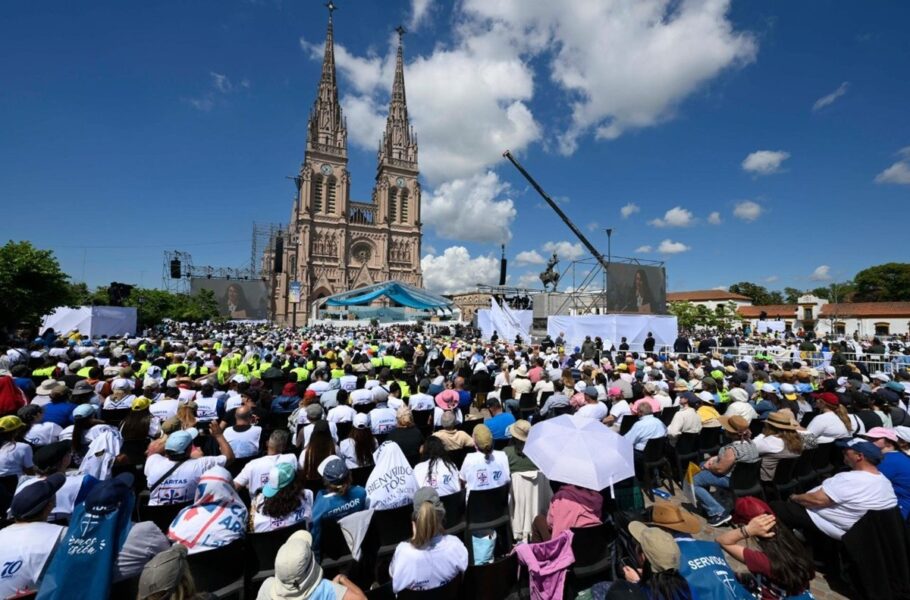
Pope Leo XIV left Argentina on November 11 heading to Peru, after closing in Luján the first visit of a Pope to the country since the trips of Saint John Paul II in 1982 and 1987. In four days he visited Buenos Aires, Córdoba and Luján, within an apostolic journey that between November 6 and 17 also takes him to Uruguay and Peru. He said goodbye with the exhortation repeated by all the media: “Argentina, arise and walk.”
Record crowds and a tent for guests
The attendance figures are the highest of his pontificate. According to the official estimate, the Mass on November 9 at the Monument of the Spaniards, in Palermo, gathered about 2.5 million people. That is more than the nearly two million who gathered John Paul II in the same place in 1982. In Córdoba, on the 10th, there were about 650,000, fewer than the 800,000 local authorities had expected. In Luján, the Holy See Press Office spoke of more than two million. All are official estimates, not independent counts.
Palermo also left the controversy most commented on by the Argentine press. Near the altar, a tent was set up for guests (politicians, businessmen and television personalities) with preferential seating and catering. According to Chequeado, it measured 30 by 40 meters and had capacity for 250 people. It was part of the production service for the Mass and vigil, which the national Government awarded by direct contract to DF Entertainment for 8.69 billion pesos. Religious sources cited by La Nación say that the Episcopal Conference, upon learning of the tent, asked that it be moved as far as possible from the altar. The head of the Buenos Aires city government, Jorge Macri, admitted that “the croissants and puddings were unnecessary.”
The distribution of Communion also marked differences between the two major Masses. In Córdoba, the archdiocese published a detailed protocol in advance. In Palermo, a reader who attended the celebration told this editorial team that he saw disorder and that the Eucharist continued to be distributed after the final blessing. EWTN, on the other hand, described an orderly Communion.
Social doctrine without proper names
The first speech was on November 8 at the Palacio Libertad, before Javier Milei. From it came the most quoted phrase of the trip: “The economy must be at the service of the person and not the person at the service of the economy.” Much of the press presented it as a reprimand to the president, but the text does not name Milei or his Government. According to Infobae, the Casa Rosada interpreted it as a doctrinal message addressed to the entire leadership. The same report noted that the president did not applaud at that passage.
The following day, before businessmen and union leaders at the Catholic University of Argentina, the Pope went further conceptually. He said that when profit is absolutized as the sole criterion of success, the company “dehumanizes itself and becomes a structure of sin that generates exclusion.” The notion is not new. John Paul II developed it in Sollicitudo rei socialis (1987) and rooted it in the personal sins that give rise to those structures. Leo XIV also defended private property, subject to its social function, and proposed the venerable Enrique Shaw as a model.
In Córdoba, in memory of Saint Leo the Great, the emphasis was different. The Pope spoke of the universal call to holiness and exhorted to teach “sound doctrine” by the example of life, with a “total adherence to Jesus Christ, without fissures.”
The requests that went unanswered
On the 9th, as the popemobile passed, a group of university students signing as “Young Catholics” displayed banners with the slogan “Young people want the traditional Mass.” They were accompanied by a document invoking canon 212 and requesting freedom to celebrate with the 1962 Missal wherever there are faithful who request it. The day before, the emeritus archbishop of La Plata, Héctor Aguer, had asked in AdVaticanum to “repeal Traditionis custodes.” He died on November 10, at the age of 83, during the papal visit.
The Pope spoke twice of diversity within the Church. At Vespers in the Buenos Aires cathedral he asked the bishops to guard communion “welcoming with charity our legitimate differences.” In Luján, citing Magnifica humanitas, he described as a richness the “diverse sensibilities” that remain in unity. Neither text mentions the liturgy. Traditionis custodes and the 2023 rescript remain in force, and Leo XIV has not personally commented on their future. Cardinal Arthur Roche, prefect of Divine Worship, assured in October that the Pope will not change the norm.
The other request appeared on a wall on Avenida de Mayo. There were posters with the slogan “Holy Father: for the good of the Church, remove Tucho” and a QR code linking to a 2023 homily by Cardinal Víctor Manuel Fernández in La Plata. Their authors have not been identified. The prefect of the Doctrine of the Faith did not form part of the entourage.
On the 9th the Pope met at the Nunciature with five victims of abuse “presented by the local Church,” according to the Holy See Press Office. Among them was none of the 43 former auxiliary numeraries of Opus Dei who are denouncing before the Argentine courts having been recruited and subjected to servitude. The prelature denies these accusations. According to EFE, the women had requested an audience on September 15 without receiving a response. Lawyer Sergio Salinas Giordano, of the Ending Clergy Abuse network, stated that the meeting “has further revictimized” highly vulnerable victims. The trip continues in Peru, where the Pope is scheduled to meet in Chiclayo with victims of the Sodalitium of Christian Life.
Related
Leo XIV in Claypole and the world of work, the Buenos Aires speech that did not name Milei…
Monsignor Héctor Aguer, emeritus archbishop of La Plata, dies during Leo XIV’s visit to Argentina
Posters in Buenos Aires ask Leo XIV to remove Tucho Fernández during his visit
Leo XIV listens to five abuse victims in Buenos Aires, without the former Opus Dei numeraries
The Pope asks Argentine bishops to “guard communion” by welcoming “legitimate differences”…
Reverence in Córdoba, complaints in Buenos Aires: Communion at the Masses of Leo XIV