


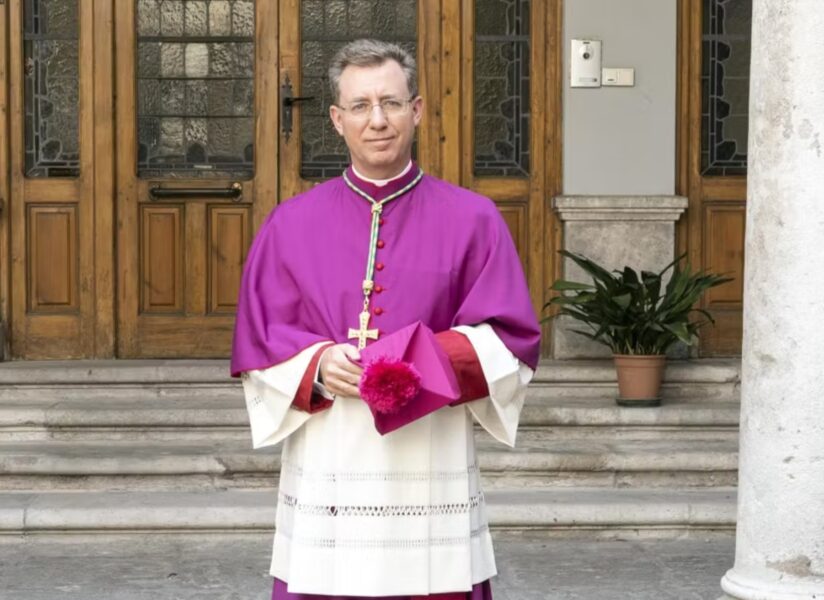
Pope Leo XIV has appointed this Saturday Monsignor Aurelio García Macías as secretary of the Dicastery for Divine Worship and the Discipline of the Sacraments, the same body in which until yesterday he served as undersecretary. He occupies the seat left by the Franciscan Vittorio Francesco Viola, sent to St. Peter’s Basilica as archpriest, vicar general for Vatican City and president of the Fabric of St. Peter, following the transfer of Cardinal Mauro Gambetti to Chieti-Vasto.
The change carries more weight than it appears. The prefect, Cardinal Arthur Roche, was born in 1950 and far exceeds the age limit, so the day-to-day management of the dicastery—responses to episcopal conferences, dispensations, case files—now rests in the hands of the Spanish prelate. The team that Francis installed in Divine Worship in May 2021, seven weeks before signing Traditionis custodes, remains essentially intact: the offices change, the men remain.
A native of Valladolid from San Anselmo
García Macías was born in Pollos (Valladolid) on 28 March 1965 and was ordained a priest in 1992. He earned a licentiate in Philosophy from Salamanca and a doctorate from the Pontifical Liturgical Institute of San Anselmo with a thesis on presbyteral ordination in the Byzantine and Roman rites. In his diocese he served as delegate for Liturgy and rector of the seminary, and presided over the Spanish Association of Professors of Liturgy. Benedict XVI made him a consultor of the Congregation in 2010; in September 2015 he moved to Rome, in 2016 he was named an official of the dicastery and in 2021 Francis elevated him to undersecretary with episcopal character and titular see of Rotdon. He received episcopal ordination in the cathedral of Valladolid on 11 July of that year.
His intellectual affinities have never been a mystery. He translated into Spanish Liturgia y belleza. Nobilis pulchritudo by Piero Marini, former secretary of Annibale Bugnini and master of ceremonies to John Paul II until Benedict XVI dispensed with him. In 2025 he received the Memorial Pere Tena from the Centre for Liturgical Pastoral Care of Barcelona, an award named after another liturgist who held the same undersecretary post.
From Sarah to Roche without missing a beat
He arrived at the Congregation under Cardinal Robert Sarah, the prefect who asked priests to celebrate facing East and was corrected by the Press Office a few days later. After the Guinean’s resignation in 2021 and an internal inspection entrusted to Italian bishop Claudio Maniago, the structure was reorganized with Roche as prefect, Viola as secretary and García Macías as undersecretary. He served both regimes, so opposed in orientation, with identical diligence, and in eleven years there is not a single public statement on record that departs from the line of the prefect of the moment. He is the profile of the impeccable functionary: efficient, discreet and perfectly interchangeable in allegiance.
He himself recounted the details of his promotion in an interview given in July 2021 to the Isabel la Católica Commission of the Archdiocese of Valladolid, days after his consecration. He said that it was Cardinal Sarah who wrote to Cardinal Blázquez requesting his transfer to Rome, and that in the spring of 2021, with the Congregation without a prefect and under the gaze of a visitor sent by Francis, he came to think he would return to his diocese. Reality was different. He was told he would remain as undersecretary, a post the curia usually reserves for a presbyter, and it was the substitute of the Secretariat of State, Edgar Peña Parra, who suddenly revealed to him that Francis also wanted to make him a bishop. The news caught even his superior off guard, and it had to be confirmed with a call to the Pope. No prior consultation or the usual time for discernment: a direct appointment, decided in Santa Marta, in the midst of the demolition of Sarah’s legacy. His episcopal motto, taken from chapter 17 of St. John, is Pro eis, “for them.”
The “San Anselmo clique”
In February 2023, journalist Luisella Scrosati pointed in La Nuova Bussola Quotidiana to a group of liturgists trained at the Athenaeum of San Anselmo as the core of the offensive against the traditional Mass. In that “cricca di Sant’Anselmo” were Viola, the undersecretaries García Macías and Marcjanowicz, and the officials in charge of papal celebrations Ravelli and Midili. All of them are products of the same Roman school that supplies professors of liturgy to a large part of Italian seminaries.
Traditionis custodes, from the second row
Francis’s motu proprio was published on 16 July 2021, five days after García Macías’s episcopal consecration. During his time as undersecretary, the dicastery issued the Responsa ad dubia of December 2021, which presented the ancient Mass as a temporary concession, and obtained the rescript of February 2023 that reserved to Rome the dispensations to celebrate with the 1962 Missal in parish churches.
His public voice on the document has been scarce; his signature, however, appears wherever the norm is applied. This past summer, some faithful of the Italian diocese of Saluzzo who requested a single traditional Mass per month appealed to Rome after their bishop denied it invoking Traditionis custodes. The response, dated 17 July and signed by García Macías, limited itself to sending them back to the same bishop who had rejected them, reminding them that only he had the authority to authorize the 1962 Missal. The bishop reiterated his refusal in September. Some of those faithful, tired of the back-and-forth between the diocesan and Roman curias, ended up in the chapels of the Society of St. Pius X.
Chiapas: incense, “principals” and rhythmic sways
The Mexican file accompanied him from the beginning. In that same 2021 interview, when describing his work, he cited as an example the adaptation of the Mass to the indigenous languages and cultures of Mexico, in Tsotsil and Tseltal, which the dicastery was already studying at the time. At the end of February 2023, García Macías traveled to San Cristóbal de las Casas to participate in the work of adapting the Ordinary of the Mass to the Tseltal, Tsotsil, Ch’ol and Tojolabal peoples. On the table were incensation carried out by men and women designated by the community, the figure of the “principal”—a layman or laywoman who leads the prayer alongside the priest—the ritual lighting of candles and dance. Bishop Rodrigo Aguilar acknowledged that these practices were already being carried out and that what was sought was Rome’s approval. The undersecretary described the experience as a personal enrichment.
The recognitio arrived on 8 November 2024, extended also to the Zoques. Sixteen days later, the Mexican Episcopal Conference had to come out to explain that no “Maya rite,” Maya altar or prayers to the cardinal points had been approved, and that what was authorized were not dances but “rhythmic sways of the body.” The semantic precision, worthy of a manual of curial euphemisms, did not prevent the images from circling the world.
The September turn against excesses in Mexico
On 4 September last, before 49 newly appointed bishops from mission territories, the same García Macías warned against improvised inculturation: “It is not enough to add a traditional song or introduce a dance,” he said, and pointed to syncretism and folklore as dangers. Sensible words, even timely, in the mouth of one who closely followed the Chiapas file. They can be read as the fruit of experience or as simple adaptation to the climate of the new pontificate; the reader will judge which sway weighs more.
What the appointment says
Leo XIV has received in these months Cardinals Burke, Sarah, Zen and Müller and Bishop Athanasius Schneider, and has heard requests for relief for the faithful attached to the ancient rite. Meanwhile, Roche assured The Tablet in July that the Pope will not touch Traditionis custodes, and the Society of St. Pius X carried out its episcopal consecrations on 1 July. García Macías’s promotion does not by itself modify Rome’s liturgical policy, but it confirms that the machinery that executes it will remain in the hands of those who designed it. The next major move will be Roche’s replacement. Until then, anyone who wants to know which way the wind is blowing in Piazza Pio XII will do well to look less at audiences and more at signatures.