


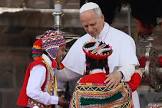
Time passes and we are on the last Peruvian day, and tomorrow the Pope will be back in Rome. From yesterday’s schedule we have an indigenous organization that handed him a letter in Pucallpa with three concrete decisions of the Peruvian State and asked him to be their spokesperson; there was a second letter, from the survivors of the Sodalicio, that asks exactly the same thing: to be received. There is also the meeting at Saqsaywamán, the Angelus in Cusco and the shroud the Pope had made in Rome for the Lord of the Earthquakes, an archbishop who had been dead for sixteen days when the Pope arrived in his city, what he said on Saturday in Zaña about the African slaves and that almost no one has reported, and a Golden Rose that the Holy See’s news service has described as if it were a flower. Another intense day in which a summary with some order is complicated. Good reading.
Pucallpa, what they asked and what he said
On the Malecón Puerto Callao, Sunday afternoon, the Pope met with missionaries and representatives of the Amazonian peoples. Apu Julio Cusurichi Palacios, of the AIDESEP board, handed him a registered letter, number 1049-2026, in which the organization lists three concrete state decisions: the rejection of the expansion of the Madre de Dios Territorial Reserve, the blocking of the recognition of peoples in isolation in the requested Atacuari Indigenous Reserve in Loreto, and the refusal to create the Yavarí Mirim Indigenous Reserve despite evidence of the presence of isolated peoples. The request was explicit: “we ask Pope Leo XIV to raise his voice in favor of indigenous peoples, especially those living in isolation who cannot do so themselves. We have asked him to be our spokesperson before the Peruvian Government to reverse the decisions that weaken our rights.” The letter also mentions the lack of legal territorial security, deforestation, invasions, monocultures, illegal mining and defenders murdered with impunity.
What the Pope said is the strongest phrase of the trip. “In recent years, many indigenous leaders have been murdered for defending their territories. The blood of these brothers cries out to God and demands justice from men”. It is also what the agencies have chosen to headline, and rightly so.
In the official text the Pope names indiscriminate deforestation, the contamination of waters by irregular mining, oil spills, drug trafficking that exploits young people, the vulnerability of women, girls and adolescents, and abandonment by institutions. Not a single reserve, decision, norm or government by name. They asked him to speak out on three named cases and received a general diagnosis and a denunciation of the murders. Both things are true and both must be told. The event also included two testimonies and a dance by the Shipibo-Konibo people, and the Pope responded to each one. To the first, the one who defends his home and it costs him his life, with the phrase about the blood that cries out. To the second, with the harshest part of the speech: that it is unacceptable that in many communities access to health and education is denied because of distance and institutional abandonment, and that it wounds “the heartbreaking pain of those who suffer sexual violence and abuse, which cause deep wounds, often in the silence of complicity and impunity.” Said in the Amazon, with Peruvian institutions present.
And we continue to move in confusing information: the phrase circulating as his—“I dream of an Amazon that fights for the rights of the poorest, of the original peoples, that their voice be heard and their dignity be promoted”—is not Leo XIV’s: it is a literal quotation from Querida Amazonia, number 7, that is, from Pope Francis. He quotes it, which is legitimate; what is not so legitimate is that it travels around with his signature. It is the third time on this trip.
The other letter, the victims’
Two letters in two days, and both ask the same thing: to be received. In Chiclayo, Fiorella Martínez Imán spoke alongside representatives of the International Network to End Clerical Abuse, and the letter from the Sodalicio survivors states literally: “Prevost, meet with all of us and do true justice”. They request a joint audience as soon as possible to clarify institutional responsibilities, including those of people who held government positions, and transparency about the fate of the group’s assets, without pending obligations being evaded through economic or institutional structures. The peasant community of Catacaos, in Piura, joins the request. The letter comes after the Pope received six victims at the nunciature in Lima, and it is from those who were not there: the criteria for that selection remain unstated, and we have been asking about it since Wednesday.
Saqsaywamán, and a feast that is not folklore
In the morning, at the Saqsaywamán archaeological park, the meeting with the faithful and representatives of popular piety. From there comes the phrase that almost everyone has headlined: “faith does not separate, but unites God and others”. And from there also comes the one that almost no one has headlined and is better: “a religious feast, a pilgrimage, a procession are not only a cultural manifestation,” because “behind every image, every song, every vow and every sign there is a community of hearts seeking God.”
Said in Cusco, in front of Andean devotion and those who for centuries have been told that what is theirs is syncretism or tourist attraction, that phrase has an addressee. The third one worth keeping is that God “seeks the most suitable ways and moments to draw near to us”. And a minor archival note, but ours: vatican.va keeps that text in the homilies section even though it was a meeting and not a Mass, so anyone looking for it among the speeches will not find it.
The Angelus of Cusco and the shroud of the Lord of the Earthquakes
Afterward, in the Plaza de Armas in front of the cathedral basilica, the Angelus. The Pope spoke of the sick and the elderly, said that the world sees illness “as a misfortune that extinguishes the value of a person” and summed it up in three words: “What a great lie!”. And he recalled the 1650 earthquake, when, according to Cusco tradition, it was enough for the image to be taken out into the street for the aftershocks to cease. He added something the agencies have not reported: “you are in the beating heart of the Church,” and that suffering offered for the salvation of souls, for vocations and for peace “becomes spiritual strength.”
The day must be placed in its physical context, and Nina Fabrizio does so in ANSA: three flights in one day, first to Cusco, at 3,399 meters, and then back to sea level in Pucallpa, just over a month after lung surgery. The report notes that at some point his voice became hoarser and that otherwise he appeared serene all day. The gesture, in any case, was the gift, and no one has explained where it came from. “With filial love, I am going to offer a shroud to be placed over this image of the Lord Jesus,” he said, and added: “When you see the Lord of the Earthquakes clothed with this shroud, remember that the universal Church is with you”. The piece bears the papal coat of arms. It was made in the Vatican to the measurements of the one the sculpture usually wears, with the measurements sent from Cusco, and that piece was chosen and not another for a canonical reason explained by the cathedral administrator, Msgr. Israel Condorhuamán: there is no tradition of crowning images of Christ, unlike certain Marian advocations. A Christ is not crowned; he is clothed.
The archbishop who had been dead for sixteen days
In that same act the Pope spoke of those who suffer from the absence of the archbishop of Cusco, and none of the day’s reports explain who he was. Msgr. Richard Daniel Alarcón Urrutia, born in Lima in 1952, appointed by Pope Francis on October 27, 2014 and in possession since January 3, 2015, died in office on Friday, October 30 after a long illness, fifteen days before the Pope landed in Peru. We reported it here on the 31st.
On August 29 Leo XIV had appointed Msgr. Lizardo Estrada Herrera as coadjutor archbishop of Cusco, and a coadjutor is not an auxiliary: he has the right of succession and, when the see becomes vacant, automatically becomes archbishop. So there was no vacant see, no college of consultors, no apostolic administrator. On October 30 Estrada was already archbishop of Cusco, and he is also secretary general of CELAM. The man who received the Pope on Sunday had been in office for sixteen days, and he himself explained it with a phrase that says it all: “by obedience I am here”.
Zaña, the slaves and the empty tomb
We gave the program for Saturday’s event in Zaña because the official text was not available. Now it is, and what it contains has been carried by almost no one. The Pope said that Zaña preserves the memory of generations of Africans torn from their homes and subjected to slavery, that many suffered great suffering and humiliation, and he addressed Afro-descendant Catholics to express affection and closeness and to thank them for their contribution to the Church. UNESCO declared Zaña in 2017 a site of memory of slavery and African cultural heritage.
In the same speech there is a paragraph about the present that the Peruvian press has headlined and the Italian press has not. He said he knows that many families in the region suffer from crime, extortion and insecurity, and that it pains him to think of those who live in fear, of those whose honest work is threatened and of those who continue to suffer discrimination. Extortion, using that word, in a country where it is the plague of the moment. And two details worth an entire report. One: in Zaña there is an empty tomb, the one that briefly held the remains of Toribio before they were taken to Lima. Two: the Pope recalled his own years in Chiclayo, naming Incahuasi and Kañaris, the heights he used to climb, and asked that they continue to pray for him.
Toribio, Prevost and “Contigo Perú”
There is a column about the trip that is worth reading and that needs correcting on two points before relying on it. Federico Jiménez Losantos draws the parallel between Toribio and Prevost, the missionary who went from village to village on a mule, and it is the best framing we have read of the trip. But he writes that Toribio “baptized Rosa de Lima and Martín de Porres,” when what he administered to both was confirmation, which is another sacrament: so the hagiographies state, adding St. Francis Solano to the list. And the correction has high-level backing, because the one who said it first was the Pope: in Saturday’s speech in Zaña he names St. Martín de Porres precisely as “he whom St. Toribio confirmed.” And he places the crowning of the Virgin in Cajamarca, when it was in the cathedral of Chiclayo at eight in the morning on Saturday; the helicopter to Cajamarca left later, for the Mass at Santa Cruz.
He says what few have said these days and what must not be forgotten: “The trip to Uruguay, Argentina and, above all, to Peru, of the man born in Chicago and reborn in Chiclayo, Peruvian by choice, has left, with its immense mobilizations of millions of people, the strength of the Hispanic heritage, of what Spain brought to America—language, religion, civilization—and also of what has been forgotten or hidden from that heritage. In Robert Prévost’s trip the immense glory of Spain has been verified, and also its cross, the little appreciation of countries for the one to whom they owe the best they have. Perhaps because the divine mission assumed by Spain in America avoids the temptation of pride, or perhaps because nationalism and indigenism have erased everything that came from Spain as Catholic, that is, universal.”
From that same column comes the fact that “Contigo Perú,” which the Pope sang upon arriving in Lima, was commissioned in 1977 from Augusto Polo Campos through General Augusto Vinatea, who summoned him to his office to convey a “secret and exclusive” request from President Francisco Morales Bermúdez: fifteen thousand dollars and a fifteen-day deadline. Polo Campos went into the Café Haití and had it ready in fifteen minutes. It was premiered by him, Arturo “el Zambo” Cavero and Óscar Avilés in the locker room, in front of the players, before the Peru-Chile match, and days later in the National Stadium. The country was playing for qualification for Argentina 78.
A rose, or the Rose
On Saturday we reported here that the Pope had given a Golden Rose at the sanctuary of Our Lady of Peace in Chiclayo, and added that no one was headlining it. We took it from the Bollettino of the 13th, which registers the act under that name: presentation of the Golden Rose, during a pause before the Blessed Sacrament, together with the blessing of a liturgical bell made in France. Luigi Casalini warns that the Polish account of Vatican News reported the act by writing that the Pope “offered a rose” before the image of Our Lady of Peace, blessed in 1985 by John Paul II. A rose, in lowercase and nothing more. And it is not a rose: it is the oldest surviving pontifical distinction, blessed on the fourth Sunday of Lent, Laetare Sunday, and granted to sanctuaries, sovereigns and institutions. The Holy See bulletin named it for what it is and the Holy See’s news service reduced it to a flower. Casalini offers to withdraw everything if he was wrong; for our part, there is no need for him to withdraw it.
Seven million, and a word that disappears
And while the Pope finishes the trip, the interpretation begins. An interview is circulating in Italian from the Catholic Herald, by Michael Haynes, with Argentine academic Rubén Peretó Rivas, who maintains that Leo XIV is not consolidating Francis’s pontificate but resignifying it. Two examples, and both are verifiable: the “todos, todos, todos” of Lisbon turned in Buenos Aires into “todos hacia Cristo, todos con Cristo, todos como Cristo,” and the “hagan lío” of 2013 reformulated in Córdoba as “un lío que lleve a la Iglesia a cada rincón y haga resonar el Evangelio.”
His strongest argument is an absence: in no speech in Argentina and Uruguay does the word “synodality” appear. It is true within that perimeter, and we must add what he could not know when he published. On Friday the 13th, at the sanctuary of Our Lady of Peace in Chiclayo, the Pope dedicated an entire meeting to synodality, with synodal teams and pastoral councils present, and said that it is easy to talk about it and difficult to practice it. The word has not disappeared from the papal vocabulary: it disappeared from two countries. The same interview includes the opposite reading, that of Austen Ivereigh, who maintains that Leo is consolidating the previous pontificate.
And on Sunday, the same problem on a smaller scale. EFE reported five hundred thousand faithful at the Angelus in Cusco, without specifying the method, the same morning and the same square for which other Peruvian media spoke of more than fifty thousand. A factor of ten. And then there is how it is done properly, which we also had yesterday: ANSA reported more than three hundred thousand people on the route from Chiclayo to Zaña and ten thousand inside the sanctuary, and wrote whose count it was, the local authorities. It is not that hard. What is certain is that in the three countries visited the welcome has been massive and especially in Peru the country has taken to the streets; the numbers may vary, what matters is the enormous affection for the Pope and the incredible manifestation of faith.
Who carried each banner at the traditional Mass
And there remains an Argentine testimony that arrives late and clarifies something. Two signatories who identify themselves only by age and career, twenty-one and Law, twenty-three and Philosophy, recount that they were the ones who carried the banner seen in Luján, that they raised flags as the popemobile passed and that they convened the rosary in front of the metropolitan cathedral. They ask that the celebration with the 1962 missal be permitted where the faithful request it and that the restrictions of 2021 be lifted, and they specify that they do not seek the abrogation of the ordinary form. This fits with what we have been publishing, that they were isolated episodes: the banner at the popemobile’s passage in Buenos Aires on the 9th, the document with five reasons and the rosary convened the following day and the request in Luján, made live on television by a young woman in a yellow vest. It is not recorded that the Pope responded to any of them: in Luján he spoke of the various sensibilities of the Church without mentioning the liturgy.
Gugerotti in the Holy Land, and how many remain
And today begins the only thing that is not Peru. Cardinal Claudio Gugerotti, prefect of the Dicastery for Eastern Churches, travels from November 16 to 21 to Israel and Palestine on behalf of the Pope, and the note announcing it brings the numbers that order the news: about 185,000 Christians in Israel, 1.9 percent of the population, mostly Melkite-rite Catholics; about 35,000 Catholics among the three and a half million inhabitants of the West Bank; and about five hundred Christians in the Gaza Strip. Five hundred. Stefano Leszczynski gives in Vatican News the program—communities of the West Bank, Bethlehem University and the pontifical institute Effatà, parishes of Upper Galilee, and meetings with Greek Orthodox Patriarch Theophilos III and Armenian Patriarch Nourhan Manougian—and specifies that the welcome communiqué is signed by the Latin Patriarch, Cardinal Pierbattista Pizzaballa, on behalf of the Assembly of Catholic Ordinaries of the Holy Land. The Ordinaries there recall the appeal of Leo XIV that Christians of the Middle East be given the possibility, “and not only in word,” of remaining in their lands with the rights necessary for a secure existence. The visit is not about the holy places: it is about who remains to inhabit them.
Closing the day
Today the Gospel is that of the blind man of Jericho. Good day.
“Those who were in front rebuked him, telling him to be silent, but he cried out all the more.”