


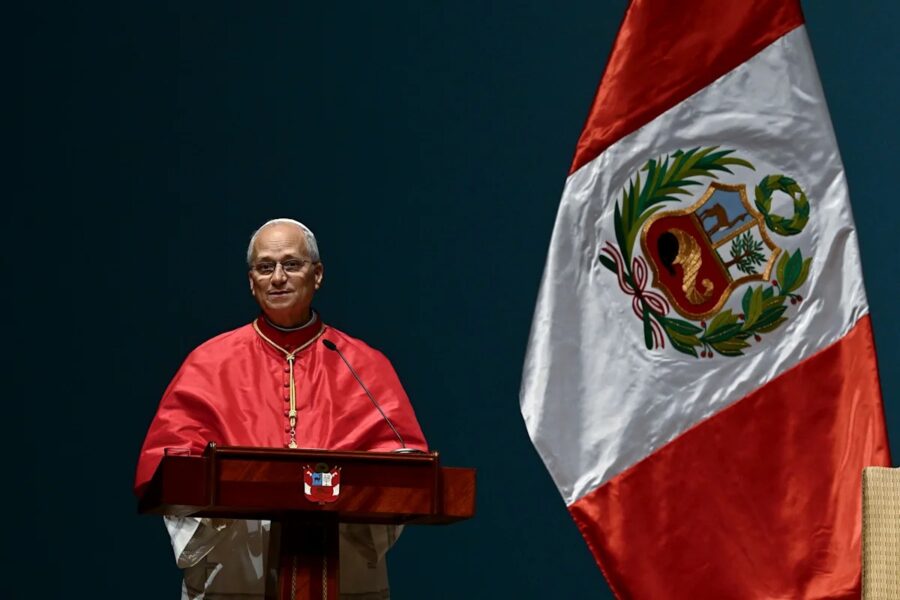
Second day in Lima and a very intense day from Peru and from Rome, where things keep happening. It continues to be noted that the response of the despised people of God is magnificent. As has happened on the Pope Leo’s recent trips to Spain and France, the bishops have not done much, and we are very generous, because their faithful attend the events organized, but the faithful have attended. The meetings with the Pope are liturgical celebrations or prayer gatherings; Catholics like to pray together and we get bored being repeatedly summoned to useless meetings to discuss induced problems that interest no one.
Today we have a message from the Pope that was published and then deleted, six victims received at a nunciature without the event appearing anywhere, three million people that the newspaper of the Holy See reports without attributing to anyone, a journalistic case built on a press conference that was not scheduled, and a pontifical speech that, on a trip to three Spanish-speaking countries, can only be cited in English. After that, the usual: Poblet, an excommunicated priest in Campobasso, the accounts, and a climbing wall with an altar.
“The Church does not belong to us”: the day in Lima
There were five events according to the official program: a meeting with the bishops of Peru in the chapel of the Archbishop’s Palace; celebration of Midday Prayer in the cathedral; a meeting on the challenges and hopes of the Peruvian people on the esplanade; a vigil with young people at the National Stadium; and dinner with the bishops at the nunciature. There was no “meeting with the clergy” as a separate event: what several agencies headline as such is the homily of Midday Prayer. And the vigil was not held at the Monumental Stadium listed in the September program, but at the National Stadium.
He spoke to the bishops about the exercise of power, and it was the toughest part of the day. The official text asks that authority not be exercised in an autocratic manner nor obedience become mere servility, and concludes: “The Church does not belong to us: it belongs to Christ.” The SIR headlined the first half and Silere non possum the second, which in Italian continues: “We are messengers who one day will conclude our journey. Only God remains”. He added that no one can be judged by their prestige, origin, or social position.
In the cathedral, the homily was about communion, and here there is an official text in Spanish. He called for a Church “capable of building bridges where others raise walls,” willing to “recognize its own infidelities and ask forgiveness with humility,” and “true artisans of peace”; and, in the Italian version, that “communion is not absolute homogeneity, nor necessarily immediate consensus.” On the esplanade he spoke about family and work, and left a phrase that in Peru has a recipient: it is sad to note the persistence of a macho mentality. Finally, a warning has arrived attached to the official text of the vigil: the published version expressly warns that it does not include the additions spoken aloud. The Holy See publishes the written text and warns that it is not what was heard after days of texts that do not correspond.
The language mess
The speech to the bishops is, without doubt, the main text of the day: it contains the passage on abuses and on despotic authority. It seems they do not want it to be disseminated and read and only the English page loads. The Spanish one gives an error and this time also the Italian. So on a trip to Uruguay, Argentina, and Peru, the day’s speech to a Spanish-speaking episcopate has to be cited in English. It is the fourth time in eleven days. Yesterday we told about the 11th, and before that about the Palacio Libertad and the texts from Córdoba. The cathedral homily does load in Spanish, and the esplanade speech does too, which rules out a general breakdown and leaves the problem where it was: on specific pages. The Spanish index of 2026 homilies works. What does not work is the document everyone wanted to cite today. We do not want to be suspicious, but everything points to topics that the Vatican ‘superiors’ do not want disseminated and known.
The abuses: the phrase is from the speech to the bishops
And it must be said where it was said, because the agencies have mixed it up. Before the bishops, in the chapel of the Archbishop’s Palace, at nine-thirty in the morning, he spoke of abuses “perpetrated by members of the clergy or in the ecclesial context” and said that one must respond “as Jesus would, with truth, justice, forgiveness, reparation” and with an ever more determined commitment to a culture of prevention and protection.
It is not, therefore, from the cathedral homily, where the word “abuses” does not appear even once, nor from the esplanade meeting, where what is mentioned is domestic violence, which is another register. Justice for ANSA, “to the bishops of Peru”.
Six victims at the nunciature, and this time too it is not recorded
It seems that important things are meant to be left out of the information and in the afternoon, for more than an hour, the Pope received six people who had suffered abuse at the nunciature in Lima. After a greeting in the chapel he received each one personally, “listening to their stories of suffering and their pain”; the note speaks of abuses committed by members of the clergy and ecclesial institutions, and specifies that some were former members of groups linked to the Sodalicio de Vida Cristiana.
The event does not appear in the Bollettino of the 12th. It is the second time on the same trip: the meeting with five victims in Buenos Aires was also not recorded. The information circulated through a note from the Sala Stampa, and the official program of the trip did not foresee any meeting with victims at any point, neither in Lima, nor in Chiclayo, nor in Cusco.
Who chose the six, no one says. Yesterday we reported that the Holy See had hardened its own formula about Buenos Aires, from “presented by the local Church” to “identified and selected by the local Church.” For Lima that formula is not repeated, and the Italian Vatican News article itself, recalling Buenos Aires, returns to the softer version. The hard formula has disappeared.
The president of the Peruvian Episcopal Conference, Carlos García Camader, denied the veto with this phrase: “The program does not depend on me, it depends on the Holy See that organizes it”, while the agencies reported that the Vatican had said the choice would fall to the episcopate. Each instance points to the other and no one remains identifiable as the author of the criterion.
What is certain is that José Enrique Escardó, the first public denouncer of the Sodalicio, was not received. He spoke at the doors of the nunciature: “they are simply taking victims we do not know who they are,” “let the whole world know that this is a deception,” “they cannot silence us”. He also said that victims have the right to be heard and that no one has the right to turn them into a media spectacle. The letter requesting an audience was signed by thirty-three survivors; it is not recorded what has become of it nor any relation between those thirty-three and the six received.
What an Italian journalist has been telling for years and today is relevant
Federica Tourn maintains that the Pope’s meetings with victims on apostolic trips increasingly resemble “courtesy visits, like those made to distant relatives”: behind closed doors, and with victims selected by the local ecclesiastical institution, the same in Buenos Aires as in Madrid or Lourdes. She points out as excluded the former numeraries of Opus Dei, the former students of Próvolo, and the Bolivian survivors. It is not an opinion column: she works with the Bollettino, with Argentine sentences, and with an open letter from Bolivian survivors, and she herself investigated the Próvolo case in 2010. The assessment is hers and we mark it as such; the documentary framework is there. She wrote yesterday that Peru would be the test of fire, and the Pope will be there until Monday the 16th; we fear the abuse issue is considered closed and Chiclayo is left out of any meeting.
Inti and Bryan at the National Stadium
At the vigil with young people, the archbishop of Lima and cardinal Carlos Castillo recalled two deceased before the Pope. He said that young people often went out to protest in the streets and that in some cases they were shot, and then: “There are two martyrs of the young, Bryan and Inti”. They are Jordan Inti Sotelo Camargo and Jack Bryan Pintado Sánchez, killed on November 14, 2020 in downtown Lima during the protests that followed the assumption of Manuel Merino. The day after tomorrow marks six years. His words provoked an ovation. The Pope then spoke of hope—“someone has told me that in Peru a sign of hope is needed; today you are that sign of hope”—of young people who feel alone even when accompanied, and that no one should think they have made too many mistakes. The Vatican News correspondent describes him as visibly moved. Of the two deceased he said nothing, and it was not he who had named them.
Three million without an owner
Many headlines stick with the enormous attendance figures; we do not enter into assessments, but even if it were half of what was published it would be significant. The figure that has gone around the world corresponds to the thirteen-kilometer route between the Callao air base and the Government Palace. The front page of L’Osservatore Romano headlines that three million people poured into the streets of Lima, and in the body writes “about three million faithful”. Without attribution of any kind: neither local authorities, nor agency, nor official count. It is the newspaper’s own data.
We have been documenting this series for a week and this tops it off. The Bollettino attributed the two and a half million in Buenos Aires and the six hundred fifty thousand in Córdoba to local authorities, left the million at the Buenos Aires vigil as an estimate without an owner, and again attributed the more than two million in Luján. The house newspaper, on the other hand, puts three million on the front page and cites no one. For the vigil at the National Stadium the figures drop and also do not add up: sixty thousand inside and three hundred thousand outside according to the Vatican News correspondent, without a named source, while El Debate attributes the three hundred thousand to the Vatican and the sixty thousand to an agency photo caption.
Zero “war,” and Gaza and Ukraine on the neighboring pages
We continue counting. In the four texts of the 12th—bishops, homily, esplanade, and vigil—the word “war” does not appear even once, and no ongoing conflict is named. “Peace” does appear, and in a civil sense: a just and peaceful society, and the dignity of each person as the foundation of true peace. And in the homily, “promote peace in justice” and a “disarmed and disarming peace”. There are still five “war” in twelve days of travel, all without a recipient. The contrast is again provided by the house, and today it is thicker than yesterday. The same issue of L’Osservatore that headlines the three million carries on its international pages the floods in Gaza and the double diplomatic step on Ukraine. The conflicts are in the Pope’s newspaper. They are not in the Pope’s speeches.
The message about the two popes that the Vatican published and deleted
Yesterday we reported that the phrase “this country from now on has two Popes, one born here and another by adoption” was not in any official text and that the Bollettino of the farewell ceremony did not record any speech. The message was published at 14:19 on Wednesday on the Pope’s official accounts, on X and Instagram, and was deleted that same night, about six hours later.
The message was in the prepared text of the final thanksgiving of the Luján Mass, distributed in advance to journalists, and from there the social media team took it. The error fits exactly with the warning that the Holy See itself prints today at the foot of the vigil speech: the published text does not record what was said aloud. When that is forgotten, this happens.
There is no official explanation. None: neither from the Sala Stampa, nor from the Dicastery for Communication, nor from the director of the Editorial Directorate, nor from the prefect, who had been in office for nine days. The media that have tried to explain it do so without a single source that shows its face. La Nación cites “Vatican sources” that speak of an internal mismatch in the dicastery, in a live follow-up entry without individual signature; Infobae, “communications officials”; and another medium even writes “a coordination failure” without attributing it to anyone.
What is documented, and is the most serious, is that the Vatican News chronicle was replaced without notice. The Italian piece on the final greeting no longer contains the phrase, carries no correction note or warning to readers, has no update mark, and retains the original link; the English one, the same. A silent cancellation is not a rectification.
Two cautions, the first: the doctrinal angle—that there cannot be two Popes—is not formulated by anyone by name in any of the pieces we have been able to read. There are paraphrases about Benedict XVI without citation and without date, and references to “different ecclesial sectors,” which is the elegant way of not citing anyone. The second: the Argentine fact-checker did the job well—reviewed the full video of the broadcast and the official transcript, which is exactly our procedure—but attributes a headline to the Vatican portal linking to a blog that denounced it and with the capture credited to that blog, without clarifying the discrepancy.
A case built on an absence
The second front is between the press and the dicastery. Il Messaggero headlined “Giallo on Leone XIV’s plane, the press conference is canceled and the case breaks out: tension between journalists and the new Prefect of Communications”, and the same text appeared in three group mastheads. We cannot summarize its content because the newspaper blocks reading and the only thing available is the summary made by whoever attacks it, so we stay with the headline, which is verified.
On the outbound flight, November 6, there was an official text of greeting to the journalists, and afterward the Pope walked the aisles and answered questions about his health, about his mail-in vote in the U.S. elections—“I am proud to be American and to exercise the right to vote”—and about a possible pilgrimage to Santiago de Compostela in 2027: “I want to; one thing is what one wants and another what one can do.” On the Buenos Aires-Lima flight of the 11th, the farewell ceremony and a telegram to the president of Chile are recorded, and no word to the journalists.
Conclusion: on no leg of this trip has there been a formal press conference on board, but to say there has been no contact with the press is false. And there is a detail that disarms the case: the in-flight press conference is a custom of the return leg, which the official program sets for the 16th and 17th and has not yet taken place. A scandal has been built on the absence of something that was not scheduled to occur.
Silere non possum responded the same day with a piece that defends the prefect and attacks the Vaticanist, and contains serious imputations against journalists identified by name and surname, none verified, one of them acknowledged by the site itself as not closed, and disqualifications we will not reproduce. No one has responded: neither the Sala Stampa, nor the dicastery, nor those named.
We continue with curiosities amid Vatican subtleties that manifest in the Pope’s absence. The Bollettino of June 2 that named María Montserrat Alvarado prefect does not mention Paolo Ruffini at any point: neither formula of resignation, nor dismissal, nor thanks. It published the successor without recording the predecessor’s departure, who had served eight years. What there was was the Grand Cross of the Order of St. Gregory the Great, awarded on October 31 at the Secretariat of State before Cardinal Parolin, the day his mandate ended, and that piece does not cite any bulletin.
What falls to the headline
Three cases in twenty-four hours, and all three of the same type. The first, the president of Peru. It has been headlined that she said “we do not have to think alike to recognize ourselves as brothers”, and what she said in full was “we do not have to think alike to recognize ourselves as brothers and work together for the benefit of Peru.” Without the second half it seems a doctrinal concession; with it it is an appeal to governability.
The second, on the route of the 12th toward the nunciature. A young woman crossed the police cordon and stepped onto the roadway, and the Lima press specifies that she did not approach the vehicles and that the route continued normally; a headline, however, asserts that she lunged at the van, contradicting its own body text. No arrest, no identification, no statement from authority.
And the third is not from a headline but from a figure. The official deployment is 37,149 officers, of them 22,464 in Lima and Callao, with three rings and twenty-four venues. Also circulating is the round figure of forty thousand, which does not match the official datum. Still unanswered, by the way, is what we asked on Tuesday: the state of emergency in force in Lima and Callao requires prior administrative authorization for massive religious events, and it is not recorded that it was requested or granted for those of the trip.
Poblet: the grade 33 meeting, and what doctrine says and does not say
Outside the trip, what happened in Barcelona has taken a step. We published yesterday in Infovaticana that the Supreme Council of the 33rd Degree held a three-day meeting at the monastery of Poblet, and independent verification confirms it by two prior routes unrelated to us: the chronicle of the Supreme Council itself, published in August 2017, which places the meeting from June 9 to 11 of that year, and a note from the Síndic de Greuges office of June 12, 2017, disseminated by the European Network of Ombudsmen, according to which Rafael Ribó inaugurated the day in Poblet before about fifty attendees, with the Grand Master of the Grand Lodge of Spain present.
Octavi Vilà was abbot, from December 3, 2015. It is true that neither of the two sources mentions the abbot or the community, neither as hosts nor as attendees, nor specifies in which dependencies it was held. That it was in the guesthouse is an inference declared by whoever has collected it afterward.
And it is worth recalling exactly what doctrine says about Freemasonry, because that is where everyone is going to be mistaken. The 1983 Declaration, signed by Ratzinger and approved by John Paul II, says that the Church’s negative judgment remains unchanged, that membership remains forbidden, and that the faithful who are members are in a state of grave sin. And the Dicastery’s response to the bishop of Dumaguete, signed by Cardinal Fernández with a note of papal audience, prohibits active membership because of the incompatibility between Catholic doctrine and Freemasonry. Both prohibit the faithful’s affiliation. Neither regulates the rental of facilities nor the cession of Church-owned spaces to Freemasons, which still looks like collaboration, at least material.
Two amendments of ours, from yesterday. We said that the only manifesto signed by Vilà in 2017 was the one in September with the abbot of Montserrat, and there are two: on October 3 of that year he signed another with eight abbots, abbesses, and priors of Catalan monasteries, which says “we will always condemn violence, whether physical, verbal, or that which consists in denying reality”. And we said there was not a single statement of his about Puigdemont; there is one attributed to him, without date and without identified source, so we do not use it, but our phrase was too absolute.
Of the monk from Poblet accused of abuse, the real state, which the press is recounting badly. There is no resolved indictment, no dismissal, no trial held, no sentence: the last verified is an out-of-court settlement with the family in April 2025, with financial compensation and a restraining order, which at that time was unsigned. And a “he pleads guilty” is circulating that comes from a 2021 headline whose own body text wrote it in the conditional and attributed to monastery sources.
Campobasso: the headline that invents a crime
An excommunicated priest announces his arrival in Campobasso and the archbishop writes to the faithful. The newspaper headlines that whoever participates “commits heresy”. What the letter says, according to the quotations that same newspaper reproduces, is that whoever participates puts their faith in grave danger and compromises communion, “exposing themselves to the risk of incurring” the crimes of heresy and schism. Risk of incurring, not crime consummated.
It is not a nuance. Canon 1364 punishes the apostate, the heretic, and the schismatic, and in that block of the Code there is no canon that sanctions attending the rite of an excommunicated person. The archbishop does not cite any, and does well, because none exists. The headline fabricates a canonical penalty that is not in the law. Alessandro Maria Minutella was not excommunicated by the Pope: the excommunication was declared by decree of the archbishop of Palermo in August 2018, for the crimes of heresy and schism. And the archbishop of Campobasso-Boiano is Biagio Colaianni, appointed in December 2023. The letter itself is not indexed and we have not been able to open it on the archdiocese’s website, so all quotations are from the newspaper.
The impossible challenge of Vatican transparency
And speaking of accounts, which is what is really decided while the Pope is traveling. A column is circulating on Vatican financial transparency as the great challenge of the pontificate that does not handle a single balance-sheet figure: neither the Holy See’s deficit, nor the pension fund, nor APSA’s assets, nor the budget of the Obolo. The figures it gives are from the scandal of the eighties, and the only current ones come from the report of the Supervisory Authority. That is well done: seventy-eight suspicious communications in 2025, sixteen reports to the Promoter of Justice and three operations suspended for 522,000 euros. What it does not tell is the most interesting part of the document: suspicious communications have almost doubled compared to the forty-three in 2024, while exchanges with foreign units have fallen from forty-four to thirty-five.
The real news is the written acts, which are three and all go in the same direction. The chirograph of June 25, 2026 approves the new statute of the Supervisory Authority, abolishes the Presidency and the Board of Directors created in 2020, leaves the Authority governed by a director appointed by the Pope for a five-year term and makes it depend on the Council for the Economy. Previously, the motu proprio Coniuncta cura repealed the 2022 rescript that gave the Institute for the Works of Religion exclusivity in asset management. And in August the Council for the Economy was renewed, with four new cardinals and four new lay members and Cardinal Marx confirmed as coordinator. Remove power from the Institute, abolish collegiate bodies, and concentrate supervision in the Council.
The Becciu case in Italy
In the Rome prosecutor’s office, not in the Vatican. In October the prosecutors asked to archive the investigation into Francesca Immacolata Chaouqui, opened on a complaint by Cardinal Becciu, for lack of evidence of instigation to reveal a secret and for lack of the complaint necessary to prosecute the other conduct. The cardinal’s defense then announced that it was considering opposing.
That opposition was filed on November 5, and among other proceedings it requests hearing the commissioner of the Vatican Gendarmerie, which only one site reports. We present it as what it is, with its name, and add two cautions: the sources do not agree on which articles of the penal code grounded the investigation, and the commissioner’s rank appears in chronicles but not in an official document, because the Vatican does not publish the Gendarmerie’s organizational charts.
A deacon argues that the diaconate should not be defined
Its content is worth it, although it is not the day’s news. An American university professor, permanent deacon of Los Angeles, maintains that the indeterminacy of the diaconate is not a defect but a constitutive and beneficial feature, and describes deacons as clerics without clericalism and ministers without cultic purity. The text first appeared in an American Jesuit magazine.
What is interesting is the calendar. The Study Group on ministerial forms presented in October 2024 that a positive decision of the Magisterium on women’s access to the diaconate is not yet possible, which the Pope confirmed, and that the study may continue. The commission presided over by Cardinal Petrocchi concluded in September 2025 that there is no theological, historical, or pastoral consensus. And the synodal proposal to continue studying it was the most rejected paragraph of the final document. The argument that it is convenient to keep the diaconate undefined because discernment is better that way is exactly the door the dicastery left ajar.
A bishop blesses a climbing wall, and the altar remains where it was
On November 7 the bishop of Innsbruck, Hermann Glettler, inaugurated and blessed a climbing room inside the former parish church of Peter Canisius before about two hundred fifty guests, and the next day the first Mass was celebrated inside it. He preached that the new use of the building does not change that this place continues to be a place of encounter with God, and of the altar, which remains, he said that Jesus is the center.
The diocese speaks of change of use and dual use, with a surface right ceded to the operator, and the bishop warns that this should not be seen in any way as the beginning of a series of changes of use of churches. The chapel will remain open at all times and Sunday Masses and Taizé prayers are planned. In none of the three diocesan notes do the words desecration, loss of dedication, or profane use appear: no decree reducing to profane use is recorded. That it has ceased to be parochial is an act distinct from that, and the diocese only documents the first.
Wrapping up the day
The Vatican Observatory is directed by Father Richard Anthony D’Souza since September 19, 2025, by appointment of the Bollettino of July 31 of that year, Guy Consolmagno moved to preside over the observatory’s foundation. It comes to mind because yesterday a priest-astronomer spoke of the Specola at an Italian university and half the chronicle continued attributing the direction to someone who no longer holds it.
From Spain comes the news that the Episcopal Conference presents the commemorative books of the trip that already took place: chronicles, photographs, the volume of speeches, and that of the Congress of Deputies. The only thing that points to a return is what the Pope himself said on the inbound flight about Santiago de Compostela in 2027, and he said it in the conditional.
In Castel Gandolfo, on the 10th and 11th, religious leaders of various traditions met and signed a call to move from courtesy meetings to practical commitment. It is worth saying who organizes it, because it is not the Holy See: it is promoted by a center of the Atlantic Council with the interreligious center of the Focolare and a university institute, and from the Curia only one official of the Dicastery for Interreligious Dialogue participated. The Pope was in Peru.
News reaches us from Argentina. Former deputy Julio Bárbaro recounts that, being a friend of both, he never managed to get Bergoglio and Néstor Kirchner to shake hands, and maintains that Francis did not return to Argentina because the fracture of society did not allow it. It is personal memory without contrast: the only document he invokes, a handwritten letter from the Pope, he does not show and announces he will publish it when he dies.
Two things remain outside and we will see how they evolve The Russian priest found dead in Rome which no other medium reports. An Italian piece on the decree of excommunication of the Priestly Fraternity of St. Pius X which is a rehash of what we published on November 3, without new document or resolution of the appeal.
Today, the memorial of St. Frances Xavier Cabrini, and there is coincidence. Pius XII proclaimed her in 1950 heavenly patroness of all emigrants; she was born in Sant’Angelo Lodigiano in 1850 and naturalized American in 1909. An Italian with two homelands, the day a Pope born in Chicago and naturalized Peruvian in 2015 ends his second day in Lima. Here we will not fall into the hackneyed term “migrant”: what is certain is that Rome calls her patroness of emigrants and the U.S. episcopal conference, patroness of immigrants.
We close the day that begins with a message published and then deleted, brings a warning that admits no gloss.
“Remember Lot’s wife.”