


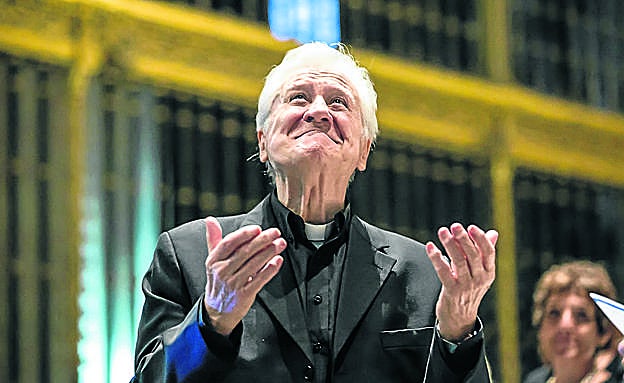
Pablo Colino died in Rome on November 18, 2026, at the age of 92, on the same day the Basilica of St. Peter marked four centuries since its dedication. For twenty-six years, from 1980 to 2006, he served as maestro of the Cappella Giulia, the choir of the Vatican chapter that in the sixteenth century was directed by Giovanni Pierluigi da Palestrina, and for more than sixty years he trained and conducted the choirs of the Accademia Filarmonica Romana. Between those two lecterns lies much of the musical life of the Church in Rome since the Council: the liturgy of the basilica, a school through which generations of boy choristers passed, a premiere by Nino Rota, the RAI Christmas concerts, the Sony and Universal recordings, and the recovery of the forgotten music of Cardinal Merry del Val. L’Osservatore Romano bid him farewell as the “dean of sacred music.” The phrase falls short unless one adds what he never separated: his music was always at the service of his priesthood, and that unity explains both the breadth of his work and his intransigence toward music that passes itself off as sacred without being so.
He was born in Rionegro del Puente on January 25, 1934, in a house where music was a trade. His father, Francisco Colino, joined the military band of Zamora at sixteen and later won a place in the Band of the Civil Guard in Madrid, which was dissolved with the arrival of the Republic. The son recounted that as a child he would climb onto the kitchen table and conduct the family carols with a spoon. His vocation led him to the seminary of Saturrarán, on the Gipuzkoan coast; he studied Philosophy in Vitoria, where he had the composer Julio Valdés as a teacher, and Theology from 1953 to 1957 at the newly built seminary in San Sebastián. He was ordained deacon at the sanctuary of Loyola, beside the birthplace of St. Ignatius, and priest at the cathedral of San Sebastián. Barely ordained, he recalled, he became the first musician of that seminary. Valdés did not disappear from his life: sixty years later, his Cantad a María was still on the programs with which Colino toured the churches of Spain.
In 1957, at the age of 23 and with his bishop’s permission, he arrived in Rome to validate his studies. Pius XII was reigning. At the Pontifical Institute of Sacred Music, then presided over by the Catalan musicologist Higinio Anglés, he obtained the degree of Magisterium in Sacred Music in 1960 and that of Composition and Choral Conducting in 1963, and completed his training with singing studies in Paris, Salzburg, Geneva, Bucharest and Kecskemét, the birthplace of Zoltán Kodály, the composer who made choral singing the foundation of musical education. At the abbey of Montserrat he studied the didactic and vocal techniques of its choir. The voice, and in particular the child’s voice, would from then on be the center of his work.
Rome retained him. The Jesuits of Sant’Ignazio, in Campo Marzio, soon began inviting him to make music in their church and eventually named him honorary maestro of their choir; one of them said his concerts were like a spiritual retreat. When, already trained, they offered him a post as maestro in Rome, he went to ask permission from the bishop of San Sebastián, Lorenzo Bereciartua, who after thinking for a while told him that if he asked him to stay in his diocese, he would be displeased. Colino replied that he had been ordained to obey his bishop. Bereciartua gave him permission with a phrase that he himself recounted to InfoVaticana in 2019: “I prefer to have a friend in Rome than an enemy at home.” They never moved him from there. Sant’Ignazio would be one of his stages for sixty years, and within its walls he celebrated his eightieth and eighty-fifth birthdays with concerts.
His artistic home was the Accademia Filarmonica Romana, founded in 1821. From the early 1960s he directed its School of Musical Education and Choral Singing, from which in 1961 was born the choir that would eventually also be known as the Vatican Philharmonic Choir. The Auñamendi Encyclopedia, which draws on the entry dedicated to him by the Dictionary of Spanish and Hispanic American Music, describes that school as one of the most prestigious vocal training centers in Italy. Colino worked with children from five to twelve years old, teaching them to sing the great foreign and Spanish polyphony, and from its classrooms, it was said at the Philharmonic, the boys entered out of tune and left in tune. In 1970 he published Teoria della musica e pratica del canto corale, and he is also the author of La voce del fanciullo cantore, an essay on choral pedagogy that the Vatican obituaries highlight among his writings.
With that children’s choir his name became linked to that of Nino Rota. The composer of Fellini wrote his Canto di Gloria in 1968 and dedicated it to Colino and the children of the Philharmonic. On March 23, 1970, those same children, conducted by him, sang together with the white-voice choir of the RAI under Renata Cortiglioni and the instrumental ensemble of the Academy in the premiere of Il Natale degli innocenti, Rota’s Christmas cantata, in the Basilica of Santa Maria in Aracoeli, atop the Capitoline Hill. Colino moved with ease in that musical Rome, and the press remembered him as a friend of Goffredo Petrassi, Roman Vlad and Massimo Bogianckino. The Canto di Gloria never left his repertoire: he was still programming it in 2013, forty-five years later.
In the early 1970s he also assumed the direction of the Philharmonic choir, which had previously been led by masters such as Armando Antonelli and Luigi Colacicchi. It was an amateur choir, people with a passion for music who sang in the Academy’s seasons, and with it he toured for half a century the basilicas, academies and theaters of Rome and of Milan, Venice, Florence, Naples, Bari, Lecce, Palermo or Sassari. His Christmas concert became a custom of the city: in December 2013 he celebrated its fifty-third edition at the Teatro Olimpico, which places its origin in 1961, the year the choir was born. The program that night ranged from Bach’s chorale Jesus bleibet meine Freude to Rota’s Canto di Gloria, passing through Francesco Durante, Adolphe Adam, a Christmas carol by St. Alphonsus Maria de Liguori and the Angelitos negros popularized by Antonio Machín. Colino presented it as a moment of sweetness that everyone could share.
With the choirs of the Philharmonic he performed in the main halls of Europe. The reviews of his choir list Paris, Reims, Nice, Amiens, London, Cologne, Bonn, Freiburg, Basel, Lugano and Moscow, the International Festival of Santander, the fifth centenary of Josquin Desprez in Ferrara Cathedral, at the invitation of Cardinal Carlo Caffarra, and the third centenary of St. Petersburg. Among his memorable performances they cite the Mass of Stravinsky in Palermo and the concert for the fourth centenary of Girolamo Frescobaldi, who was organist of St. Peter’s, in the Vatican basilica itself. His singers formed the youth choir of a Parsifal at the Teatro dell’Opera in Rome, a house of which Colino was artistic advisor and in which he was, according to Auñamendi, the first Navarrese to conduct. The choir sang under the direction of Riccardo Muti, Jesús López Cobos and Claudio Scimone, and Colino served on the jury of international singing competitions.
Those reviews also record two episodes that portray the breadth of his craft. With the bands of the Italian Army and Navy, the choir recorded the Italian national anthem, a record that President Carlo Azeglio Ciampi sent to the country’s primary schools. And it sang with the Band of the Civil Guard, the corps in whose band his father had played before the Republic.
In 1980 came the appointment that defined his life: maestro di cappella of the Basilica of St. Peter. The Cappella Giulia, founded by Julius II at the beginning of the sixteenth century, sings the solemn functions of the Vatican chapter, the Mass, Lauds and Vespers, when the Pope does not celebrate; papal celebrations belong to the Sistine Chapel, then directed by Domenico Bartolucci. Among the masters of the Giulia had been Palestrina, who directed it from 1551 to 1554 and again from 1571 until his death in 1594, Giovanni Animuccia and Domenico Scarlatti. Colino received it in full rupture. That same year the historic chapel was dissolved and its function passed to a choir that he directed as magister ad nutum of the chapter. From then on the service of the basilica rested on a mixed choir in which the voices of the Philharmonic choir joined the men of the Giulia, always under his direction. It was his way of ensuring that St. Peter’s would not be left without music in its solemn celebrations. In 1990 he published a Liber Vesperalis, and prepared editions of basic liturgical books and adaptations of polyphonic works for his choirs.
With him, the chapel accompanied papal liturgies, recorded albums and was heard on Vatican Radio and RAI, and Colino collaborated in the organization of choral singing for the general audiences. These were the years of John Paul II and the great televised ceremonies. On June 29, 1985, at the Mass of Sts. Peter and Paul, Herbert von Karajan conducted the Vienna Philharmonic and the Wiener Singverein in Mozart’s Coronation Mass inside the basilica, with Kathleen Battle, Trudeliese Schmidt, Gösta Winbergh and Ferruccio Furlanetto as soloists; as the Roman press recalled in 2021, it was Colino who set the tempo for them. That same year he presented on RAI a program on Bach for the third centenary of his birth, which was broadcast internationally. Bach was for him the best, and of all his work he unhesitatingly chose the St. Matthew Passion. In 2006 he was succeeded by the Canadian Pierre Paul, and Colino became maestro emeritus without breaking his bond with the basilica or with his singers.
Television gave him his largest audience. With his choir and the RAI orchestra he conducted the Christmas concert from the upper basilica of St. Francis of Assisi, which was broadcast by Eurovision; the review of his choir dates those broadcasts to 1989 and 1990. He considered it the most important concert of his life. According to that review, his programs at various times featured Plácido Domingo, José Carreras, Montserrat Caballé, Jessye Norman, Raina Kabaivanska, Shirley Verrett, Cecilia Gasdia, violinist Uto Ughi and cellist Mstislav Rostropovich. With baritone Renato Bruson he recorded, at the head of the Cappella Giulia and the Rome Symphony Orchestra, the Benedictus from Mascagni’s Messa di Gloria.
With Montserrat Caballé he shared some of the moments he remembered most. They recorded together Verdi’s Ave Maria with the choirs of the Cappella Giulia and the Philharmonic, and on April 2, 1999, at Sant’Ignazio, he conducted her in the ecstasy of Massenet’s La Vierge. Colino recounted that the soprano considered that one of the most moving concerts of her career and that she sang with tears in her eyes the passage in which the Virgin, at death, sees the gates of paradise open. The soprano died in October 2018; months later, Colino was still pointing on the wall of his house to the memory of that concert.
His most patient work was archival. English professor Robin Anderson placed in his hands some eight manuscript motets by Cardinal Rafael Merry del Val, among them a Pange lingua and a Tantum ergo. The cardinal, who composed, had been archpriest of St. Peter’s and Secretary of State to St. Pius X, the Pope who in 1903, with the motu proprio Tra le sollecitudini, established Gregorian chant as the model of liturgical music. Those scores looked like sketches and were doomed to oblivion. Colino ordered them, cleaned them and added voices and keyboard accompaniment so they could be sung, and in 2005 he recorded with the Philharmonic choir an album shared with Lorenzo Perosi, Inni, mottetti e canzoni, which includes, among other pieces, the cardinal’s Veni Creator, Ave maris stella and Audivi vocem de caelo. The manuscripts are preserved in the archive of the Cappella Giulia and in the Pontifical Spanish College of St. Joseph. When in November 2025 the Spanish national church in Rome commemorated the cardinal, a Servant of God with his cause for beatification open, with a concert of his works, the chronicle of the New Liturgical Movement attributed to Colino the recovery of that music.
The recordings took his choir far beyond the basilicas. Between September 29 and October 1, 2008, the Philharmonic choir recorded in the Choir Chapel of St. Peter’s, together with the Northern Irish priests Eugene and Martin O’Hagan and David Delargy, The Priests, the album with which Sony launched them and which became an international success, with the record for the fastest debut of a classical artist in the United Kingdom.
A year later came Alma Mater. The idea came from the Paulines: their musical director, Father Giulio Neroni, who had known Colino for thirty years, proposed uniting Gregorian chant and contemporary music with the voice of Benedict XVI. The album, released by Universal with Multimedia San Paolo and with proceeds destined for musical education in poor countries, features the Pope praying and singing in Latin, Italian, Portuguese, French and German, wrapped in music by Simon Boswell, Stefano Mainetti and Nour Eddine, with the Royal Philharmonic Orchestra and the Philharmonic choir conducted by Colino, who prepared the choral parts and closed each track with Gregorian chant. He defined it as a paraliturgical project, close to the liturgy but not intended for worship. The reviews of his choir also mention a Christmas album for Sony in France, Chœurs du Vatican, some hymns by Palestrina for the Christmas season published by San Paolo and several Gregorian chant albums; in total, some twenty recordings.
He lived in Rome through eight pontificates and kept photographs of almost all of them. The oldest of his papal photographs was of St. Pius X, whom he did not know. When he arrived, Pius XII was reigning; of John XXIII he kept the image of his first visit to the Spanish College to celebrate Mass, and of Paul VI a photo with a Hungarian choir. To John Paul II, who one day told him he had already seen him conduct, he replied that he had also seen him sing.
He considered Joseph Ratzinger his idol. On April 19, 2005, he positioned himself where the new Pope’s car was going to pass; Benedict XVI stopped, got out, approached him, and Colino, kissing his hand, stumbled: “Congratulations, Eminence… forgive me, Your Holiness.” The Pope laughed: “Thank you, Maestro.” Of the six Popes he had known until then, he said in 2009, none knew music like him: he played the piano, sang with excellent pitch and preferred Bach and Mozart. Colino was a friend of Georg Ratzinger, the Pope’s brother, who for three decades directed the choir of Regensburg Cathedral, and one day he praised Georg’s music to Benedict; the Pope replied that his brother was very good, but that he was too.
His idea of sacred music was clear and he did not change it over the years. St. Pius X was for him the Pope of music, because he “cleansed all the music that was thought to be sacred without being so,” and he said it in the present tense: that same music, he warned, “is resurfacing again with guitars and accordions.” Guitar and drum Masses seemed disordered to him. His work, he said, was guided by faith. The demand was more noticeable in the way of singing than in the choice of repertoire: from the Ave Maria of Verdi’s Otello he removed, he recounted, “ogni sdolcinatura, ogni enfasi,” and in polyphony he sought the clarity of the voices and not the effect.
In 2011, as artistic director of the International Festival of Sacred Music and Art in Rome, which was celebrating its tenth edition with an inaugural Mass in St. Peter’s and concerts in the great Roman basilicas, he explained to ACI Prensa that “sacred music has always been the essential element of solemn liturgy,” lamented that in some liturgies taste had been relaxed and the level lowered, and defended that concerts outside worship should also be spiritual elevations. Benedict XVI had attended the 2008 edition, and in 2004 the program of the Pro Musica e Arte Sacra Foundation, which organizes the festival, had celebrated Colino’s seventieth birthday with a spiritual concert dedicated to Bach, with the Philharmonic choir and the Cappella Giulia.
As a composer he worked mainly for liturgical use and for his choirs. After the Council, when church musicians were encouraged to write in the vernacular, he set to music in Italian an Anima Christi for Communion and a Lenten Mass with texts prepared by Don Gilberto Agustoni, then secretary to Cardinal Ottaviani and later a cardinal himself. He frequently arranged for his singers, as he did with the Cant dels ocells, and reworked polyphonic works for the Philharmonic. One of his pieces figured in the program of his eighty-fifth birthday concert, alongside a fourteenth-century Franciscan lauda, Verdi and Perosi.
His repertoire ranged from Gregorian chant and Palestrina, Victoria, Lasso and Marenzio to Mozart, Schubert, Beethoven, Mendelssohn, Kodály, Perosi and Mascagni, with a fixed place for Spanish composers, from Francisco Guerrero to Nemesio Otaño, Jesús Guridi, José María Beobide or his teacher Julio Valdés. On his tours he incorporated popular songs from the places he visited, and thus the choir ended up gathering a wide repertoire of international folklore.
Recognition came early and from both countries. The Royal Academy of Fine Arts of San Fernando named him corresponding academician in Italy on June 28, 1976, at the age of 42. Italy made him Commander of the Order of Merit of the Republic; Spain awarded him the decoration of Civil Merit and the Commandery of the Order of Isabella the Catholic, and the Order of Malta also distinguished him. In 2014 the Pro Musica e Arte Sacra Foundation awarded him its prize for a lifetime dedicated to sacred music, in the same ceremony in which Nikolaus Harnoncourt received it. He was music critic for L’Osservatore Romano, in which he published numerous articles, and artistic advisor to the Teatro dell’Opera in Rome and to cultural institutions in the Lazio region. In the Church he was canon of St. Peter’s, prefect of music of the basilica and apostolic protonotary.
Spain was, after Rome and Italy, the country where his choir sang the most. He took it to Madrid, Toledo, Bilbao, San Sebastián, Vitoria, Pamplona, Santiago, Oviedo, Salamanca, Valladolid, Barcelona, Montserrat, Córdoba, Seville, Tenerife or Mallorca, and to places of pilgrimage such as Santo Domingo de la Calzada, San Millán de la Cogolla or Santo Toribio de Liébana. On April 25, 2015, he sang in the church of San Pedro in Vitoria in honor of Blessed Pedro de Asúa and the Virgen Blanca, with works by Vicente Goicoechea, Felipe Gorriti and Julio Valdés. In April 2017, during the Jubilee Year of Liébana, he toured Liébana, Santander, Torrelavega and Santillana del Mar. On September 14, 2018, he offered the Cathedral of Segovia the concert for the 250th anniversary of its dedication, with a program that united the polyphony of Palestrina, Guerrero and Victoria, Durante and Verdi’s La Vergine degli Angeli with Negra sombra, his own arrangement of the Cant dels ocells, Guridi’s Goiko mendian, Beobide’s Dulce Madre and María Ostiz’s Vivo sin vivir en mí. That autumn, at the age of 84, he also conducted a concert in Brescia for the canonization of Paul VI, which the Philharmonic accompanied with an album recorded under his direction, and another at the European Parliament in Brussels.
On January 25, 2019, he celebrated his eighty-fifth birthday conducting a dozen pieces at Sant’Ignazio. At that time he was preparing his choir’s performance at the opening of the Calceatense Jubilee Year and continued to present himself as maestro of the boy choristers of the basilica. He left the Philharmonic in the summer of 2021, at the age of 87, after sixty-one years at the head of its choir and its school, and the Academy bid him farewell with a tribute in its summer cycle. He lived in the palace of the canons, between St. Peter’s and Santa Marta, in an apartment that those who visited it described as a museum of his musical memory, with hundreds of books, scores, photographs and concert posters in a disorder of which he claimed to know every piece. Those who knew him spoke of his irony, his lordly manner and a hidalgo pride that did not prevent him from preparing sangria for everyone after a concert. In 2024 the church of Sant’Ignazio dedicated its organ cycle to his ninetieth birthday.
His place in the music of his time is not measured by his own work. He was a trainer of voices and a custodian. Generations of Roman children and amateurs learned to sing with him; the Basilica of St. Peter maintained its choral service when the historic chapel was dissolved in 1980; the music of Cardinal Merry del Val sounded again; and the sacred music of the basilica reached, through television and the Sony and Universal recordings, a mass audience. He did all this without lowering his standards. He died on the day the basilica he had served since 1980 marked four hundred years since its dedication. For its chapter the chapel of Palestrina has sung for five centuries, and for twenty-six years it was directed by a man from Pamplona. Requiescat in pace.
Read also