


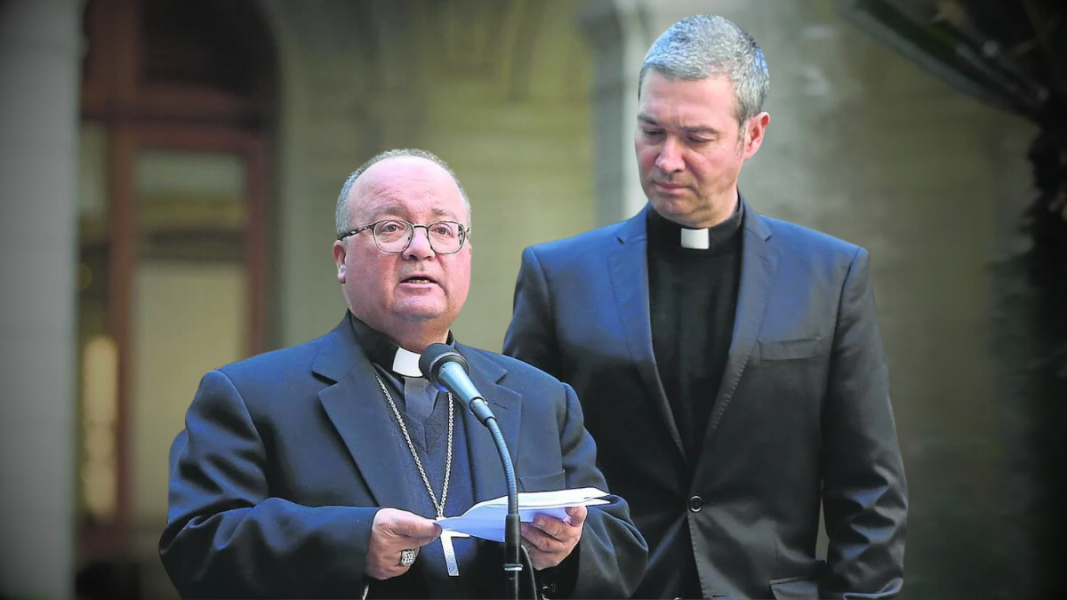
Jordi Bertomeu, commissioner for the liquidation of the so-called “spiritual family” of the Sodalitium, has informed the victims that he will not close the liquidation process, a prerequisite for any reparation, until the economic and administrative bodies of the Holy See assisting him have “sufficient certainty regarding the validity and canonical licitness of the economic activities carried out by the suppressed group” and until they have been able to assess “any legal actions that may be initiated before state authorities.” He sets no deadline. In the same letter, which is mainly devoted to defending his actions, he cites a document from the Peruvian Chancellery stating that he “was granted immunity in criminal matters, as well as civil and administrative, during the duration of his mission in Peruvian territory.”
It is an internal communiqué dated in Rome on November 7, four days before the arrival of Leo XIV in Peru, to which InfoVaticana has had access, and it is the second in eight days. The decision is stated in the first person, “I will not consider the liquidation process concluded, prior to the reparatory process,” and is supported by two popes: the commissioner says he is taking it “in fulfillment of the mandate received from Pope Francis and ratified by Pope Leo XIV.” The liquidation, he explains, must “clarify the legitimacy of the economic activities that have given rise to the ecclesial patrimony” and not be limited to the assets that the former leaders of the group have so far made available to the process. Bertomeu acknowledges the cost: “I am aware that the wait may be especially painful for those of you who have been waiting so many years for truth, justice, and reparation.” On October 30 he had written that his responsibility obliged him to ensure that the actions could “soon translate into real results.”
The announcement occupies about 300 of the nearly 2,100 words of the communiqué. Some 1,400, two-thirds of the total, form the section “On the information questioning my conduct,” devoted to rebutting Narrative and Persecution, a recent book by Peruvian lawyer Percy García Cavero about his role in the Scicluna-Bertomeu Special Mission of 2023, in the suppression of the Sodalitium, and in the liquidation. Bertomeu presents it as a continuation of another book by the same author, from 2018, entitled The Pedro Salinas Case: From Abuse Whistleblower to Defamer of Reputations. At the end, he asks the victims not to take “sides in a dispute about my person.”
Regarding his diplomatic status, the commissioner reproaches the book for giving relevance to a certificate issued by “Mr. Linares Arenaza” on July 8, 2026, whose content he does not detail, and counters it with document OR. RE. (SGG) no. 4-3-A/969, of March 11, 2025, signed by Mr. Salamanca Castro, in charge of the General Secretariat of the Ministry of Foreign Affairs, from which the phrase about his immunity comes. He adds that this documentation “was already submitted as evidence in the judicial proceeding initiated by Mr. Percy García Cavero against the undersigned of this communiqué.” The letter does not clarify what proceeding this refers to, nor whether it is the criminal complaint for violation of professional secrecy that Giuliana Caccia and Sebastián Blanco filed against him in July 2024.
That complaint was archived in January 2025 by a prosecutor who relied on documents provided by Bertomeu’s defense, including a photocopy of his diplomatic passport, and weeks later the Prosecutor’s Office declared the complainants’ appeal against the archiving admissible, according to this newspaper at the time. Caccia and Blanco stated at that time that the Chancellery had responded to their lawyer that Bertomeu entered the country with an official visa and at no time requested “temporary or permanent accreditation as a diplomatic mission before the Ministry of Foreign Affairs.” The document now cited by the commissioner is from March 2025, after that response and after the appeal.
Regarding the leak, the letter denies less than it seems. Bertomeu writes that “in no case were the names of Giuliana Caccia and Sebastián Blanco communicated to Paola Ugaz and Pedro Salinas, as stated in the investigation records.” The phrase is impersonal, refers only to the names, and relies on records that the commissioner himself describes, a few paragraphs earlier, as “reserved material kept in the Holy See and to which it is not appropriate to give indiscriminate publicity.” There is no express denial regarding the content of what was declared, only the warning that he does not consider it correct “to draw conclusions” about “a possible transmission of reserved information without sufficient evidence.” Nor does he mention the WhatsApp messages that Caccia and Blanco claim to have notarized and in which, according to them, Bertomeu acknowledges having transmitted information from their statements to Salinas and Ugaz.
The letter also maintains that the column “The Pope’s Elite Command,” published by Raúl Tola in La República, “should not be automatically interpreted as the result of a leak,” and to explain its origin refers to an interview with Salinas on August 19, 2023, to an article of his own on September 29, 2024, and to an interview with Ugaz on December 11, 2024. The column was published on July 29, 2023, before the three, when the mission was still receiving testimonies at the Nunciature, which it did between July 23 and August 1 according to the letter itself. Tola did not give names. He spoke of “a militant ultra-Catholic very active on social media” and of “a man (who ended up being the brother-in-law of the first)” who, when “the Spanish priest asked him if he would like his son to be subjected to those practices,” “kept an explicit silence.” Caccia and Blanco maintain that that column was born from the leak of their statements. Bertomeu recalls that in those days there were photojournalists around the Nunciature, an argument that, according to Crux, was already included in the prosecutor’s decree of January 2025. The letter does not explain how what was said inside reached the columnist.
In the same section, Bertomeu attributes to Francis the penal precept with the threat of excommunication that the nuncio in Peru delivered to Caccia and Blanco in September 2024, and presents it as the result of “the conduct attributed” to both during the mission, which “prompted the intervention of the Holy Father and the consequent imposition by him of a penal precept with the warning of excommunication in case of disobedience.” As Tola himself described at the time, the precept gave them 48 hours to withdraw the complaint against Bertomeu and publicly apologize to the Pope’s envoys. The letter does not mention that, according to what Caccia and Blanco later recounted, Francis received them in a private audience in November 2024, assured them that the excommunication “was not appropriate,” that “it had been a mistake,” and revoked it “in his own handwriting.” Finally, he explains to the victims who testified at the Nunciature in 2023 that none of them signed a confidentiality agreement because the reservation “did not depend on a contractual formality, but on the commitment to protect the information received,” and that “the information you shared was not intended to be automatically transmitted to the Holy Father without prior examination.” Caccia and Blanco maintain that they were promised that whatever they said would only reach the Pope.
The communiqué opens with thanks for “the numerous expressions of recognition, trust, and support” received after the previous one and closes with Hannah Arendt, with an idea attributed to Dietrich Bonhoeffer about repetitions “without evidence” that end up being confused with the truth, and with Psalm 33: “Keep your tongue from evil, your lips from falsehood.” The one of October 30 was signed “The Pontifical Commissioner of the ‘Spiritual Family’ of the Sodalitium.” This one bears his name, “Msgr. Jordi Bertomeu Farnós,” and ends thus: “With my affection and closeness, always at your service.”
Read also