


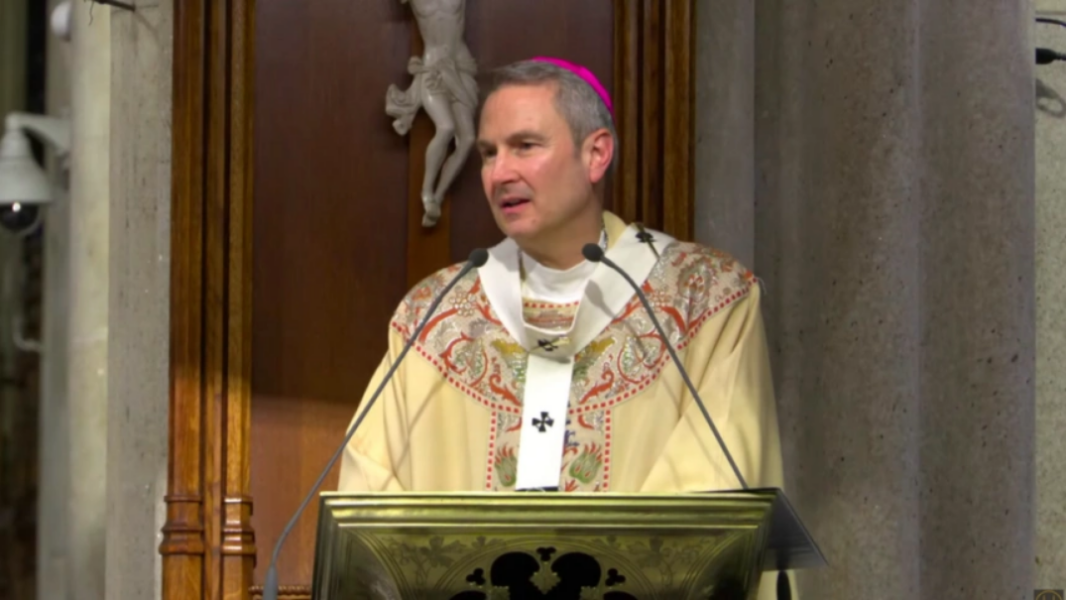
The Archbishop of New York, Ronald Hicks, has joined the lawsuit filed by four religious congregations and several Catholic healthcare institutions against the obligations arising from the state’s assisted suicide law. Alongside the prelate, the archdiocese and ArchCare, its healthcare network, have joined the suit to seek judicial protection against provisions that, according to the plaintiffs, could compel them to participate in the intentional death of their patients.
“We refuse to allow New York to force us to harm precisely those we have been called to care for,” said Monsignor Hicks, according to a report on October 30 by the legal organization Becket, which represents the Catholic institutions.
The archbishop recalled that the Church’s healthcare mission is inspired by the compassion of Jesus Christ and directed toward all persons in need of care, regardless of their circumstances or beliefs.
The archdiocese joins a lawsuit that has already obtained judicial protection
Hicks’s decision expands the proceeding initiated in July by the Carmelite Sisters for the Aged and Infirm, the Dominican Sisters of Hawthorne, the Missionary Sisters of St. Benedict, and the Little Sisters of the Poor, together with the Bishop of Rockville Centre, John Barres, and other Catholic healthcare institutions.
On July 30, a federal judge issued a preliminary injunction, accepted by the state of New York, that prevents certain obligations related to assisted suicide from being applied to the plaintiff institutions while the litigation continues.
That ruling marked a first judicial victory for the religious sisters, who had turned to the courts to defend their right to care for the sick without participating, directly or indirectly, in procedures intended to cause their death.
The protection was granted just days before the law took effect on August 5. Since then, the Church has kept its legal battle open in New York, while the congregations covered by the injunction can continue their caregiving activities without being subject to the contested obligations.
The archdiocese and ArchCare now seek equivalent protection through the amendment of the complaint filed before the federal court.
ArchCare defends its mission to care for the sick until natural death
ArchCare carries out extensive caregiving work through hospitals, nursing homes, home-care services, palliative care, and specialized programs for people with disabilities.
Among its institutions is Calvary Hospital, dedicated exclusively to palliative care for adults with serious illnesses that limit life expectancy. Also part of its network is Mother Cabrini Hospital, which specializes in the care of children and young people with severe disabilities and complex medical needs.
For these institutions, facilitating assisted suicide is incompatible with their commitment to care for and accompany each person from birth until natural death.
The plaintiffs argue that the legislation may require them to inform terminally ill patients about assisted suicide, participate in the procedures necessary to obtain lethal substances, or refer patients to professionals willing to prescribe them.
According to Becket, failure to comply with certain obligations could expose the institutions and professionals to financial penalties, consequences for their licenses, and even criminal liability.
The controversy centers on the scope of the obligations of information, cooperation, and referral provided for in the regulations and whether the legal safeguards for those who refuse to participate in assisted suicide sufficiently protect the religious freedom of Catholic institutions.
Legislation rejected by the bishops of New York
The so-called Medical Aid in Dying Act was signed on February 6, 2026, by Governor Kathy Hochul and took effect on August 5.
The law allows adult residents of New York who have been diagnosed with a terminal illness and a life expectancy of no more than six months to request a medical prescription for substances intended to cause their death, which they must self-administer.
Its approval provoked strong opposition from the Catholic Church. In April, the bishops of New York published a document against euthanasia and in defense of human life, in which they recalled that deliberately causing the death of a sick person constitutes a morally unacceptable act.
In that document, titled Now and at the Hour of Our Death, the prelates distinguished between the refusal of disproportionate treatments and the intentional causing of death. They recalled that the Church does not require prolonging life through extraordinary interventions when these are burdensome or lack a proportionate benefit, but it does require respecting the dignity of the person until natural death.
The bishops also warned of the consequences that the legalization of assisted suicide may have for the sick, the elderly, and people with disabilities, especially when dependence or suffering is presented as a reason to consider that a life has lost its value.
Religious freedom at the center of the legal conflict
Adéle Keim, lead counsel at Becket and representative of the plaintiff institutions, maintained that the congregations and Catholic healthcare centers have dedicated their existence to serving those most in need of care and compassion, especially during the final moments of their lives.
“Assisted suicide is completely incompatible with the compassionate care offered by the religious sisters and ArchCare,” she stated.
The attorney explained that the lawsuit seeks to ensure that these institutions can continue their healthcare activities without being forced to participate in procedures intended to end the lives of their patients.
The conflict is not limited to the state of New York. In September, Cardinal Blase Cupich and two religious congregations sued the state of Illinois over similar obligations contained in its legislation.
A few days later, a federal court granted preliminary protection to the Archdiocese of Chicago and the plaintiff congregations, temporarily preventing the contested provisions from being applied to them.
In both states, Catholic institutions maintain that authorities cannot require them to participate in procedures they consider contrary to the dignity of human life as a condition for continuing to care for the sick and vulnerable persons.
The New York lawsuit remains open. The provisional protection obtained by the religious sisters does not yet resolve the merits of the litigation, while Archbishop Hicks and the archdiocese’s healthcare institutions request that the court extend the same guarantees to their centers.