


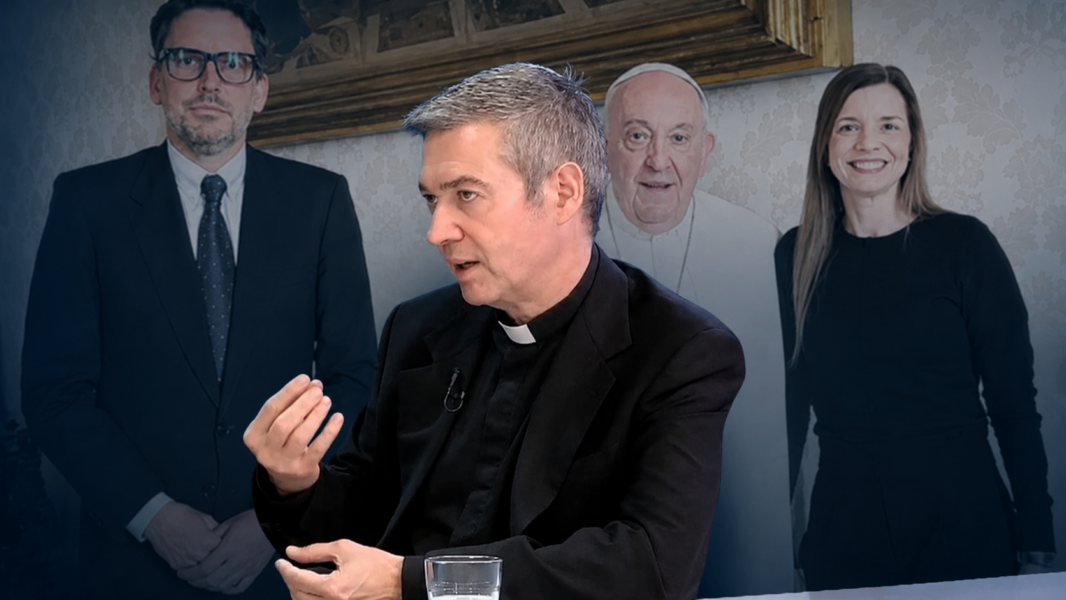
Bertomeu acknowledged that he leaked to two journalists —Pedro Salinas and Paola Ugaz— the content of the reserved statements made by two Peruvian laypeople, Giuliana Caccia and Sebastián Blanco, before the special mission sent by Rome for the Sodalicio case. When they reported him for breaching confidentiality, Bertomeu responded with a penal precept that threatened them with excommunication to force them to withdraw the complaints against him and demanded money from them for a diocesan institution. It has now emerged that there are notarized WhatsApp messages in which Bertomeu himself admits to the leak.
The new evidence has now come to light through an extensive interview given by Giuliana Caccia and Sebastián Blanco to journalist Vanya Thais, broadcast on her YouTube channel. In it, both recount in detail the sequence of events that followed their statements before the special mission sent by Rome to investigate the Sodalicio case and provide new information about Jordi Bertomeu’s subsequent actions.
Of particular relevance are the references to a series of WhatsApp messages that the interviewees claim to have had notarized and in which Bertomeu himself would acknowledge having passed on to journalists Pedro Salinas and Paola Ugaz information from the reserved statements made before the mission. According to Caccia and Blanco, those messages would constitute direct proof of a leak that for years had been denied or presented merely as a suspicion on the part of those affected.
The interview also provides new details about the steps taken by both to request explanations for the breach of the promised confidentiality, the complaints they subsequently filed in both civil and canonical forums, and the circumstances under which they were notified of the controversial penal precept that threatened excommunication if they did not withdraw the actions taken against Bertomeu. The testimony of the interviewees thus offers a complete reconstruction of the events from their perspective and constitutes the main source of the revelations that once again place the case at the center of debate.
The entire matter stems from a promise that, according to the account of both declarants, was expressly and repeatedly made to them: that whatever they said before the mission entrusted to Charles Scicluna and Jordi Bertomeu would remain under reserve and would reach only the knowledge of the Holy Father, without any intermediate dicastery even being able to know it. Whoever comes forward to recount intimate or painful facts does so trusting in the secrecy of office, and without that trust the entire institution makes no sense.
What is now confirmed is that the content of those reserved statements did not remain within the scope that had been promised, but ended up in the hands of two journalists —Pedro Salinas and Paola Ugaz— who at the same time maintained a notorious public hostility toward the declarants, and that from that leak was born the first defamatory article, signed by Raúl Tola, which launched a smear campaign that has lasted years and has been replicated in numerous media outlets inside and outside Peru.
Until now, it could be maintained, as Bertomeu’s media defense did, that it was merely a conjecture of those affected; what is decisive is that Bertomeu himself acknowledged it in writing in a series of messages that the complainants have notarized, and in which, sent from the phone of the then secretary of the Nunciature, he admits having passed on to Salinas and Ugaz the content of what was declared, including the exact question of whether one of them would enroll their child today in a Sodalicio school. The fact that the leak was directed precisely at those who were already attacking the declarants strips the act of any appearance of carelessness and turns it into an act whose harmful result —the reputational lynching of two laypeople who had trusted in confidentiality— was entirely foreseeable to the one who opened the source.
The response of those affected to that breach was, at first, strictly private and measured. They limited themselves to sending notarial letters requesting that what had been disseminated be rectified and that they be explained how the press could have accessed the details of confidential meetings. They received only informal responses and a refusal to provide them with any signed document to repair the damage. It was only after exhausting that avenue, and after consulting —according to their account— with more than a dozen canon lawyers and several civil attorneys, that they decided to file a criminal complaint with the Peruvian Prosecutor’s Office, as this was the forum where the damage had occurred, and to prepare in parallel a canonical complaint before the Rota. A decision that any legal system recognizes as the legitimate exercise of a fundamental right and which, far from being reprehensible, is exactly what the Church itself has been demanding.
The reaction triggered by that complaint is what places the case in uncharted territory in recent years. In September 2024, the complainants were urgently summoned to the Nunciature with the announcement that they would receive “good news” from the Holy Father. What was read to them instead was a penal precept that threatened them with latae sententiae excommunication and conditioned the lifting of that penalty on compliance, within a strict forty-eight-hour deadline, with a list of obligations: immediately withdraw the criminal complaint filed with the Peruvian prosecutor’s office, offer public apologies to the members of the mission, issue corrections to all media outlets they had contacted, and refrain in the future from any public statement or complaint regarding the facts under investigation by the mission.
All of this under the additional warning of a payment of one hundred thousand soles each and a prohibition on ever again presenting themselves publicly as Catholics.
It is worth noting what this set of demands means when stripped of the solemnity of canonical language, because what the document did, in plain terms, was to use the most serious spiritual sanction the Church can impose on a faithful —the rupture of their communion— as a means of pressure to make two citizens renounce recourse to the courts of their own country in defense of their honor.
Read also. Bertomeu on Peru: “It’s a forest, a jungle, and you manage as best you can”
The use of a medicinal penalty for a purpose entirely foreign to the salvation of souls, which is the only cause the Church’s law recognizes for this type of sanction, constitutes spiritual abuse in its most naked form, insofar as it instrumentalizes a person’s ecclesial communion as a bargaining chip to protect an official from the consequences of his own actions.
That same conduct is, at the same time, a fraud on the law, because the canonical penal precept exists to prevent or correct canonical crimes and not to shield an agent of the Holy See from a criminal proceeding conducted in civil court, so that diverting it to that end amounts to using the instrument against the purpose for which the legal system provided it; and it is, moreover, a textbook abuse of authority, because the burdens imposed exceed any imaginable corrective purpose and, by their very disproportion, reveal that their true object was the impunity of the accused.
There remains to consider the darkest aspect of all. The document appeared attributed to Francis and headed with his name, but it lacked —and this is a verifiable fact on the document itself, not a mere assertion by those affected— a protocol number, a folio, and any reference to a case file, an absence that is simply unthinkable in an authentic act of the Holy See, where, as those familiar with the workings of the curia recall, even the most routine request leaves a registration trail.
To that formal anomaly is added the account of the audience that Francis himself granted them in November 2024, which fits in a disturbingly consistent way with that material fact: according to their account, the Pontiff, upon reading the document they themselves handed him, called it an error, asked whether they had been the ones who had made it, and ultimately revoked it in his own hand along with the signature that headed it.
The question the Pope is said to have directed at them only makes sense if the signature was obtained on a text whose content he did not know, and if that was the case, the conclusion that follows is that someone drafted and processed in the name of the Roman Pontiff an act that the Pontiff had not made his own, which would amount to a de facto usurpation of the papal function and the use of the supreme authority of the Church as cover for a strictly personal interest.
Taken together, the resulting picture is that of a mission born to listen to and repair victims that ended up generating new victims, and of an official charged with safeguarding the trust of those who came to testify who first broke that trust and then, when called to account, instead of responding attempted to impose silence on the aggrieved with the worst currency a priest in his position had at his disposal, which was communion with the Church.
The complainants themselves start from the premise that real victims exist, that those who committed crimes must answer for them through due process, and that those harmed must be compensated. What this case makes clear is that the mission, at least in this episode, violated all the guarantees it demands for others, and that the credibility of any future listening process depends on clarifying the breach of an official secret and the use of excommunication as an instrument of coercion.