


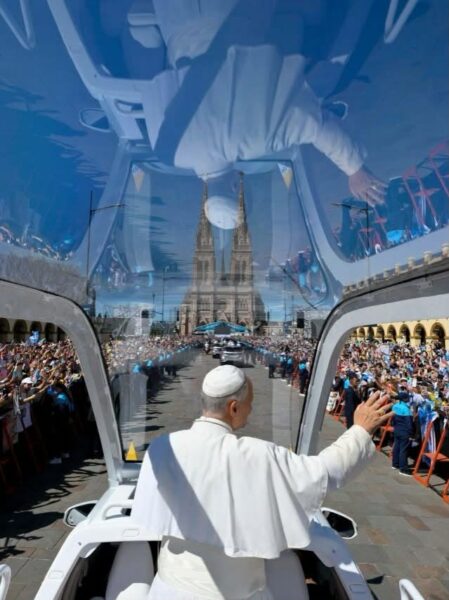
A very intense day, as intense as this journey has been. What stands out in splendor is a very numerous people of God seeking good shepherds. Pope Leo’s interventions, without shame or glory, are becoming routine, and everything is very politically correct; we are not facing a pontificate of surprises. The local bishops, perfectly dispensable—at least this trip has given their faithful the chance to see them properly dressed and with their mouths shut, and they certainly gain a lot from it. And the priests who have appeared at the Pope’s various activities are splendid; the reality is that if we do not have better bishops, it is not because we lack talent—we have it, and of the good kind—but the tastes of the discerners go another way, and the gap grows greater every day. Today we have the first full Peruvian day; much remains from last night and yesterday, and Argentina remains with a massive closing.
“I also return to my homeland”
The speech at the Gran Teatro Nacional was last night at 20:30 in Lima, 02:30 in Rome, and dated the 12th in the Italian agencies. ANSA headlines “profonda gioia tornare nella mia patria,” and in its own body quotes “tornare in Perù”. What the Pope said, according to the full text published by the official Peruvian newspaper, was: “Therefore I can say to you, with deep gratitude, that I also return to my homeland.” Earlier he had said, “in 2015 I received Peruvian nationality,” and the Italian version of Vatican News keeps the “anche” and adds that distance does not diminish love for the homeland.
And we continue with the cautions that abound in these times and force us to keep our eyes wide open. Two circulating quotes that are not citable. La República headlines “No one should live in fear,” and that phrase is not in the speech: what it contains is “go to work without fear” and “no one should be deprived of them.” And circulating in Italian is “Questa è la patria che mi porto nel cuore,” which we have not located in any text.
Of what he did not say: neither insecurity, nor state of emergency, nor illegal mining, nor corruption. Instead, “honesty, uprightness, and willingness to meet,” and mining appears only once, alongside agriculture and fishing, as an economic activity that “requires caring for nature.” He does not name the president: he calls her “Madam President of the Republic.” Of the past he speaks generically, of a “difficult coexistence” that must be addressed “with justice and sensitivity.” The Peruvian state agency publishes the same text, word for word.
Five times “war,” no conflict named
We continue counting, because it is now a series. In the Lima speech, “war” once—“the wars and tensions afflicting so many peoples call for patient diplomacy”—“peace” four times, “weapons” none, and the only country named in the entire text is Peru. In the two texts of the 11th in Argentina, the count is zero: in the prison greeting “peace” appears once and it is “making peace with God”, and in the Luján homily another, and it is the inner peace renewed by forgiveness and reconciliation. The farewell ceremony had no speech: only telegrams, with protocol formulas of peace to Milei and the president of Chile.
So there are five “wars” in eleven days of travel; yesterday we counted four, and the fifth is Lima’s. And a contrast that is not ours, but from the Holy See’s own newspaper. Issue 257 of L’Osservatore Romano devotes its international pages to the new Israeli Knesset and the Abu Dhabi negotiations, which Zelensky describes as constructive and substantial. The conflicts are present in the Holy See but not in the Pope’s speeches.
The president asks for reconciliation and leaves for China
Before the Pope, Keiko Fujimori spoke, and her entire speech was about national reconciliation, which she presented as “our most urgent and pending task.” Literal: “we have carried many decades of confrontation and distrust,” “Peru needs to live in peace with its past in order to embrace its future,” “may healing and reconciliation be the great gift of his visit,” and the closing, “welcome to your homeland”. She spoke, she said, “as a mother and as a woman of faith.” She did not mention her father.
What was resolved last night was the trip. The Senate authorized it by forty-four votes in favor, one against, and five abstentions for the bilateral meeting with Xi Jinping on the 17th and the summit with the Japanese prime minister on the 20th. The Pope closes Peru on Monday the 16th with the farewell Mass at Las Palmas Air Base; the president will not be there. Mirtha Vásquez proposed voting on China and Japan separately and delaying the departure one day “to bid farewell to the Supreme Pontiff,” and it was rejected; Silvana Robles spoke of “a total lack of respect for the Catholic people”; and Carlos Caballero denounced “diplomatic weakness.” She replied that “it would never occur to me to slight our Pope Leo XIV” and asked “not to politicize such a beautiful arrival.” The president of the Peruvian Episcopal Conference, Carlos García Camader, settled the matter by saying that “respect for authority means that each one has his space” and that the bishops will be present, “and as such, that is our task”.
Leo XIV, heritage of Peru
The Ministry of Culture has declared the documents of the Pope’s Peruvian naturalization as national cultural heritage. Viceministerial Resolution 000317-2026 declares the naturalization certificate and the handwritten application. The application is from 2015, handwritten on paper with the letterhead of the Diocese of Chiclayo and bears his signature and fingerprint; it is kept in the Central Archive of Migration and is exhibited free of charge until November 24 at the Ministry of the Interior. It recounts his origins, his pastoral work in Peru since 1985, and his reasons for requesting nationality.
And here is what no media outlet has said: not a single line of the manuscript has been published. Not a single quote. A document whose text no journalist has read has been declared national cultural heritage, and all the reports describe in general terms what it says without quoting anything. The Pope himself said last night “in 2015 I received Peruvian nationality,” as the text of the speech records.
“Father Roberto,” without Chiclayo
ANSA headlines the dispatch “Padre Roberto torna a casa,” in quotation marks, and does not explain the nickname in the body. Nor does it bring a single testimony from Chiclayo, nor from Trujillo, nor from Lima. A headline of sustained reunion without anyone from the place of the reunion. The testimonies exist, and they are elsewhere. Father Juan Mechán Sánchez, vicar of the cathedral, says that when “Monsignor Roberto” was bishop of Chiclayo “I could define him as a father and a person very close to everyone”; and Óscar Ramírez Flores, sixty years old, waiter at the Las Américas restaurant, sums it up better than anyone: “it seems he likes his Chiclayo”. Three forms are documented there: “Monsignor Roberto,” “Father Roberto,” and, in Avvenire’s chronicle from the city, “Monsignor Robert”.
Numbers that make history.
For Luján the Bollettino writes “more than two million faithful” in the square and in the street in front of the basilica, “according to estimates by local authorities”. What happened afterward is the data of the week. Canal 26 closes the day at 22:30 with “more than 3,500,000 pilgrims,” Todo Provincial also headlines three and a half million, with “an estimated attendance” For Luján, L’Osservatore prints “more than two million faithful”; for Córdoba, in the same issue, it attributes the six hundred fifty thousand to the official figures from the Sala Stampa.
The prison that is closing, and the word that was not said
It was a greeting and not a Mass, the Bollettino publishes it expressly as “the Greeting that the Pope addressed to those present”. The order was welcome hymn, introduction by Archbishop García Cuerva, words from the director, three testimonies, speech, signing of the Book of Honor, gifts, and blessing.
The Pope thanked by name Cristian, Maximiliano, and Reinaldo. Here is a precision that the press overlooks: the Bollettino specifies two inmates and one person who has already served his sentence. Which of the three has already served it is not stated. From the speech, “a new life is possible” and that the prison is also “a stage of profound changes and conversions”—note, conversions, not “growth,” as has been published—are supported. And he spoke of “a new beginning, reconciling with God and reintegrating without fear into their families and into society”.
He said nothing about overcrowding. We have searched word for word in the official English and Italian text of the Bollettino, and it does not appear. It is a silence worth noting in someone who denounced it at the Jubilee of Prisoners. And of the closing of the prison he did not speak either: the context is provided by Salvatore Cernuzio in L’Osservatore, who recounts the drop from about one thousand seven hundred inmates to about seventy-five and the transfer to Marcos Paz.
What L’Osservatore did not publish about Luján
Issue 257 does not open with the end of the trip. It opens with the youth vigil of the previous day and publishes the Córdoba homily in full, and leaves the Argentine day in chronicles. The fact is this: it does not publish the text of the Luján homily, and its chronicle of Luján does not quote a single phrase from it. Nothing about the richness of Argentina, nothing about the passage on reconciliation and forgiveness, no mention of Francis, nothing about “Argentina, rise up and walk.” The most probable cause is the closing of the edition—the Mass was at ten in the morning local time, two in the afternoon Rome time; that it is a deliberate omission is conjecture. What we recounted on Monday about the Palacio Libertad was a cut within a text that the newspaper did publish. What is missing in the two prison pieces, and here the parallel is exact, is the passage in which the Pope asks society and the authorities to protect minors from criminal networks. The report of the speech includes it in full except for that section. The order seems to be that sections with political edge are out, as with corruption on Monday.
The VIP tent, and the bill no one claims
There is an Argentine scandal that has not been told in Europe. At the Mass on Monday the 9th in front of the Monument to the Spaniards, a reserved tent with catering and air conditioning was set up. The tender, according to El Disenso, specified thirty by forty meters, air conditioning, furniture, three thousand five hundred chairs, separate bathrooms, and food. What was leaked afterward shows varied gastronomic offerings and cold drinks on a very hot day.
No one claims it as their own, and that is the knot. It was contracted by the Chief of Staff, according to Diario Huarpe; the Casa Rosada press office limited itself to saying that “the Presidency issued the VIP invitations”; and the presidential spokesperson, Adrián Ravier, listed yesterday at Casa Rosada the official guests that the Nation did host and dispatched the rest with a phrase: “the rest was not run by the national Government”. Who paid for the catering, and with what funds, remains unanswered.
The Argentine Church distanced itself entirely. The president of the Episcopal Conference, Marcelo Colombo, said on radio that “everything that followed took us by surprise,” that “our organization had no provision in that regard” and that “ours were the celebrations and the contents, what you saw”. And he closed with an elegance that is half an answer: “I think society has already spoken on that.”
The money, with each figure attributed to whoever gives it, because they do not match. El Disenso identifies seven direct contracts with eight awards for 20.477 billion pesos, of which 8.690 billion went to a single company, El Heraldo de México headlines “almost 6 million dollars”. The issue is not minor and there are already two criminal complaints. They were filed by deputy Marcela Pagano for abuse of authority, misappropriation of public funds, and fraudulent administration: one on who authorized the two hundred fifty invitations from the Nation, another on the direct award: “the Pope’s Mass was NOT free for the faithful.” Deputy Esteban Paulón also presented a draft resolution with the question in the title: “Who invited them, by what criteria, and, above all, who paid for this joke?”
Of the guests, the best response is Yanina Latorre’s, who has the virtue of frankness: “I don’t feel touched,” and “I think it’s even logical, the invited guest will be in favor and those who were not invited against.” Vice President Victoria Villarruel said she had not received the QR code to enter; Casa Rosada maintains that it was sent to her. LaPresse describes that at the Tuesday vigil the Pope was “received like a pop star, with a pyrotechnic show included”, and Askanews places them at the end of the meeting. Who paid for the fireworks: also not stated. It circulates that the Pope expressed “deep discontent” with the organizers. It is given by a medium “according to what transpired” and without any source.
Milei cries at Ezeiza
The farewell was at the foot of the gangway, with a children’s choir singing Alma misionera, and Milei broke down. La Nación recounts it and does not report what he said; La República gives two different versions of the phrase in the same piece, both attributed to El Doce. On X, in capital letters: “ARGENTINA: BEACON OF LIGHT OF THE WEST,” and “thank you all very much for these days that will remain recorded in the best pages of Argentina’s history”, with a video of the trip that includes his own farewell. Of the tears, not a word.
The two popes of Argentina
This is the piece of the day and has two halves. The first: “this country from now on has two Popes, one born here and another by adoption” has gone around America as a phrase pronounced at the farewell. It is not in any official text. It is not in the Luján homily, it is not in the final thanks, and the Bollettino of the farewell ceremony records no speech by the Pope. The press placed the phrase at an event where there was no speech.
Where it is is on the Pope’s official account, as a written message. Il Globo publishes it embedding the tweet itself in Spanish, under the heading of Leo’s greetings on his official account, and Infobae correctly attributes it to “a farewell message on his social networks”. Half a dozen Argentine headlines published it as spoken: “I have felt at home” and “until always, my dear Argentina” are from the final thanks of the Luján Mass, not from the airport.
The second half is the accusation. Silere non possum maintains that Vatican News put in the Pope’s mouth “words never pronounced” and calls Andrea Tornielli to account. And here two things must be separated. Publishing on an institutional account a line from a prepared text that was not read aloud is not inventing a quote: a written message is not a transcription. “Words never pronounced.” What is a real methodological problem is disseminating as the Pope’s farewell a phrase he did not pronounce without marking it as written text, and the result is visible in half the Argentine press.
In May 2019 the Italian transcription of Francis’s interview with Valentina Alazraki omitted that the Pope said he did not remember whether Viganò had spoken to him about McCarrick, and it was corrected a few minutes after Associated Press asked; Tornielli attributed it to the haste of translating from Spanish.
What he did not say in Argentina
Pope Leo is clearly intent on avoiding any kind of controversy. We have scanned term by term in the seven published texts of the Argentine stage. The words “disappeared,” “dictatorship,” “human rights,” “Mothers of Plaza de Mayo,” and “Grandmothers” do not appear even once. “Memory” appears three times and none is historical memory. The closest he comes is the speech to the authorities on the 8th, with “painful memories” and “the unjust consequences of the past”
On that silence a headline has been built. Il Messaggero titled it “Papa Leone cita Francesco: ‘Fate chiasso’. Ma pesano i silenzi sui desaparecidos.”
“The Church is not an NGO”: quoting Bergoglio to break with Bergoglio
Yesterday we recounted that the phrase is Francis’s and that of all the media that headlined it. Today we can close it completely, and the result is better than we expected. The Bollettino of the meeting with the clergy in the Córdoba cathedral carries a footnote: Francis, general audience of October 23, 2013. And the audience that day says, literally, that the Church is not a business, is not a humanitarian agency, the Church is not an NGO.
Two Italian media outlets have headlined on that phrase and both attribute it wrongly. Secolo d’Italia headlines “‘La Chiesa non è una Ong’: Papa Leone prende le distanze dalla ‘dottrina Bergoglio’ nella sua Argentina” and at no point says he was quoting Francis. La Verità headlines “La sfida di Leone XIV: ‘Non siamo una Ong. Se non porta a Cristo, la Chiesa muore’.” The Italian account of EWTN wrote that they were very strong words that the Pope “recalled.” Il Giornale, which holds the same underlying thesis about an episcopate shaped by twelve years of Bergoglio, does so without relying on the phrase, which is the honest way to defend that framing.
Octavi Vilà in Barcelona, and the only manifesto that can be read
We already said that these days one must look to Rome; the Pope’s absences are used for important things and the appointment of the archbishop of Barcelona is one. Bollettino 0901 carries a single heading, “Rinuncia e nomina dell’Arcivescovo di Barcelona”: it accepts the resignation of Cardinal Juan José Omella and appoints Octavi Vilà Mayo, Cistercian, as metropolitan archbishop, transferring him from Girona. The Spanish press announces it with three framings—Catalanist, critical, and condemnatory—built on the same material. The only manifesto that can be shown and read is the one he signed in September 2017 with the abbot of Montserrat, and it says “listening to the voice of the majority and at the same time respecting that of those in the minority,” asks to “exercise the utmost prudence of the rulers,” and is addressed to the rulers of Catalonia and of Spain. It does not mention the right to decide or independence. Crónica Global claims he signed “sovereigntist manifestos.”
What is documented regarding language and national sensibility is solid: in June he publicly demanded that the papal blessing of the Tower of Jesus “should be in Catalan”, and in a 2025 interview he said that “the Church can also be a good place for linguistic integration,” that the autumn of 2017 “was one of great pain for many people” and that “it is good that the tension subsides”. Of the friendship with Puigdemont, however, there is no act, no visit, no joint photo, no statement by Vilà about him: the documented relationship goes in only one direction. Puigdemont praised him when he was appointed to Girona, said it had filled him with joy and described the choice as “intelligent and sensitive”. The photo circulating in the critical framing is with Quim Torra. In June Puigdemont called Omella a “national-Catholic” and demanded that the Church not be financed, and called for a protest against the Pope at the Sagrada Família over the Catalan issue.
Of him, on the day of his appointment, there are three fragments and nothing more. He assumes with “respect and humility,” the move from Girona to Barcelona is “an important change” and a priority will be to be “at the side of the young”. Neither language, nor politics, nor abuses. On abuses he has his own concrete record: in August 2021, as abbot, a monk of Poblet was arrested for alleged touching of a girl, and in the homily of the 29th he said that “as a community we feel deeply ashamed”.
Press conference on November 24 and taking possession on December 19, so whoever has taken him for archbishop “since yesterday at noon” has moved quickly. Omella announced the changeover at the Episcopal Palace and said he is leaving for Zaragoza.
We have some balance of Omella and the hardest data of the record is not political: the memory of the archdiocese itself gives four seminarians for two hundred twelve parishes, with income and expenses squared at 56,424,170.67 euros. His was a late vocation: he entered Poblet past forty, after more than twenty years in the Hemeroteca of Tarragona, and was ordained a priest at fifty-three. Girona is vacant again.
Spira: the one who suspends is the nuncio, and no one names a dicastery
With the Pope in America other important news reaches us from Germany. The diocese of Spira has had to stop a two-year reform in its tracks. The one who orders it is the nuncio in Germany, Hubertus van Megen, who wrote to diocesan administrator Markus Magin to suspend the reform of parish structures throughout the vacant see.
The reasons, as the diocese summarizes them, are “reservations of canonical foundation,” with the warning that continuing to work could “raise expectations, set changes in motion, and generate personal commitments,” and the reminder that erecting, suppressing, and substantially modifying parishes is reserved exclusively to the diocesan bishop. What is suspended is the reduction from seventy parishes to nine large units, whose bases had been approved unanimously by the diocesan assembly in June.
Magin complies and does not disguise it: “we will respect the decision and apply it; however, I am disappointed by the content of the letter,” and that a path of this type is interrupted without the participation of the diocesan leaders “is difficult for me to understand.” He fears that the suspension will “discourage many involved and weaken their commitment,” and adds that the process cannot “simply be resumed at the point where it was left” and that “the backlog of reforms will continue to grow” in the meantime, so that the future bishop will arrive with the clock against him.
Ninety-one US congressmen ask for the Pope’s presence in Congress
There is a letter and it is dated. On October 30, ninety-one members of the House of Representatives asked Mike Johnson and Hakeem Jeffries to issue a formal invitation to the Pope to address a joint session of Congress, and it is headed by a Democrat and a Republican, Mike Thompson and Brian Fitzpatrick. The detail that almost no one has pointed out: they ask for it for the start of the 120th Congress, which is not constituted until 2027. The signatories invoke Francis’s 2015 speech and its “undeniable historical relevance.” That speech, of September 24, 2015, is on vatican.va and was the first by a Pope before the United States Congress. No one has responded yet: neither Johnson, nor Jeffries, nor the Holy See.
Taipei pays for the pastoral work, and no one talks about Beijing
Everything that has to do with China is important. On the 10th and 11th, bishops and those responsible for human mobility from Australia, Taiwan, Vietnam, the Philippines, Timor-Leste, Indonesia, Japan, and India met in Taipei. It was promoted by the Santa Francesca Cabrini province of the Scalabrinians, with sponsorship from the Dicastery for the Service of Integral Human Development and support from Taiwan’s Ministry of Foreign Affairs through its embassy to the Holy See. The most quotable is from Pascale Debbane, regional coordinator of the dicastery: it is necessary to “move from a pastoral care for migrants to a pastoral care with migrants.”
There were no agreements: there was talk of appointing a person responsible per episcopal conference, of mobile applications, and of a data center. The UCA News version adds participants and does not entirely coincide with the Italian one in the list. And the three planes, because the temptation is evident: no source mentions Beijing, nor the People’s Republic, nor the agreement between China and the Holy See. That Taipei uses ecclesial channels as soft diplomacy is a reasonable inference, and the fact that supports it is that it co-financed the meeting and sent officials.
In Rome the Orlandi case continues
Twice in one day, in the same newspaper, and it is a vice we have been pointing out for weeks: a headline is not judged by the direction of its URL. First case. From the Messaggero piece on Mirella Gregori the expression “spy nuns” circulates, and the headline does not contain it: it speaks of “the mysterious man who asked the nuns for information.” “Suore spie” is only in the slug, it is a keyword for positioning, and the newspaper does not sign it. In the Rai program from which the new material comes, the nuns appear as witnesses and as appellants: the religious sister who prepared her for communion asks that the search continue. Of espionage, nothing.
Wrapping up the day
The Holy See’s official communication continues to be a disaster that seems to have no end. The texts of the 11th—the Luján homily and the prison greeting—are marked in the Bollettino as originals in Spanish, and the Spanish pages of vatican.va to which its own index refers return an error, while a Spanish homily from April loads without problem. It is not a site outage. It is curious that today one must cite the Argentine stage in English or Italian from the official index of the trip, which, for a trip to three Spanish-speaking countries with a Pope who writes in Spanish, is an administrative detail with its own charm; better to think this than to remain with the uselessness of some very expensive media and the contempt for the language most spoken by Catholics.
Of Flores, which half the world took for visited: there was no papal stop. It does not appear in the program, and what there was was the opposite. The parishioners of Bergoglio’s parish were preparing to receive him and the pastor was explaining how to get to the Mass in Palermo. They went to him.
An image of Bergoglio and Prevost together at a Mass in August 2004 in the parish of San Agustín, in Recoleta, is circulating. The arithmetic adds up and the account is plausible, but the authentication is from a single witness, the Augustinian Pablo Hernando Moreno, who recovered it from inherited material; the photographer is not named and the images illustrating the piece are not clearly that photo.
Today, feast of Saint Josaphat, martyr bishop: “the kingdom of God does not come with fanfare,” and “the kingdom of God is in your midst.” After a week counting crowds that double in twelve hours, of a pope pop star with fireworks and of a tent with air conditioning for guests with QR code, the closing writes itself.
“The kingdom of God does not come with fanfare.”