


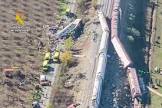
Friday, and the day opens outside Rome, we cannot do otherwise. In Spain, sixty-nine dead in the collision of two trains between Los Yébenes and Urda, in the province of Toledo; a telegram from the Pope to the archbishop of the primatial see; and two parish priests who arrived first and gave absolution among the wreckage. In the Vatican, the appeal hearing of Cardinal Becciu lasted eleven minutes, did not enter into the merits and left everything for January 26: the only thing the Court did was to recall that its own ordinances remain unfulfilled, seven months after issuing them.
The rest of the day: one hundred years since the first six Chinese bishops are commemorated and the centenary is celebrated by the agency of Propaganda Fide, not the Pope; Peru presents the helicopter that will carry the Pope and does not say whether it is pressurized, which was the only question that had been asked; the letters of the Tridentine pilgrimage finally appear and partially refute the Vatican; the Holy See speaks at the UN about space and this time does not mention weapons; the almoner is in Ukraine and someone denounces an information silence that does not exist; the UBA awards the Pope an honorary doctorate and the official program of the trip does not foresee passing through the UBA; some rules that bear the name of a Pope and are not from the Holy See; a book about a eucharistic miracle that was never presented to the Vatican; the Peruvian itinerary names a town and assigns it no event; the port workers of Genoa strike today against the transit of arms.
The Urda accident and the Pope’s telegram
We begin with Spain, where the most serious situation is today. On Wednesday, at five minutes to nine in the morning, at kilometer 118 of the Madrid-Seville high-speed line, between the municipalities of Los Yébenes and Urda, a Renfe AVE struck an Iryo train that was stopped on the track. Up to four cars derailed and fell down an embankment. There were five hundred forty-four passengers. The Railway Accident Investigation Commission corrected the tally last night and returned it to sixty-nine dead, after a figure of seventy-four had circulated and was withdrawn. Of one hundred ten admitted, sixty had been discharged and fifty remained hospitalized at midday on Thursday. These are provisional figures and must be reported as such.
The cause has not been established. There is a secrecy order on the investigation, the black boxes have been seized and the case has just been opened in a court in Orgaz. The Minister of Transport spoke of an erroneous decision by the Atocha control center that would have allowed the AVE to pass a red signal: it is the minister’s version, not a conclusion of the investigation, and the distinction is not minor when there are sixty-nine dead.
The Pope wrote on Thursday. The Bollettino of the 29th records it as a telegram from the Holy Father signed by the Cardinal Secretary of State, for the victims of the railway accident in Spain, and the Press Office released it in Spanish, so the Italian versions circulating are translations. The original was published in full by the Archdiocese of Toledo. It is addressed to the Archbishop of Toledo, Monsignor Francisco Cerro Chaves, and not to the civil authorities; it is signed by Cardinal Pietro Parolin on behalf of the Pope. Leo XIV says he is “deeply saddened,” “offers suffrages for the eternal rest of the deceased,” conveys “his heartfelt condolences to the families of the deceased,” encourages the rescue teams “to persevere in the work of rescue and assistance” and imparts “the comforting Apostolic Blessing, as a sign of hope in the Risen Lord.” It is the second papal telegram for a Spanish railway disaster this year. The first was for the Adamuz accident, in the province of Córdoba, and appears in the Bollettino of January 19.
Absolved among the wreckage
What follows has been reported by this house. The parish priest of Los Yébenes, Fernando Fernández de Bobadilla, was among the first to reach the track. He gave general absolution to those lying among the wreckage, held IV bags for the medical staff and accompanied a woman in the school until her son confirmed the death of her daughter-in-law. He told ABC: “I gave a general absolution; in these cases, that is what the Vatican recommends.” On the radio he described the deceased as “a multitude.” He does not remember when the first medical teams arrived.
The canonical precision, because it is relevant and not an ornament: canon 961 permits general absolution without individual confession when there is imminent danger of death and no time to hear each person. The penitent must be repentant and, if he survives, must later confess his grave sins. Administering the anointing of the sick to each seriously injured person was materially impossible.
The parish priest of Urda, José Miguel Fernández, learned of the accident by a call from the archbishop, went to the track and helped extract passengers; one of them said to him: “Father, I’m alive, give me a hug!” He then attended to the lightly injured in the pavilion and in the school, and says no one rejected his presence. His summary was four words: “God always helps.” There was also a priest from Consuegra, and the vicar of La Mancha and the archpriest were on the track or in the pavilions from the first hour. Cerro Chaves went to the two towns, called the scene “Dantesque” and ordered the parishes of Urda, Los Yébenes and Consuegra to be opened.
The Basilica of the Christ of the True Cross and the bells of the archdiocese
Urda is not just any town on the Spanish ecclesiastical map, and that fact has not appeared in any report. Its sanctuary is the Pontifical Minor Basilica of the Most Holy Christ of the True Cross, raised to the status of a basilica on February 2, 2021. John Paul II had granted the image an extraordinary jubilee year with a plenary indulgence for its fourth centenary, in 1995 and 1996, and in 2005 a perpetual jubilee for the years when September 29 falls on a Sunday: the last one ran from September 22, 2024 to September 20, 2025, united to the Holy Year.
And it is where people have been praying these two days. On Wednesday there was Mass at midday and in the afternoon in the basilica, offered for the victims. The archdiocese also placed Diocesan Caritas at the disposal of the families. At midday on Thursday the bells of the entire archdiocese tolled for the dead with an invitation to pray the Angelus, and at six in the evening there was exposition of the Blessed Sacrament in the parish of Urda. The Episcopal Conference signed a note of condolences on the 28th, suffrages for the deceased and thanks to the emergency services. Cerro Chaves wrote of the residents of Urda and Los Yébenes and of their parish priests that “their humanity is a beacon of light amid so much sadness.” And the Archbishop of Oviedo, according to Religión Digital, called for “governance responsibility” and said that “something is not working well.”
Audience with the President of Costa Rica
On Thursday morning the Pope received Laura Fernández Delgado, President of the Republic of Costa Rica, and the Press Office published it as a communiqué in the day’s Bollettino. The first fact that must be corrected today: Fernández Delgado won in the first round on February 1 and took office on May 8 for the 2026-2030 term, succeeding Rodrigo Chaves. The audience had been announced since September 23 and forms part of a European tour from October 27 to November 6 that includes the Ibero-American Summit in Madrid on the 4th and 5th.
According to L’Osservatore Romano, after the audience the president met with Cardinal Parolin, accompanied by Monsignor Paul Richard Gallagher, Secretary for Relations with States and International Organizations. A single meeting, not two, which is the usual formula and which should not be split. The topics: satisfaction with the good relations between the Holy See and Costa Rica and between the State and the local Church, and the social and political issues of the country and the region, with particular mention of security and immigration.
The exhibition of the popemobile
Yesterday we gave two pieces of information incorrectly and we correct them, because the reader read them here. We wrote that the exhibition “Un secolo di papamobile” belonged to the Vatican Museums and that it had opened on Wednesday the 28th. First: the official communiqué of the Governorate presents it as an exhibition of the Governorate of the Vatican City State in collaboration with Mercedes-Benz; the Vatican Museums provide the venue and the curator, not the ownership. Second: the 28th was the press presentation, in the Conference Hall, and the opening to the public was on the 29th. It remains open until January 31, 2027.
The file, now complete. Eight Mercedes-Benz vehicles, displayed alongside a Benz Patent-Motorwagen from 1886 and a current S-Class, in the glass pavilion of the Giardino Quadrato. The curator is Sandro Barbagallo, of the Department of Historical Collections; Barbara Jatta directs the Museums. Among the cars, the Nürburg 460 of Pius XI with brocade silk seat, a 600 Pullman Landaulet of Paul VI, the 300 SEL used by Paul VI, John Paul I and John Paul II, the 230 G with transparent dome from John Paul II’s trip to Germany in 1980 and the ML 500 of Benedict XVI.
And regarding the century of the title, two clarifications that reinforce what we were saying. The institutional sources are more cautious than the label: the Governorate communiqué speaks of “almost a century” of service and Jatta of “one hundred years of Mercedes-Benz at the service of the Pontiffs,” while the title rounds up the ninety-six years from 1930 to the present. The second is better: the Vatican Museums’ own website credits a Toyota Land Cruiser as the first popemobile, unrelated to the set on display. So “the first automobile regularly used by a Pope” is a sponsor’s claim about a Mercedes, and the company has written something else about the first popemobile. The two statements may be compatible, but they are not the same phrase. What the Pope said needs no arbitration: that the relationship began in 1930 with Pius XI and that the popemobile has become “an instrument of encounter.”
Becciu’s hearing lasted eleven minutes
Yesterday we wrote that the appeal hearing was this morning and that its object was the omissis, the acts that the promoter of justice did not deposit in full. The first was true; the second was what had been announced and was not what happened, and it must be corrected. Riprende il processo Becciu, sotto esame gli omissis e i diritti della difesa was the headline with which the day arrived. The day was different.
The hearing lasted eleven minutes, from nine seventeen to nine twenty-eight. The president of the Court of Appeal, Monsignor Alejandro Arellano Cedillo, opened it by saying that it was dedicated “uniquely and exclusively to the scheduling of the next hearings”; that those would be devoted “exclusively to the examination of preliminary questions,” because the written submissions had already been deposited; and that “we will not yet enter into the merits of the case.” The dates, set after consulting the parties’ agendas: from Tuesday the 26th to Friday the 29th of January 2027, from nine to one thirty. Three of the ten defendants were in the courtroom: Cardinal Becciu, Fabrizio Tirabassi and Enrico Crasso.
What the Court did do, and it is the only movement of the day, is reported by AgenSIR: it recalled the need to comply with its own ordinances, beginning with that of March 17, which requires the Office of the Promoter of Justice to deposit in the secretariat the complete version of the acts of the investigation. A reading notice, because the morning dispatches do not say the same as those of midday: the first from ANSA stops at “end of January,” without dates, and whoever cites only that falls short.
Becciu gives thanks, and the acts remain undeposited
The cardinal spoke twice and did not say the same thing. In the morning, through his lawyers, the “we are nervous” that ANSA put in the headline: he did not say it before anyone and no outlet places it in a scene. In the afternoon, a written statement of his, and it is worth reading carefully because the circulating headline is understood backwards. The phrase “there is no true justice if there is not a just justice, respectful of the rights of the parties and, in this case, of those of the defense” is his, but it is not a reproach: he says it thanking the magistrates of the Court of Appeal for “having reaffirmed a fundamental principle.” And he adds that the day “has reaffirmed the principles of due process,” that “for more than six years my life and that of my family have been upended” and that he will await “with confidence” the end of January.
The lawyers were less lyrical. Fabio Viglione: “we respect this calendar, we will be ready in January, we already were today,” and “the acts must be made available to the defense to fully exercise its right. All this has been lacking, we will reiterate it in the January hearings.” Luigi Panella, who defends Crasso, went further: “that is what we ask, the deposit of all the acts without omissis,” he declared himself “positively impressed” by the Court’s insistence on its own ordinances and maintained that, if they are not complied with, “the criminal action cannot proceed.”
And an absence that we have not seen noted anywhere. Since the Vatican Court of Cassation took note on January 12 of Alessandro Diddi’s abstention at this level, it is correct to write “the Office of the Promoter of Justice” and not his name. The problem is that none of yesterday’s reports name who today sustains the accusation, nor identify him in the courtroom. It is not a denial, which we could not give; it is a lack of accreditation, which it is. And the conviction, for the fourth time, has not been annulled.
The Holy See at the UN and what it did not request this time
La Santa Sede all’Onu: l’esplorazione dello spazio sia beneficio di tutti i popoli, by Daniele Piccini. And before the content, the name, because it is a new post: Monsignor Christophe Zakhia El-Kassis, titular Archbishop of Roselle, Permanent Observer of the Holy See to the UN in New York since July 25, previously nuncio in the United Arab Emirates and in Yemen and apostolic delegate in the Arabian Peninsula, spoke. He succeeds Gabriele Giordano Caccia, who left New York in March for the nunciature in the United States. It was on Wednesday, in the Palazzo di Vetro, before the Fourth Committee of the eighty-first General Assembly, on the item of international cooperation for the peaceful uses of outer space.
What he requested, specifically: that the exploration of space be “a benefit for all peoples”; that scientific knowledge be shared with developing countries; an “internationally coordinated response” to orbital overcrowding, the accumulation of space debris and growing commercial activity; “responsible management” of space so that future generations can use it; and the use of space technologies to address climate change, food insecurity, water scarcity and natural disasters. The legal basis he invokes is the 1967 Outer Space Treaty.
What is interesting is the comparison. The report contains not a single line about the military uses of space. In 2019, at the same annual meeting, Monsignor Bernardito Auza asked that space be kept “free of weapons of any kind”, that attacks on satellites “from space or from Earth” be prohibited and proposed an international satellite surveillance agency. In 2024, Caccia called for non-militarization and that space, as a common good, take priority over national and commercial interests. This time, environmental management of the orbit and sharing of benefits. What can be affirmed is that the report does not record it; not that it was not said, because the full text has not been published. We note it and will return when it is.
The almoner in Ukraine and the silence that did not exist
The Pope’s almoner is these days in Ukraine, and we must begin with who he is, because the circulating headline reads as if there were two people and there is one. Luis Marín de San Martín, Augustinian, Spanish, has been pontifical almoner and prefect of the Dicastery for the Service of Charity since March 12, with the dignity of archbishop, and previously was under-secretary of the General Secretariat of the Synod; in the same act Cardinal Konrad Krajewski, almoner since 2013, became Archbishop of Łódź.
The trip runs from October 27 to 30. From Warsaw to Kiev by road, Mass at the nunciature, a Caritas-Spes center, an underground shelter, a Latin parish, the Greek-Catholic Curia, the patriarchal cathedral of the Resurrection and a prefabricated building on the outskirts; then Zaporizhzhia, Dnipro and Fastiv. The cargo consists of some six hundred boxes of winter clothing, blankets, bedding and food, collected from October 22 to 24 among employees of the Holy See and of the Vatican City State. In the entire index of the October Bollettino there is not a single entry about the Almonry or about this mission: the trip was not announced by the Press Office.
And here is the matter. L’elemosiniere che nessuno insegue, unsigned, maintains that of the trip “there is practically no trace,” that only Vatican News reports it and that the silence is explained because part of the press inflates its friends and leaves in the shadows those who do not serve it. The inventory of facts in the piece is good and coincides with everything we have been able to verify; the framework does not hold. EWTN published it on October 26, one day before the trip began, with statements by Marín himself to its Spanish desk, signed by Victoria Cardiel, and the dispatch was replicated in English and Portuguese. And this house published it on the 24th, five days before the silence was denounced. The prosaic explanation is in the previous paragraph: without a communiqué from the Press Office the teletype is not triggered, and that is enough to explain a low profile without attributing intentions to anyone.
One hundred years since the first Chinese bishops, and the Pope has said nothing
It had slipped our notice and it is the centenary of the year. On October 28, 1926, the feast of Saints Simon and Jude, Pius XI consecrated in St. Peter’s the first six Chinese bishops of the modern era. His homily is published and he calls them “first fruits and new shoots of the Chinese Episcopate”; he does not say St. Peter’s in those words, he says “the tomb of the Apostles” and “this temple dedicated to Peter.” The six: Odorico Cheng Hede, of Puqi; Melchior Sun Dezhen, of Lixian; Giuseppe Hu Ruoshan, of Taizhou; Filippo Zhao Huaiyi, of Xuanhua; Simone Zhu Kaimin, Jesuit, of Haimen; and Aloysius Chen Guodi, of Fenyang. They had been accompanied to Rome by Celso Costantini, first apostolic delegate to China.
The centenary is celebrated by the agency of Propaganda Fide, not the Pope. The congress is on November 5 at the Urbaniana, organized by Fides and on the platform will be Cardinal Parolin, Cardinal Tagle, Cardinal Chow of Hong Kong and two bishops brought from China: Giuseppe Li Shan, of Beijing, and Ignazio Ding Zuyao, of Haimen. Of Leo XIV, to date, there is nothing: neither homily nor speech on the matter, and in the index of his October speeches the only one on the 28th is that to the Mercedes-Benz executives. The program of celebrations released by the Bollettino on the 27th also contains nothing about China.
The comparison that matters is with last year. In October 2025, for the centenary of the Council of Shanghai, there was a message from the Pope read at the Urbaniana, in which he called that council “a milestone in the history of the Church in China,” and Parolin and Tagle were present. This year, same auditorium, same cardinals and no message. A documentary precision, in case someone asks for it: what the Catholic press associates with the centenary is Maximum illud, the apostolic letter of Benedict XV of November 30, 1919, and not Rerum Ecclesiae, the encyclical of Pius XI of February 28, 1926, which speaks of native clergy and barely touches on the bishops. Presenting the October consecration as the execution of the February encyclical is a convenient inference and is not in the text.
Of the six sees of 1926, one no longer exists
And here is the fact that no medium has placed next to the other. Haimen, the see of Zhu Kaimin, has a new bishop: Ding Zuyao, ordained on October 15 in Nantong within the framework of the Provisional Agreement, and he is one of the speakers at the congress. Xuanhua, the see of Zhao Huaiyi, has no bishop because it is no longer a see: the Holy See suppressed it on July 8, 2025 together with Xiwanzi, erecting in its place the diocese of Zhangjiakou, and the note did not mention the situation of the clandestine bishop Agostino Cui Tai. One of the six circumscriptions of the centenary has ceased to exist fourteen months before the centenary.
Of the Agreement, the exact status, because false dates are circulating. It was signed on September 22, 2018 in Beijing, by Monsignor Antoine Camilleri and Vice-Minister Wang Chao; it was renewed in 2020, in 2022 and on October 22, 2024, this time for four years and not for two. There is therefore no renewal pending in 2026, and the text remains unpublished eight years later. And the fact that this house has documented twice this year: of each appointment, Rome speaks of appointment by the Pope and Beijing of approval by its own Episcopal Conference. The same act, recounted in two ways, which is exactly what the Agreement leaves unresolved.
The letters of the Tridentine pilgrimage, and what they refute and what they do not
The letter we have been looking for since August finally appears. Diane Montagna has published four documents from the dossier of the XV Summorum Pontificum pilgrimage, that of October 24, and three of them with facsimile of the original French. On June 12 Abbot Claude Barthe asked the Pope to renew the authorization of the previous year. On August 7, protocol 55.786, Archbishop Paolo Rudelli, Substitute for General Affairs, denied the Mass in the usus antiquior in St. Peter’s with a formula worth retaining: “for this year, we are not in a position to grant your request.” On September 8 Barthe asked for something different: to enter in procession in the basilica, to pray for the Pope at the Confession and to adore the Blessed Sacrament at the altar of the Chair at one o’clock. And on September 30, protocol 58.510, Rudelli also denied that, without a single line of motivation. The first of the letters had been anticipated by her on the 25th and the Italian version is by Luigi Casalini in Messa in Latino.
What is refuted, and it is serious. The Pillar published on the 26th, by Edgar Beltrán, that a Vatican spokesman maintained that if the organizers wanted adoration or prayer “they should have submitted a specific request to that end.” The letter of September 8 lists exactly those two things, with the hour included. Two methodological clarifications, because they matter: in The Pillar’s piece the spokesman appears without a name, and the one who identifies him as Matteo Bruni is Montagna; and Edward Pentin wrote that he asked Bruni for comment on the 23rd and there was no response by closing time.
And what is not refuted, which is the other half and almost no one says. The spokesman added that the rejection referred “exclusively to the procession.” Since the letter of September 8 grouped the three requests in one and the denial of the 30th motivates nothing, the letters do not allow us to deduce whether only the procession or the entire package was denied: the document is silent. The dossier solidly overturns the phrase about the unspecific request; it does not overturn with the same solidity the one about the procession. Montagna treats both as equally refuted, and there she moves from the documentary plane to the interpretative. The most useful observation is Pentin’s: Rudelli also did not deny that the basilica was available at that hour.
The rest, to close the matter. AdVaticanum underlined in September that that “for this year” leaves the door open and that the restriction affects the Mass of the pilgrimage and not the Latin Mass in St. Peter’s in general. The Mass ended in Santa Maria Maggiore, authorized by Cardinal Rolandas Makrickas and celebrated by Monsignor Athanasius Schneider, and there was discussion about whether it went from pontifical to low Mass. And the reply, which is not official despite the tone, was signed by Silere non possum on the 26th: it calls Montagna’s headline of the 25th “completely false,” maintains that the letter only accredits the denial of the specific request of a priest and attributes the barriers in the square to some works. It paraphrases Rudelli’s letter; it does not quote it.
The papal helicopter is a Mi-17, and no one says anything about pressurization
On October 24 we wrote that the helicopter of November 14 had not been confirmed by any Peruvian authority. Now it has. The Ministry of Defense presented it on Wednesday at Air Wing Number 2 of Callao: four Mi-17 helicopters of the Peruvian Air Force, one for the Pope and three for protection and evacuation; two Bell 212 and 412 with paramedics and flight physicians for aeromedical evacuation; and a Beechcraft King Air 360C air ambulance that will remain stationed in Chiclayo and that could transfer the Pope to Lima if necessary. The Mi-17 carries up to twenty-four people and four tons, flies day and night with night-vision goggles and has, according to the ministry note, about three and a half hours of autonomy. The note concludes: “the aircraft arranged for the trip of the Supreme Pontiff in Peru are in optimal condition.”
And now the datum that matters, which is what is not there. The presentation details the pressurization of the air ambulance —cabin maintained below nine thousand eight hundred feet, thirty-five thousand feet ceiling— and says not a word about that of the helicopter. It was the only question that was on the table: on October 22 Father Juan Bytton spoke to AgenSIR of an unpressurized cabin and of two thousand thirty-five meters of altitude. The second is confirmed: the Regional Government of Cajamarca places Santa Cruz de Succhabamba at 2,035 meters. The first remains unanswered, and silence is not an answer in any sense. Nor does anyone say whether there will be a doctor on the Pope’s flight. The only thing the Holy See has said about his health is that of October 26, when confirming the trip: Dr. Luigi Carbone, that “the Holy Father’s post-operative recovery continues to progress” and that the latest examinations “confirm good health,” and that “no contraindications are noted, given the current clinical picture.” Neither altitude, nor cabin, nor helicopter.
Two more things about the name and about the number of flights. “Papacóptero FAP” is the label of the ministry’s press release, not a military designation: none of the officers who gave the press conference pronounced it, and Euronews shortens it to “papacóptero” saying that the aircraft was “christened” that way, without saying by whom. And Press Office notice number 1 contemplates exactly two helicopter legs in the entire twelve-day trip, both on Saturday the 14th, of one hundred kilometers and fifty minutes each, with the word in the plural: “elicotteri militari.” The Peruvian press adds stages in Lima and in Cusco that the official program does not record, and El Comercio warns that the plan is tentative. Regarding duration, the program says fifty minutes and Euronews, paraphrasing the pilot, thirty or forty.
Around it, the device. The Peruvian Ministry of Health has mounted the so-called Operation Lion: four thousand one hundred eleven personnel, ninety-three advanced medical posts, more than one hundred fifty ambulances and one hundred ninety-two hydration points for some three million four hundred thousand people. Neither of the two pieces that report it relates it to the Pope’s health or to altitude. And a Vatican advance delegation, of eight to ten people, is in Peru until November 2 reviewing routes. For the record: Father Bytton had already announced on October 21 a helicopter “with health supplies” for the transfers in the north, when the trip to Santa Cruz was still listed as probable.
The itinerary names Zaña and assigns it no event
We review the official program of the trip to America because there are seven days left and there is an unexplained detail. The trip was announced on August 5 —Uruguay, Argentina and Peru, from November 6 to 17— and the program with schedules was published on September 21, with the motto “Welcome all. Go and announce.” Uruguay from the 6th to the 8th, with Montevideo, Paysandú and Florida; Argentina from the 8th to the 11th, with Buenos Aires, Córdoba and Luján; Peru from the 11th to the 17th, with Lima, Chiclayo, Cusco and Pucallpa.
We had been writing “Succhabamba” and the official name is Santa Cruz de Succhabamba, so the abbreviation was ours. The day of the 14th is titled “Chiclayo-Santa Cruz de Succhabamba-Zaña-Chiclayo” and runs as follows: at eight, rite of crowning of the Virgin Immaculate in the cathedral of Santa María de Chiclayo; at nine ten, departure by helicopter from the air base; at nine fifty, arrival at the helipad of Santa Cruz de Succhabamba; at eleven, Mass; at one fifteen, return by helicopter; at two, landing in Chiclayo; and at five thirty, prayer meeting for the closing of the Jubilee Year of Santo Toribio de Mogrovejo in his sanctuary. The two helicopter flights, confirmed.
The anomaly is Zaña. It appears in the heading of the day and in the time-zone table of the official itinerary, and has no event assigned in the published schedule; the five-thirty meeting appears at the sanctuary of Santo Toribio without indication of locality. A program that names a town in the title of the day and puts nothing inside it is either a suppressed event that has not been removed from the heading, or a locality that is taken for granted. We do not resolve it today. Of the Jubilee Year it can be said what it is about: Santo Toribio was canonized on December 10, 1726 by Benedict XIII, so this year marks the third centenary, and his remains are in the cathedral of Lima.
The Divine Child of the Miracle, a book and an approval that was never requested
Entregan a León XIV un libro sobre el Divino Niño del Milagro, devoción que él mismo alentó, by Walter Sánchez Silva in ACI Prensa. And the headline must be read carefully, because “of the Miracle” is part of the name of the devotion and not a recently recognized miracle. What has happened is that Father Edwin Limas Falcón, Oblate of St. Joseph, delivered to the Pope a book by the lay group Milagro Eucarístico Perú 1649 about a pilgrimage through twenty-one parishes of Lima and Callao. The delivery took place within the framework of the audience with participants in the Gregorian congress for the 150th anniversary of its Faculty of Canon Law, on October 23 in the Clementine Hall, and in the Pope’s speech that day neither the Divine Child, nor Eten, nor any eucharistic miracle appears.
The matter interests us because it is Chiclayo. The devotion is that of the Divine Child of the Miracle of Ciudad Eten, in Lambayeque, the diocese the Pope governed: two apparitions of the Child in the host, on June 2 and July 22, 1649. As bishop, Prevost promoted the recognition of Ciudad Eten as a eucharistic city and managed eleven hectares of land for a sanctuary. What there is not is any juridical act: the piece itself says that formal approval “is now in the hands of Pope Leo XIV,” and reports that in 2019 the bishop of Chiclayo declared that the miracle had never been presented to the Vatican. Let us add what is missing: the applicable framework would not be the Causes of Saints but the norms of the Dicastery for the Doctrine of the Faith of May 17, 2024 on presumed supernatural phenomena, where the diocesan bishop is instructed. And there is press from 2025 that already headlined the miracle as recognized by Leo XIV. It is not.
The University of Buenos Aires awards Pope Leo an honorary doctorate
The Superior Council of the University of Buenos Aires unanimously resolved on Wednesday to grant its highest honorary title to Leo XIV, with his civil name, Robert Francis Prevost. The resolution bases the distinction on an influence that “transcends” his functions as head of the Vatican City State and of the Catholic Church, and lists inequality and poverty, immigration, environmental crisis, the effects of artificial intelligence on work, armed conflicts and peace-building, democratic coexistence and interreligious dialogue.
The Argentine press headlines in both past and future tense, and both are correct because there are two acts. The UBA Code provides that the diploma mention “the Resolution of the Superior Council that grants it” and that the Rector deliver it later “in a public and solemn act,” after which the distinguished person delivers a lecture. The title has been granted; the delivery has no date. And there appears the problem: the official program of the trip does not foresee any event at the UBA, and the only university meeting in Buenos Aires is that of November 9 with the working community of the Catholic University of Argentina, which is another institution. La Nación says it without circumlocution: it is unknown whether the UBA authorities will meet with the Pope to deliver the title to him.
Two things we will not write, because no source accredits them. One, that he is the first Pope distinguished by the UBA: no report affirms it, and the only precedent they offer is that of Lionel Messi, distinguished a few hours before his farewell from the national team. Another, that there were no objections: what is on record is that none have been reported. What is documented is that other Argentine public universities distinguished Pope Francis: Río Cuarto gave it to him in memoriam in 2025 and Salta, in September 2023, at the request of its students.
The “Pope Francis Rules” are not from the Holy See
The name is misleading and it is worth saying so first of all: they are not a pontifical document, nor from a dicastery, nor from the Pontifical Academy of Social Sciences. They are eighteen rules of voluntary adherence born in Argentina, promoted by the Judicial Pastoral, and were presented at the Catholic University of La Plata with rector Rita Gajate, the bishop of San Justo, Monsignor Eduardo García, the Buenos Aires provincial state attorney Hernán Gómez, the judge of the Court of Cassation Alejandro Slokar, the attorney general Julio Conte-Grand and the archbishop of La Plata, Monsignor Gustavo Carrara.
They were born in a parish, Santa María Madre del Pueblo, in the Padre Rodolfo Ricciardelli neighborhood of the capital, and emerged from the “Dialogues for a more human justice” that since May 2024 brought together in popular neighborhoods of La Plata, La Matanza, Moreno, Rosario and the greater Buenos Aires area more than one hundred magistrates, prosecutors, defenders and officials. Their basis is not juridical but ecclesial: they cite Fratelli tutti and in particular its number 22, on human rights that are not exercised equally in practice. And they have been entering the apparatus: they were adopted by the Council of the Judiciary of the city and the National Committee for the Prevention of Torture in December 2025, the Buenos Aires Public Ministry in February 2026 by means of an act signed with the Diocese of San Justo, and the Council of the Judiciary of the province incorporated them into the curriculum of its Judicial School. An oral court of the capital cited them in a dismissal.
What is concrete, which is what matters: recognizing the identity of those who have no document by means of provisional certificates; returning seized goods that are indispensable for daily life when they are not needed for the investigation; attending to housing risk so that a State intervention does not leave anyone on the street; and recognizing as work odd jobs, recycling and street vending. No source publishes the eighteen rules in full: the most extensive lists thirteen. A detail that no one has underlined: on November 9 the Pope visits the Pequeño Cottolengo Don Orione of Claypole, which is where one of the sessions of those “Dialogues” was held in May of this year. The coincidence of place is a fact; that there is a relationship between the two things no one says. And La Plata, where the rules were presented and where one of their promoters is archbishop, is not on the itinerary.
Emilce Cuda speaks today in the Argentine Congress about the encyclical
Today from one o’clock, in the Hall of the Lost Steps of the Legislative Palace, Emilce Cuda analyzes “the scope of the papal encyclical Magnifica Humanitas and its challenges for Latin America.” Convened by the president of the Chamber of Deputies, Martín Menem, and deputy Eduardo Valdés, and participating is the president of the Argentine Episcopal Conference, Monsignor Marcelo Daniel Colombo. It is a single source: we have found no institutional convocation by the Chamber.
Two file clarifications. Cuda is secretary of the Pontifical Commission for Latin America since February 18, 2022 —she had been in the Commission since July 2021, but then as head of office—, so the “in office since 2021” of the convocation is not exact; and since January 19 of this year she is also consultor of the Dicastery for Interreligious Dialogue. The Commission is integrated into the Dicastery for Bishops and the presidency corresponds to its prefect. And of the encyclical, which is the only one of the pontificate: signed on May 15, 2026, on the 135th anniversary of Rerum novarum, and published on the 25th. The Holy See writes Magnifica Humanitas with a capital H, and we had been writing it in lowercase.
The event takes place nine days before the Pope arrives, about his encyclical, convened by the president of Deputies and with the president of the bishops in the room. And the official program of the trip does not contemplate any event in the Congress: on November 8 there is a reception at the Casa Rosada, a visit to the President and a meeting with authorities at the Palacio Libertad, and on the 9th, a meeting with religious leaders at the Palacio San Martín, which is another building. That one thing compensates for the other no one says and neither do we.
The Confiteor: the error that travels is the signature, and ours was another
The matter has reached the Italian press and it is worth closing it well, because we told it here yesterday and we must correct ourselves on one point. Una riscrittura del Confiteor che elimina la Madonna e gli angeli e introduce i «santi queer», by Sabino Paciolla, correctly identifies the author, Ariell Watson Simon, and the medium, Outreach, and does not attribute authorship to Father James Martin. His only excess is in the verb of the headline: “introduces” suggests a list of names where the original text has only a generic, “spiritual ancestors, queer saints,” and the body of the piece corrects it by describing a substitution.
The error that truly travels is another and is in the headlines of major media, while the bodies get it right. James Martin’s «ministry» posts «LGBTQ confiteor» calling on «queer saints» in LifeSiteNews; Fr Martin publishes «Confiteor for LGBTQ Catholics» in The Catholic Herald, whose text actually says that his organization published it; and the English edition of this house, on the 28th, headlined «Outreach, by James Martin, publishes an LGBTQ Confiteor that invokes queer saints». Three headlines that shift the signature toward Martin and, ours and LifeSite’s, that additionally take for granted the invocation of saints that the text does not name. The three bodies are correct. It is the eighth case of the week and the first in which we are inside.
And the correction that falls to us. Yesterday we wrote that the names of Sergius and Bacchus and of Perpetua and Felicity, which circulate associated with this prayer, came from another author and from a congress last June. That of the other author is correct: they are from an article by Flora Tang in the Political Theology Network, from 2022. The June congress is something different that is in the same LifeSiteNews piece, an indirect citation of Tang made by the Jesuit James Keenan. We confused the origin of the names with who cited them again four years later. What remains true, and what matters, is that the prayer does not name any saint.
The port workers of Genoa and the Church of Tasca
Today the ports strike. More than twenty-five port unions in one hundred thirteen ports of twenty-two countries, in what is presented as an application of the Istanbul Declaration of May, against the transit of arms and rearmament; in Italy USB and Orsa Porti call the strike, and the CGIL has called a general strike the same day. In Genoa, concentration of port workers at nine thirty at the Varco Albertazzi, the rest of the categories at ten in front of the Principe station and confluence at midday at the Terminal Traghetti. No medium names a specific ship, cargo or destination, and the Guarantee Commission declared the strike illegitimate on October 19 in some sectors.
What interests us is the ecclesial subject, and there we must be precise because the formula “the Church with the port workers” is used with great looseness. Avvenire, which is the newspaper of the Italian bishops, covered the mobilization yesterday without citing any ecclesial instance. What is documented in Genoa, and comes from afar, is something else: the personal presence of the archbishop alongside Catholic associations, never the archdiocese as convener. On April 2, 2022, in the march “The war begins in Genoa,” promoted by Pax Christi, the collective of port workers, the ACLI and the scouts among others, Monsignor Marco Tasca said: “we are here for peace and in solidarity with the port workers who refuse to load,” and “it is important to be on their side, also and especially if they are accused and investigated.”
The rest of the series. In June 2021 Pope Francis received in audience the Genoese port workers who had refused to load military material on a Saudi ship; in June 2025, when those of Marseille and Genoa blocked a freighter with ammunition destined for Haifa, the coordinator of Pax Christi Italy said that those port workers are “friends of the Italian Church”; and on October 13 of this year, at the picket of the former Ilva, Tasca summarized his own doctrine: “it does not seem anything new to me that the Church of Genoa is on the side of labor.” Tasca, a Conventual Franciscan and former minister general of his order, has been archbishop of Genoa since May 8, 2020, in succession to Cardinal Angelo Bagnasco.
Twelve Roman churches of the third millennium
Roma, dodici chiese contemporanee raccontano il volto inedito della città, by Valeria Figoni. It is not an exhibition, it is a book: “Luoghi e percorsi del Giubileo. Le chiese di Roma del terzo millennio,” with an itinerary of some one hundred twenty kilometers through twelve contemporary religious architectures of the Roman periphery. It is directed by ambassador Umberto Vattani, signed as curators by Andrea Bruschi, Federica Amore and Francesca Romana Castelli, and was proposed in 2024 to the Jubilee coordination table. It was presented at the Embassy of Italy to the Holy See, with mayor Roberto Gualtieri, ambassador Francesco Di Nitto and Monsignor Rino Fisichella. The Vicariate of Rome does not appear.
Of the twelve, the report names four in the text —Dio Padre Misericordioso in Tor Tre Teste, Santa Maria delle Grazie in the Bufalotta, Santa Maria Josefa in Ponte di Nona and San Tommaso Apostolo in the Infernetto— and three more only in the photo captions. Of the architects it gives not a single name, which has its grace in the presentation of a book of architecture.
Good day.
“Which of you, if his son or ox falls into a well, will not pull him out immediately, even if it is the Sabbath?”