


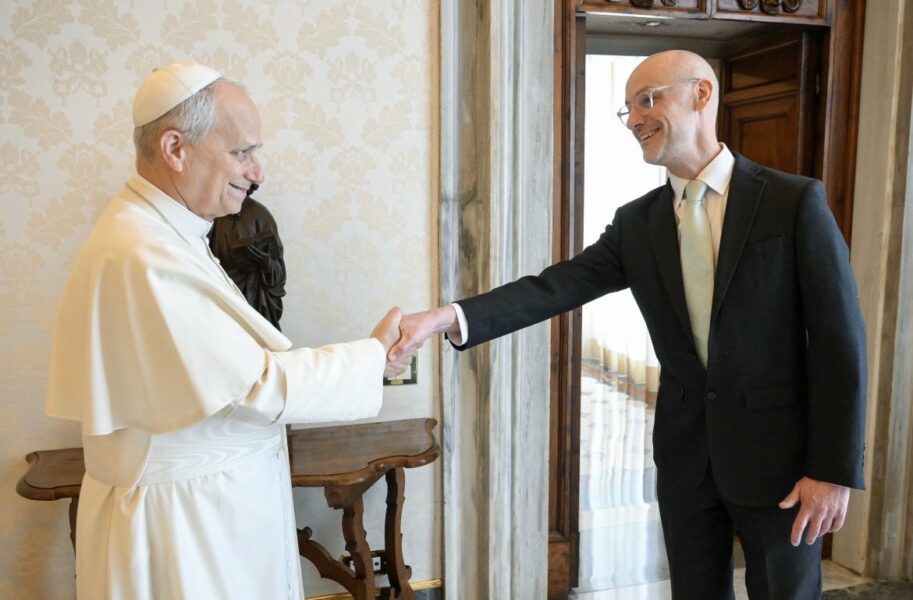
British journalist Gareth Gore, author of Opus, a book that accuses the prelature of spiritual, psychological and economic abuse and of human trafficking, published a long thread on X on November 13 in which he reveals what Leo XIV told him during the private audience on March 16 at the Apostolic Palace.
Gore handed the Pope a dossier containing internal documents leaked by former members, victim testimonies and a report by Argentine prosecutors investigating the institution for trafficking and forced labor. According to his account, the Pontiff replied upon receiving it: “Thank you for bringing them. I’m going to keep them locked in my room because if I give them to anyone around here, they’ll simply disappear.” He is said to have added that it was he who decided to make the meeting public, along with a harsh remark about Opus Dei: “You know, these people are very powerful around here.”
The journalist claims he remained silent for eight months to give the Pope time. He now denounces the silence in response to his offer to put the Vatican in contact with victims, the refusal to meet Argentine women who say they were exploited since childhood, and similar obstacles in Spain and Italy. He reproaches Leo XIV for preaching zero tolerance while ignoring the complainants and wonders whether he has decided not to act or whether someone in the Curia is preventing him. His conclusion is a full-fledged summons: ultimate responsibility lies with the Pope, and Vatican anger over the indiscretion will be nothing compared to that of the victims.
Neither the Holy See nor Opus Dei has responded to these new statements. The prelature has always described Gore’s book as a distorted and conspiratorial account.
The key and the lock
The scene has something of an Italian comedy. A Pope who hides papers in his bedroom to protect them from his own Curia delivers that confidence, which portrays his government as a palace of treacherous corridors, to a journalist who eight months later posts it on social media. The documents may still be safe under lock and key; the phrase now belongs to everyone, and with it the image of a pontiff who distrusts his collaborators and speaks of a Church institution with the caution one uses when speaking of a hostile power.
It is possible that Gore embellished the dialogue. It is also possible that he transcribed it accurately. Both hypotheses lead to the same place: the Pope has been exposed by someone to whom he opened the door of his house.
Useful friendships
Gore reached that audience with the help of Pedro Salinas, the Peruvian journalist who exposed the Sodalicio. It was Salinas, according to Gore himself, who conveyed that then-Cardinal Prevost knew his work and wanted to see him alone—an intermediary role that InfoVaticana already considered striking in March. The detail matters because it sketches a circle: a handful of journalists, activists and some victims with whom Robert Prevost maintained direct and close dealings for years, with personal messages and open doors, according to their own accounts, and who today behave toward the Pope like a creditor toward a debtor.
Aristotle distinguished between friendship founded on the good and that based on utility, and warned that the latter dissolves as soon as it ceases to yield. The Bishop of Chiclayo and Prefect of Bishops could afford confidants. The Successor of Peter now discovers that every old confidence was also a promissory note, and that its holders are presenting it for collection with interest: they set deadlines, demand photos, publish reserved conversations and address him publicly in the tone a managing director uses to reprimand a slow employee.
The phenomenon is not limited to Gore. In Peru, the circle of Sodalicio victims that pontifical commissioner Jordi Bertomeu has sheltered for years, with the constant echo of several Lima journalists, operates under the same logic of privileged interlocutor. Bertomeu boasts of having arranged the Pope’s meeting with Sodalicio victims during his trip to the country, while those from Chiclayo, Huacho or Juli do not appear in any known invitation. Whoever has a godfather sits in the room; whoever does not waits outside. And those who sit inside, celebrated on talk shows and columns, have learned that media pressure opens doors that patience never opens.
The Pope cannot govern the universal Church as if he were managing a messaging group. The confidentiality of an audience protects both speaker and listener; breaking it to force a decision turns dialogue into moral blackmail, however noble the cause invoked.
The order of sorrows
The underlying question remains, and it is the most uncomfortable. Adults who joined ecclesial movements and ended up psychologically subjugated, with their conscience administered by superiors and their freedom mortgaged, recount serious stories that deserve to be heard and examined. The structures that produce such dependence can and must be analyzed. But those accounts, by the very nature of the spiritual relationship, always contain a component of subjectivity and a range of nuances: who consented, when, with what degree of freedom, what part corresponds to the institution’s method and what to a personal surrender lived in an idolatrous way, confusing obedience to God with submission to a director.
None of that admits comparison with the rape of a nine- or eleven-year-old girl. Whoever assumes the government of the universal Church finds on his desk cases of that kind, and finds them by the hundreds. Saint Augustine spoke of the ordo amoris, the well-ordered love that gives each thing its proper place; Saint Thomas applied the same logic to distributive justice, which distributes according to need and gravity. A government that places on the same level the conditioning of an adult and the sexual abuse of a minor disorders the sorrows, and that disorder always harms the weakest.
Gore will object that among his complainants are Argentine women who say they were recruited almost as girls to work without pay. That complaint exists and is serious, and precisely for that reason it is already in the hands of prosecutors who have coercive means the Holy See does not. Civil justice is doing its work there. What civil justice cannot do is replace Rome in the canonical processes against clerics who abused minors and who remain uninvestigated, as in Chiclayo, where three women have been waiting since 2022 for access to their own file and where the diocese stopped paying for their psychiatric treatment.
Governing without debts
Leo XIV faces a bitter and useful lesson. The closeness with certain interlocutors, cultivated when he was bishop and cardinal, has become a mortgage on his freedom to govern, and the creditors have begun to foreclose it in public. The remedy lies in setting his own priorities, based on the objective gravity of the cases and not on the loudness of those who push them, and in remembering that victims without a loudspeaker, without a godfather in the Curia and without a talk show in Lima, also exist.
The Pope kept some papers under lock and key so they would not disappear. He would do well to guard the order of his duties with the same zeal.