


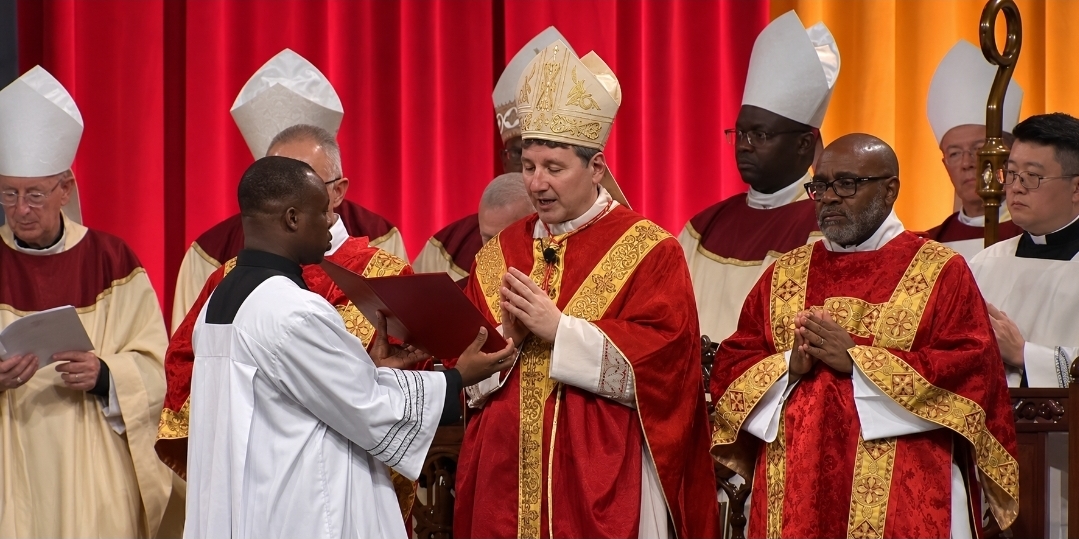
Savannah dawned on this October 31st with an unusual crowd for a southern city accustomed to other celebrations on the eve of All Saints. Some ten thousand faithful filled the Convention Center to attend the elevation to the altars of Friar Pedro de Corpa, Friar Blas Rodríguez de Cuacos, Friar Miguel de Añón, Friar Francisco de Veráscola and the lay brother Antonio de Badajoz, the five Spanish Franciscans murdered in September 1597 on the coast of present-day Georgia for refusing to bless what the Church cannot bless. It is the first beatification celebrated on Georgian soil and throughout the southern United States.
The ceremony was presided over by Cardinal Frank Leo, Archbishop of Toronto, as legate of Pope Leo XIV. Concelebrants included the nuncio to the United States, Gabriele Caccia; the Bishop of Savannah, Stephen D. Parkes, and his emeritus predecessor, J. Kevin Boland; the Archbishop of Atlanta, Gregory J. Hartmayer; the Archbishop of Mérida-Badajoz, José Rodríguez Carballo, and the Archbishop of Urgel, Joan-Enric Vives, representing the Spanish Episcopal Conference, together with the Franciscan provincial minister Michael Perry, the Order’s postulator general, Giovangiuseppe Califano, and dozens of priests. The liturgy, celebrated in English and Spanish, retained Latin in the chants.
The apostolic letter and the unveiled canvas
At the beginning of the Mass, Bishop Parkes presented the formal petition for beatification and reviewed the long history of the cause, recalling that the Church is living the Jubilee Year of the eighth centenary of the death of St. Francis of Assisi. The biographies of the five friars followed, read in English and then in Spanish by Father Pablo Migone, one of the great promoters of the recognition of the martyrs.
The cardinal then read the apostolic letter signed by Leo XIV on the past September 30th, the feast of St. Jerome, which Archbishop Hartmayer, a Conventual Franciscan, proclaimed in English and Monsignor Vives in Spanish. The Pope presents the new blesseds as messengers of Christ whom no one succeeded in bending, men who placed the saving truth of the Gospel above their own safety, and fixes their liturgical memorial on September 22nd. With the proclamation, the official image of the martyrs, painted by Savannah artist Jared Matthew Seff, was unveiled, while the assembly intoned the hymn of praise. The processional cross displayed palms, the ancient emblem of martyrdom, and a choir with orchestra premiered pieces composed expressly for the occasion, including a psalm in Spanish.
A death for the truth of marriage
The story of these five men is of a clarity that makes one uncomfortable. They had been living for two years among the Guale, without military escort, in five missions spread along the coast and islands of Spanish La Florida. Juanillo, heir to a chieftainship and baptized, wished to take a second wife according to the custom of his people. Friar Pedro de Corpa forbade it. Juanillo and his men killed him in his mission and, between September 14th and 17th, 1597, ended the lives of four other friars. A sixth, Francisco de Ávila, was kidnapped and tortured for months before regaining his freedom. Friar Blas Rodríguez, according to accounts of the time, asked to celebrate one last Mass before dying.
Bishop Parkes, at the conclusion of the rite, expressed his conviction that the intercession of the new blesseds will bring a renewed respect for the dignity of the sacrament of marriage, fidelity between spouses and the flourishing of believing families in Georgia and beyond. This is the reading that InfoVaticana had already advanced this same morning: it is worth dying for marriage.
The homily: against a watered-down Gospel
Cardinal Leo, who preached in English and Spanish and offered a special greeting to the delegation from Spain, called the five Franciscans “luminous witnesses of the Gospel” and emphasized that their recognition is a gift for the entire Church, and not only for the Diocese of Savannah. He cited the Catechism to define martyrdom as the supreme testimony to the truth of the faith and drew on the Gospel of St. John to recall that faith overcomes the world.
The sharpest passage came when the legate described the current pressures to dilute the demands of the Gospel, compromise the integrity of the faith and yield to the spirit of the age. In the face of that temptation, he said, the example of the martyrs compels us to look at every relationship, every work and every study in the light of Christ and his Kingdom. He also recalled that the beatification coincides with the 250th anniversary of the American Declaration of Independence, encouraged young people to follow Jesus with an undivided heart and closed with a phrase that sums up the day: “There are still things worth living and dying for.”
Four centuries of cause and some lost relics
The path has been long. The proposal to bring the cause to Rome was born in the American episcopate at the beginning of the 20th century, Father Marion Habig was named vice-postulator in 1950 and the diocesan phase was not opened until February 1984, under Bishop Raymond W. Lessard. In January 2025, Pope Francis approved the decree recognizing their death out of hatred for the faith, which opened the door to beatification without the need for a miracle, as InfoVaticana explained at the time. The organizers paid tribute to Franciscan Conrad Harkins, former vice-postulator who died in 2020, and to archaeologist David Hurst Thomas, whose excavations at the mission of Santa Catalina de Guale illuminated that period.
A mystery remains unsolved. The relics of four of the friars were collected and taken to St. Augustine, Florida, where healings were attributed to them, but their whereabouts are unknown. Some historians maintain that the Franciscans took them to Cuba when the post passed into British hands in 1763, and a skull found in Darien is being analyzed to see if it belonged to one of them.
The eight palm trees that adorned the venue will be transplanted next to the monument to the martyrs at the parish of Our Lady of the Nativity in Darien. This Sunday, November 1st, Monsignor Parkes will celebrate a Mass of thanksgiving in the Cathedral Basilica of St. John the Baptist in Savannah, and La Albuera, birthplace of Friar Antonio de Badajoz, will celebrate its new blessed with a Eucharist presided over by the Archbishop of Mérida-Badajoz. Extremadura adds two blesseds in a single day: Brother Antonio and Friar Blas, a native of Cuacos de Yuste.