


On October 29, 1963, the Fathers of Vatican II voted on what seemed a procedural matter: whether the text on the Virgin would be a separate document or a chapter of the constitution on the Church. The second option won by 1,114 votes to 1,074. A margin of forty votes. It was the first time the conciliar assembly had split into two almost equal halves, and what was at stake, as Roberto de Mattei reconstructs it in The Second Vatican Council, was not the placement of a schema, but the place of Mary in the Church that would emerge from the Council.
De Mattei describes two camps. On one side, those he calls maximalists, with the Franciscan Carlo Balić and the Servite Gabriele Roschini, who hoped the Council would issue a solemn statement on Mary as Mediatrix of all graces. On the other, the minimalists, with Congar, Rahner and Laurentin, whose book The Marian Question gave, according to the author, the signal for the offensive in 1963. The schema had reached the Fathers in May 1963 with a title that today seems revealing: De Maria Mater Ecclesiae. According to the book, in August of that year Rahner wrote to the German-speaking bishops gathered in Fulda with a precise instruction: if they could not defeat the text, they should reduce it to a chapter of the document on the Church and remove the formula of universal mediation, for ecumenical reasons.
In the aula, Cardinal Frings opened the offensive in favor of integration on September 30. He was followed by Silva Henríquez, on behalf of 44 Latin American bishops, and a long list of French, Mexican and English prelates. On the other side, Cardinal Arriba y Castro spoke for 60 Spanish bishops. On October 24, the Filipino Santos and the Viennese König clashed in two speeches that summarized the two positions. Five days later came the vote of the forty votes. Balić experienced it as a personal catastrophe: “There my whole work foundered!” De Mattei, drawing on sociologist Melissa Wilde, attributes the defeat to the disorganization of the conservatives, and maintains that that blow, together with the one they received the next day in the vote on collegiality, forced them to organize.
The second battle was fought a year later, and in it appears the most disconcerting figure in the account. On June 20, 1962, while still Archbishop of Milan, Giovanni Battista Montini had considered the title of Mediatrix inopportune. Already as Paul VI, as Congar noted in his diary, he still did not want the Council to pronounce on mediation, but he insisted on another title: Mother of the Church. In September 1964 the blocs squared off again. Cardinal Wyszyński, on behalf of 70 Polish bishops, asked the Pope to proclaim Mary Mother of the Church. Cardinal Alfrink, backed by 124 bishops, called for the word Mediatrix to be removed, and Döpfner spoke against it on behalf of 90 German- and Scandinavian-speaking bishops. Mexican bishop Méndez Arceo rejected the title Mother of the Church as foreign to the East and too recent. The compromise was drafted by Balić and Philips: Mediatrix remained in the text, in a secondary place and alongside other traditional titles, without the addition of “all graces.” It was voted on October 29, 1964, with 1,559 votes in favor, 521 in favor with reservations, and 10 against.
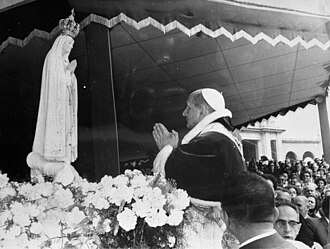
The title remained. The doctrinal commission refused to include Mother of the Church in the constitution Lumen gentium, although Paul VI had been requesting it since the summer of 1963. On November 21, 1964, the same day the constitution was approved by 2,151 votes to 5, the Pope closed the third session and, at the end of his address, proclaimed Mary Mother of the Church, a title that rests on a simple logic: the Mother of Christ is the mother of his Body. What the Council had not wanted to write, the Pope said in the aula. The response was prolonged applause. De Mattei also records the displeasure of the observers and the more ecumenist Fathers, Semmelroth’s diary entry accusing the Pope of once again setting himself against the Council, and the testimony that De Lubac saw in that gesture the end of John XXIII’s Council. Ralph Wiltgen counted the proclamation among the grievances that the progressives held against Paul VI in that black week.
The episode occupies only a few pages of a book of more than five hundred, but it encapsulates its method. De Mattei is not a theologian; he is a historian, and he reconstructs the Council with the official acts, the diaries of its protagonists, and the correspondence of the groups that organized in Rome to push it in one direction or another. The question left open is the one that runs through the entire book: how a Council that relegated Mary to a chapter ended with the Pope proclaiming her Mother of the Church against the criterion of his own commission, and who really won that match.
 |
Homo Legens The Second Vatican Council Roberto de Mattei · Bibliotheca Homo Legens · 24,90 € |
Read also