


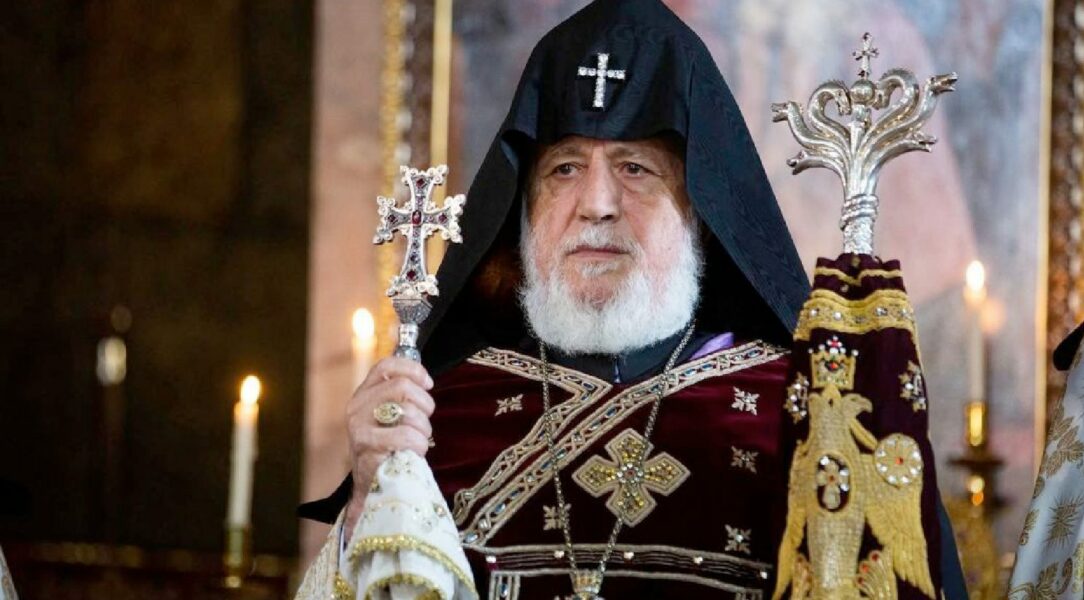
The Court of First Instance of Armavir, in Armenia, dismissed on October 21 the civil case concerning the removal of Arman (Gevorg) Saroyan, former bishop of Masyatsotn, and revoked the precautionary measures issued on January 16, whose alleged non-compliance gave rise to the criminal proceedings against Catholicos Karekin II, primate of the Armenian Apostolic Church, and six other prelates, according to Korazym.
Saroyan had sued the Church following the decree of January 10, 2026, by which Karekin II removed him from his position. He requested the annulment of the decision and his reinstatement, alleging lack of reasoning and procedural guarantees. For its part, the Holy See of Etchmiadzin maintained that the civil courts lacked jurisdiction to resolve the dispute, since the appointment and removal of diocesan officials are governed by the Church’s internal canon law.
According to Korazym, Judge Edgar Hovhannisyan concluded that no employment relationship between Saroyan and the Church had been proven. Neither the payment records nor the documentation submitted demonstrated the existence of an employment contract.
Therefore, the court considered that the matter fell outside civil jurisdiction and dismissed the case without ruling on whether the removal was justified. The decision may be appealed before the Civil Court of Appeal within one month of its publication.
The precautionary measures that gave rise to the criminal case
The precautionary measures issued on January 16 ordered the ecclesiastical hierarchy not to obstruct Saroyan’s exercise of his functions, including the management of diocesan finances, while the dispute was resolved.
The alleged non-compliance with that court order constitutes the basis of the criminal case opened against Karekin II and six members of the Supreme Spiritual Council: Archbishops Nathan Hovhannisyan and Haigazun Najarian, and Bishops Moushegh Babayan, Hovnan Hakobyan, Makar Hakobyan, and Vahan Hovhanessian.
All seven are accused of obstructing the enforcement of a judicial decision by using the prerogatives of their ecclesiastical offices.
Following the recusal of Judge Hakob Manukyan, the criminal proceedings were transferred from Armavir to Yerevan, where they were assigned to Judge Vahagn Melikyan.
The defense has requested the dismissal of the case, arguing that the facts do not constitute a crime and that decisions regarding the appointment and removal of bishops fall under ecclesiastical authority.
The Armavir ruling provides a new element for that request, although the dismissal of the civil case does not automatically extinguish the criminal proceedings.
The next hearing is scheduled for October 30, when the court will examine the preliminary issues raised by the defense in light of the new judicial decision.
Read also: The Armenian Patriarch before the courts: Karekin II faces two years in prison alongside six bishops.
Etchmiadzin’s lawyer, Ara Zohrabyan, stated, according to Korazym, that the ruling confirms the ecclesiastical nature of the conflict and the lack of jurisdiction of civil courts to intervene in this type of decisions.
The confrontation between the Government and the Church
The case against Karekin II is unfolding amid the growing confrontation between Prime Minister Nikol Pashinyan’s Government and the Armenian Apostolic Church.
In February, the Prosecutor’s Office brought charges against the Catholicos and prohibited him from leaving the country. In August, Karekin II appeared before the courts alongside the six accused prelates, in proceedings that carry possible penalties of up to two years in prison.
That same month, the Executive included in its program for the 2026-2031 period the removal of Karekin II, the appointment of an interim ecclesiastical authority, and the subsequent election of a new Catholicos.
According to Korazym, on October 9 the Constitutional Court declined to rule on the merits of an appeal filed by the opposition against those provisions, considering them political statements without legal effects of their own.
The National Assembly also established an investigative commission on the Armenian Apostolic Church, without the participation of the opposition, which has questioned the legitimacy of this initiative.