


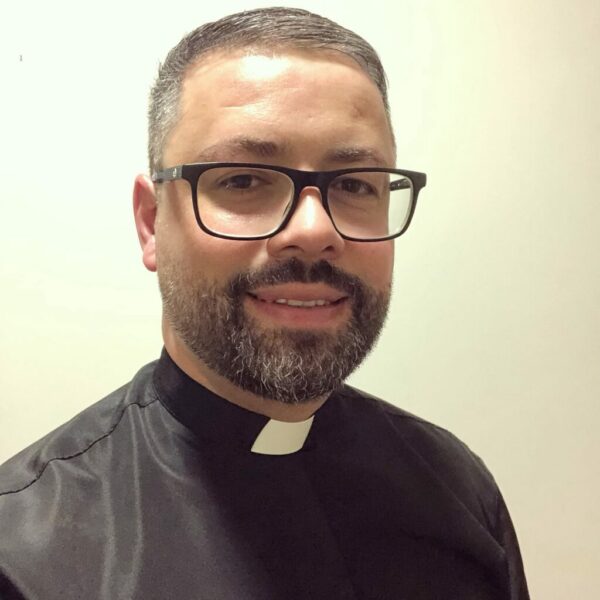
Pope Leo XIV on Monday, October 19, appointed Brazilian priest Tiago de Fraga Gomes, 39, a member of the International Theological Commission. He is a presbyter of the Diocese of Osório in the state of Rio Grande do Sul and an associate professor at the School of Humanities of the Pontifical Catholic University of Rio Grande do Sul (PUCRS) in Porto Alegre. He is one of the 24 new members announced that day in the Holy See Press Office bulletin, appointed according to the Commission’s statutes on the proposal of the Prefect of the Dicastery for the Doctrine of the Faith, Cardinal Víctor Manuel Fernández. A significant part of his academic work, from his 2015 master’s thesis to an article published this year, is devoted to the theology of religious pluralism of the French Dominican Claude Geffré. In it he maintains that “no historical religion is absolute” and that the singularity of Jesus of Nazareth “cannot be absolutized to the point of excluding other religions.”
The two sentences come from “Dialogue between religions from the economy of the incarnate Logos. Christological references from Claude Geffré and Nostra aetate,” an article he co-authored with Vanessa Mirapalheta Oliveira and which the journal Fronteiras, of the Catholic University of Pernambuco, published on January 30, 2026. The abstract explains that the text starts from the Christological paradox, defined as “the qualitative but not quantitative fullness of Revelation in Christ,” to argue that no historical religion is absolute and that Christianity, in coherence with its incarnational logic, must open itself to dialogue. It presents as its own contribution a hermeneutic that “conceives pluralism as a theological locus.” The sentence about the singularity of Jesus appears in the conclusion, on page 330.
The article also records the Church’s position. On page 310 it states that “the Church reaffirms that Christ is the sole universal mediator of salvation,” and on page 320 it specifies that, for Geffré, “it is not a matter of parallel paths of salvation.” To present Catholic doctrine on religions, it cites two Vatican documents from 1984 and 1991, Dialogue and Mission and Dialogue and Proclamation. It does not cite the declaration Dominus Iesus nor the notification of the Congregation for the Doctrine of the Faith concerning the Belgian Jesuit Jacques Dupuis, whom it does invoke as an authority on several pages.
According to the article, Dupuis “broadens” Geffré’s perspective by defending that the universal action of the Spirit “anticipates the event of Jesus Christ” (page 318), and maintains that “the Christ-event, although central and definitive, is circumscribed to a historical particularity” (page 319). The bibliography includes the Brazilian translation of his book Toward a Christian Theology of Religious Pluralism.
That book was the subject of a notification from the Congregation for the Doctrine of the Faith dated January 24, 2001 and signed by its then prefect, Cardinal Joseph Ratzinger. The text declares it contrary to the faith to hold that the revelation of Jesus Christ is “limited, incomplete and imperfect” (no. 3); it rejects the idea that the salvific action of the Holy Spirit “can extend beyond the one universal salvific economy of the incarnate Word” (no. 5); and it affirms that there is no foundation in Catholic theology for considering religions, “as such, as ways of salvation” (no. 8).
Five months earlier, on August 6, 2000, the same Congregation had published the declaration Dominus Iesus, ratified by John Paul II with his apostolic authority. The document warns against relativistic theories that seek to justify religious pluralism “not only de facto but also de iure” (no. 4), declares “contrary to the faith of the Church the thesis of the limited, incomplete and imperfect character of the revelation of Jesus Christ” (no. 6), and criticizes the theological tendency to avoid terms such as “uniqueness,” “universality” and “absoluteness” (no. 15).
The International Theological Commission itself addressed the issue in 1997 in the document Christianity and the Religions, approved by its members in 1996 and published with the authorization of Ratzinger, its president. That text maintains that only in Jesus can men be saved, that there are no paths to God that do not converge on the one way which is Christ, and that, although the salvific value of religions cannot be excluded, this does not mean that everything in them is salvific. It also reproaches pluralist theology for wrongly supposing that only it favors dialogue.
The 2026 article is the latest link in a line of research that Fraga Gomes has maintained for ten years. In 2015 he obtained his master’s degree at PUCRS with the thesis “The hermeneutical theology of Claude Geffré and its relevance for the theology of revelation,” and in 2020 his doctorate with “The Logos became dia-logos: economy of the incarnate Logos and interreligious dialogue in search of peace in Claude Geffré,” directed by Professor Érico João Hammes. The summary of the doctoral thesis proposes “a pluralist hermeneutic of the economy of revelation” in the face of current religious pluralism.
In an article published in 2018 in the journal Teocomunicação, of PUCRS, entitled “Religious pluralism in the horizon of a planetary ecumenism in Claude Geffré,” he wrote that “it is necessary to overcome every form of scriptural fundamentalism and doctrinal integrism” and that the construction of “a planetary ecumenism” and a world ethos depends on this. A year later, in a text co-authored with Hammes in the journal Pistis & Praxis, he recorded the thesis that theology is called “to reinterpret the uniqueness of Christianity,” although he specified that Geffré defends maintaining “the uniqueness and singularity of Christ’s mediation.” That article also does not cite Dominus Iesus.
The second front of his recent production is Amoris laetitia. In December 2025, a few months before the tenth anniversary of the exhortation, the Revista de Cultura Teológica of the Pontifical Catholic University of São Paulo published “The aggiornamento in the exhortation Amoris laetitia 60 years after the Second Vatican Council,” written with Jonas Emerim Velho. The authors defend “a pastoral stance of welcoming families in irregular situations, and not of condemnation,” and ask that such situations, “after a process of discernment, be tolerated with mercy.” In the conclusion, on page 79, they write: “Here there is the possibility of integration into ecclesial life, whether through participation in groups and activities, or even sacramentally.”
The article does not cite number 84 of Familiaris consortio, in which John Paul II established that divorced and remarried persons may only access the sacraments if they assume the commitment to live in complete continence. The possibility of sacramental integration in certain cases coincides with the criteria of the bishops of the Buenos Aires region that Francis approved in 2016 in a letter and which in 2017 he ordered published in Acta Apostolicae Sedis. Ten years later, the question remains open: at the meeting on Amoris laetitia that Leo XIV convened in the Vatican from October 7 to 14, communion for the divorced and remarried was discussed controversially, as the president of the German Episcopal Conference, Heiner Wilmer, later acknowledged.
His publications in recent years also touch on other matters. In December 2023 he signed in the journal Caminhos, with Marcelo Dantas da Silva Júnior, the article “Bolsonarism and the Gospel of Peace as antagonistic systems,” which maintains that former President Jair Bolsonaro’s discourse showed “a complete dissonance with the Gospel of Christ,” speaks of the idolatry created around his figure, and concludes that, because they are ideologically antagonistic structures, “it is impossible to amalgamate them.” In April 2022 he published, with Everton Ricardo Berny Machado, a study on the theology of the Eucharist in Teilhard de Chardin, to whom he attributes having contributed “considerably to the dialogue between science and faith” and whose vision of the Eucharist “in its cosmic dimension” he relates to Vatican II. The text does not mention the monitum with which the Holy Office warned in 1962 of ambiguities and grave errors in the works of the French Jesuit, although Benedict XVI and Francis later referred positively to his cosmic vision.
In 2026 he has also published an article on the passage “from juridicism to synodality,” in which he describes as a “Copernican revolution” the shift in the ecclesiology of Vatican II regarding normative authority, and another, with Clélia Peretti, on the theology of hope in dialogue with Moltmann, Metz, Gustavo Gutiérrez and Ernst Bloch, as well as Spe salvi and Saint Thomas, according to which “hope is incarnated in marginalized subjects.” Among his works are also studies on Caritas in veritate, on the theology of canon law, on the welcome of migrants in the light of Fratelli tutti, and on the theology of miracles.
Fraga Gomes was born in Osório on May 20, 1987, according to his diocese’s file. He studied in the seminaries of Gravataí and Viamão, obtained degrees in Philosophy and Theology from PUCRS, was ordained deacon in August 2012 and priest on December 21 of that year in the cathedral of Osório, a suffragan diocese of Porto Alegre. He served as parochial vicar in Maquiné and, since 2014, as pastor of Nossa Senhora da Piedade in Barra do Ouro. His most recent biographical notes present him as a doctor from PUCRS with a stay at the University of the Ruhr in Bochum, a post-doctorate from PUC-Rio, coordinator of the graduate program in Theology at PUCRS, and secretary general of the Brazilian association of graduate studies and research in Theology and Religious Sciences (ANPTECRE).
In 2023 he signed as national secretary of the Commission for the Doctrine of the Faith of the National Conference of Bishops of Brazil. That year he published an article with Antonio Luiz Catelan Ferreira, auxiliary bishop of Rio de Janeiro and Brazilian member of the International Theological Commission for the 2021-2026 term, who does not appear among the six members continuing in the new composition, according to Vatican News.
After the appointment became known, Fraga Gomes told the southern regional of the Brazilian episcopal conference that he hopes “to be able to collaborate for the growth of our beloved Church” and that he places himself “at the service so that Christ may be ever more known and loved.”
The Commission he joins has, according to article 1 of its statutes, the task of studying “doctrinal questions of special importance” to assist the Magisterium and, in particular, the Dicastery for the Doctrine of the Faith, and article 3 asks its members to distinguish themselves by their “learning, prudence and fidelity to the Magisterium of the Church.” In April 2025, on the occasion of the 1,700th anniversary of the Council of Nicaea, it published the document Jesus Christ, Son of God, Savior, dedicated to the confession of faith in Christ.
This medium has found no sanction or investigation by the Dicastery for the Doctrine of the Faith concerning his writings, nor any statements of his on sexual morality or gender issues. Nor has it found any text in which he discusses the objections of Dominus Iesus or of the notification on Dupuis to the theology of religious pluralism that he has studied since 2015.
Read also