


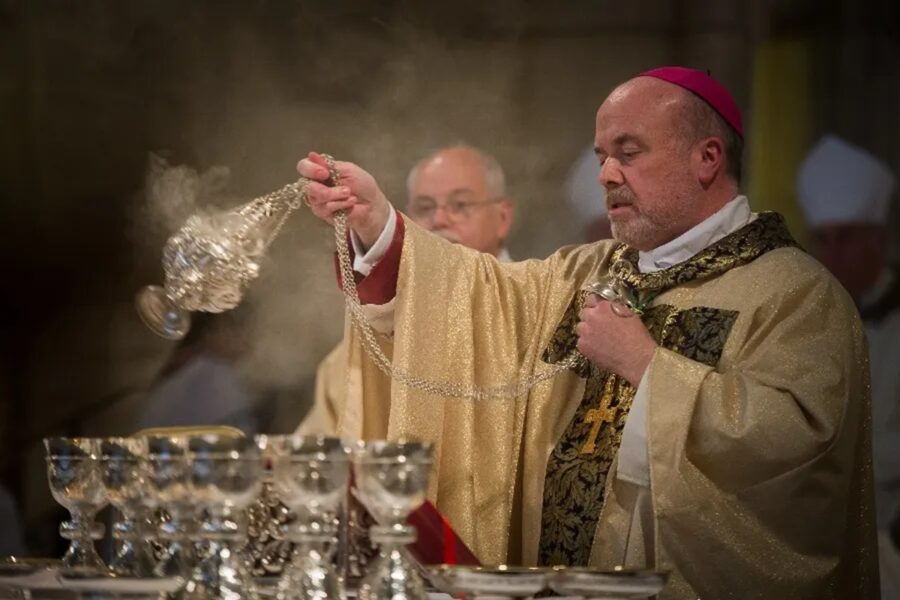
The Bishop of Leeds, Marcus Stock, has made public the report in which he recommends to Leo XIV and the Dicastery for Bishops the unification of the dioceses of Leeds, Middlesbrough and Hallam into a single diocese in northern England. The document, signed in Leeds on 25 August, sent to Rome at the end of that month and recently published by the three dioceses, concludes with a favourable votum for the union and accompanies the proposal with figures showing a sharp decline: between 2000 and 2025, average Sunday Mass attendance in the three dioceses fell from 83,409 to 40,221 people, and incardinated priests with an office, from 347 to 128.
Stock, Bishop of Leeds since 2014, already governs the three sees, although they remain distinct jurisdictions: he has been apostolic administrator of Middlesbrough since December 2025 and of Hallam since March 2026, following the resignation of Bishop Ralph Heskett. The consultation was carried out at the request of the Pope and the Dicastery. It began on 5 February 2026 with the Leeds curia and included in-person meetings in the three dioceses, consultations with priests, deacons, religious, colleges of consultors and diocesan councils, reports from the heads of Catholic school networks and an online questionnaire that received 840 responses, of which 648 were analysed.
The report’s data paint a picture of a Church that has lost half its practising members in a quarter of a century. Annual baptisms have dropped from 4,569 to 2,786, almost 40% fewer, and parishes from 274 to 193. Incardinated priests with an office have fallen from 347 to 128, a 63% decrease. Pastoral care in the territory is currently provided by 116 active diocesan priests, 51 religious or missionaries from abroad and 41 permanent deacons. The number of registered Catholics is nearly half a million: 229,453 in Leeds, 140,571 in Hallam and 125,793 in Middlesbrough. With these figures, those attending Mass on any given Sunday represent just over 8% of the region’s Catholics.
In the votum, Stock argues that the union would strengthen the mission of the local Church, allow “support for the work of evangelisation in a more strategic way” and provide greater opportunities to reach the poor and disadvantaged. The report records among the clergy “a notable degree of agreement” with the proposal, but also the doubts expressed by those consulted: the growing burden that would fall on the bishop, the practical difficulties of such an extensive diocese and the need to respect local identities, safeguard formation and ensure sound administration and the protection of minors. According to the document, Rome has indicated that it could appoint one or two auxiliary bishops; as an alternative, episcopal vicars for different zones are proposed. The text does not specify the see or the name of the new diocese.
The territory roughly coincides with the historic county of Yorkshire, which had a single Catholic diocese, that of Beverley, from the restoration of the hierarchy in England in 1850 until 1878, when it was divided into Leeds and Middlesbrough. Hallam was created in 1980 with territory from Leeds and Nottingham. This is why the dioceses also speak of reunification. The decision now rests with the Dicastery for Bishops and the Pope, and no deadline is known.
The proposal coincides with other cutbacks in the United Kingdom. Just a few days ago, the Scottish archdiocese of Glasgow presented a plan to close 24 churches and halve its parishes. What is presented in Yorkshire as an opportunity for mission stems from the fact that in twenty-five years six out of every ten priests and half of the faithful who attended Mass have been lost.
Read also
- La archidiócesis de Glasgow cerrará 24 iglesias y reducirá a la mitad sus parroquias
- Una parte de la Iglesia muere y otra resurge: un análisis global de las vocaciones sacerdotales
- Hasta 90 parroquias podrían perder la misa dominical en Detroit mientras continúa la ofensiva contra la liturgia tradicional