


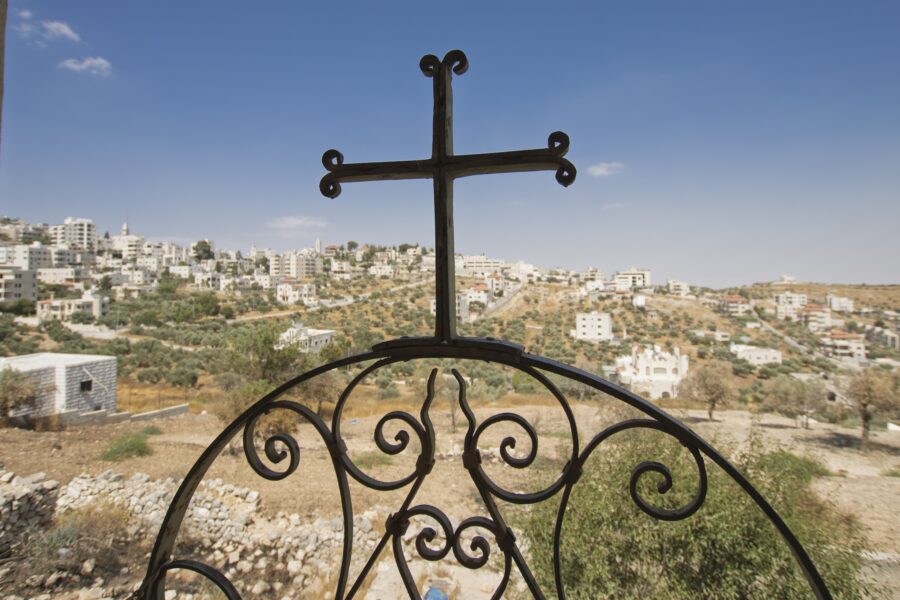
Father Bashar Fawadleh, parish priest of Taybeh, the last entirely Christian village in the West Bank, has warned that protecting the Christian presence in the Holy Land cannot be reduced to preserving its churches and historic sites if the families who keep them alive are ultimately forced to leave the region.
“Protecting the Christians of the Holy Land does not mean only safeguarding churches, monasteries, and stones. The protection of the Christian presence begins by protecting people and their right to remain in their own land,” the priest writes in a reflection published by the SIR Agency.
“How can we preserve the Christian presence if even staying becomes a cause for concern?”
Fawadleh begins with the recent meeting between Leo XIV and a French religious sister who had been assaulted in Jerusalem. In his view, the Pontiff’s gesture was not merely a show of closeness to an injured person, but once again raises a decisive question for the future of the Holy Land: how to protect the dignity and security of individuals and ensure they can remain in their places of origin.
The priest avoids interpreting the assault in terms of a general confrontation between religions. “The assault on a religious sister in Jerusalem cannot be reduced to a conflict between Christians and Jews,” he clarifies. Responsibility, he notes, lies with the perpetrator, and “every form of violence must be condemned without ambiguity.”
The episode, however, occurs within “a broader climate of tension, violence, and fear” that affects many people, and in particular the Palestinian population of the West Bank.
The pressure on Taybeh
Fawadleh mentions “attacks on land and property, fires, acts of vandalism, movements of armed settlers near homes and cultivated fields,” as well as growing restrictions on freedom of movement and work.
The situation has been deteriorating for months. In August, the parish priest himself warned that the roughly 1,200 Christians remaining in Taybeh felt “forgotten” and “alone” in the face of violent incursions and the growing fear of families for their future. Cardinal Pierbattista Pizzaballa, the Latin Patriarch of Jerusalem, later described the West Bank as a “lawless land” and denounced the “continuous aggression” by settlers against the Palestinian population.
Fawadleh insists that what is happening in Taybeh should not be interpreted exclusively as an attack on Christians because of their faith. Its inhabitants face many of the same difficulties affecting the rest of the Palestinian communities in the West Bank.
The particularity of Taybeh, however, lies in the consequences that the exodus of its inhabitants may have: “The prolongation of fear, pressure, and emigration threatens a Christian presence rooted in this land for centuries.”
“What value does preserving a historic church have?”
For the parish priest, the survival of the Christian presence cannot be separated from the concrete conditions that allow families to continue living in the Holy Land.
“What value does preserving a historic church have if the families who frequent it are forced to leave? What sense does it make to speak of the importance of the Christian presence if young people cannot find work, farmers are afraid to reach their fields, and families consider emigrating in search of security?” he asks.
The Latin Patriarchate has similarly warned that Christians in the Holy Land do not want to be preserved as “a historical curiosity”, but rather to have the necessary conditions to work, form a family, educate their children, and practice their faith in the land where their communities have been settled for centuries.
“Taybeh is not asking for privileges or protections at the expense of others,” Fawadleh concludes. What it demands is “security, the rule of law, protection of the land and of people, and the possibility of building a future for their children.”