


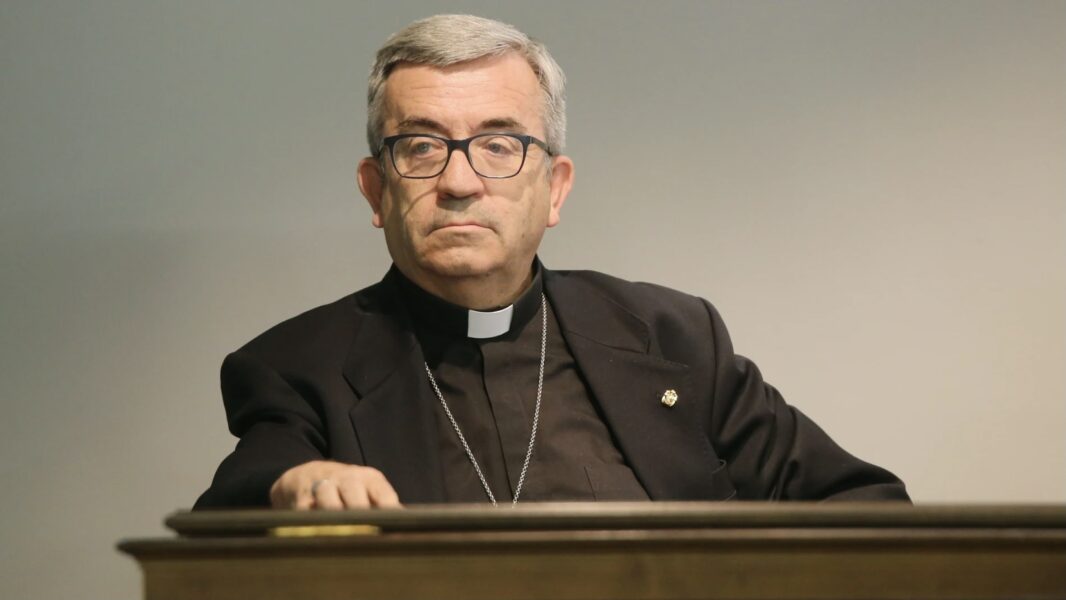
The president of the Spanish Episcopal Conference and archbishop of Valladolid, Mons. Luis Argüello, has brought together in a single reflection three highly topical issues —housing, the situation in Ceuta, and abortion— to denounce three forms of “eviction” and to question the different ways in which legality and the “right to decide” are invoked depending on the debate at hand.
In a text published this Monday, September 28, by the Archdiocese of Valladolid, under the title Three types of “evictions” are in the news: housing, Ceuta, and the maternal womb, Argüello speaks explicitly of “invasions” provoked by geopolitical interests, defines what happened in Ceuta as an “exodus-invasion-occupation,” and denounces abortion as an “eviction from the maternal womb” with irreversible consequences.
The eviction of an elderly woman and the housing problem
Argüello begins with the case of Mari Carmen, the 87-year-old woman threatened with losing the rented home she lives in Madrid, whose situation has sparked a strong political and media reaction.
The archbishop considers it necessary to reach a social agreement that recognizes the seriousness of the housing problem: scarcity of supply, closed properties, empty houses in rural Spain, high prices and rents, and rooms rented in apartments where even the kitchen ends up being converted into an additional living space.
He warns, however, of the danger that the consensus generated by specific cases may be “emotional rather than moral” and end up subject to “ideological manipulation and political and social conflict over the causes and possible solutions.”
Argüello proposes placing housing within the “new social contract” that workers and employers referred to during their meeting with Leo XIV on the Pope’s recent visit to Spain.
Ceuta: “exodus-invasion-occupation”
The second “eviction” leads Argüello to Ceuta. The president of the CEE states that “the people of Ceuta are experiencing the eviction of their streets, squares, and their normal life,” while some of the migrants who have arrived in the city have been “evicted from their countries of origin” and others have been “displaced by geopolitical interests.”
The archbishop openly acknowledges the reaction among the city’s population and in much of Spain.
The people of Ceuta, he writes, “want a quick and total eviction of those who have entered the city as ‘squatters.’” But at the same time he recalls that there is “a humanitarian crisis —physical, psychological, and moral— that affects everyone, migrants and Ceutans alike.”
Argüello rejects reducing the situation to a merely migratory issue and warns that the Ceuta crisis is shaping the perception of migrants in the rest of Spain.
The president of the bishops therefore calls for “a national agreement to help the people of Ceuta and resolve the humanitarian crisis,” accompanied by a State and European pact that also addresses the causes of population movements.
States that use exoduses to “provoke invasions”
Argüello’s proposal includes acting in the countries of origin, combating mafias, regulating immigration flows, and receiving those who arrive while respecting a dignity “that is not lost when crossing the border,” even when they must later be returned to their countries.
The archbishop also explicitly introduces the geopolitical dimension of the crisis and calls for confronting States “that use the exodus of people to provoke invasions for geopolitical interests with mafia-like behavior.”
When assessing the different responses proposed for Ceuta, he uses an even more significant expression. Some positions, he explains, advocate immediate expulsions even disregarding legality; others “refuse to see that many Ceutans are also victims of the humanitarian crisis triggered by the exodus-invasion-occupation.”
The expression adds to other episcopal interventions that in recent weeks have rejected interpreting what happened in Ceuta exclusively as a migration phenomenon. Mons. Jesús Sanz Montes denounced the invasion and spoke of a “calculated stalking,” although he also recalled that many of the young people who arrived in the city “are equally victims.”
Argüello also introduces a warning about the European demographic crisis: if the current birth rate situation continues, he states, “in a few years Europe will compete for the scarce immigrant.”
Abortion, “eviction from the maternal womb”
The third eviction pointed out by the president of the CEE is “that of the maternal womb caused by abortion,” which, unlike the others, has “irreversible consequences.”
Argüello here directs an express criticism at the Government for its institutional campaign on abortion. The Executive, he denounces, presents it as a good act because it is legal —“you have the right”— and autonomous —“whatever you decide will be fine.”—
Faced with this approach, the archbishop recalls that the issue does not affect only the will of the pregnant woman.
“Science shows that in the womb of a pregnant woman there is a human being, a child, distinct from her, over whom she cannot decide without considering the morality of that decision,” he states.
Argüello calls for social, labor, and housing assistance and “full support” for pregnant women. He admits that there may be cases of “great ethical conflict,” but rejects that they can be resolved by simply appealing to a right recognized by legislation.
“It can never be justified by a legal right that denies the child the life on whose dignity all rights are based,” he maintains.
The reflection comes after the Government launched an institutional campaign on abortion under the message “Whatever you decide, it will be fine,” an initiative that has drawn criticism for presenting as morally indifferent a decision that ends the life of the conceived child.
From the “right to decide” of the owner to that of the pregnant woman
It is precisely in the “right to decide” that Argüello finds the thread connecting the three debates.
“Faced with these three types of evictions, the ethical argumentation varies in a self-interested way,” he denounces.
The archbishop contrasts “the staunch defense of the right to decide of the owner or the pregnant woman, if the decision is legal, without taking into account who suffers the consequences,” with the rejection of the owner’s free decision when, despite being legal and judicially confirmed, it affects a person considered especially vulnerable.
A similar contradiction appears in Ceuta. While some call for immediate expulsion even disregarding legality, other positions, according to Argüello, ignore that the city’s inhabitants have also become victims of the crisis.
“The three issues call for serene dialogue and major agreements,” he maintains.
The fourth eviction
From the three cases, Argüello finally draws a fourth “eviction,” which he places in the public debate itself.
“Reason and the will for agreement in defense of human dignity and the common good” seem, he laments, “to have been expelled from our common home.”
The reflection of the president of the CEE thus places three very different realities under the same moral question: who bears the consequences when another’s decision is presented as legitimate because it is backed by law, whether it be the owner of a home, the management of the invasion of Ceuta, or the decision to abort.