


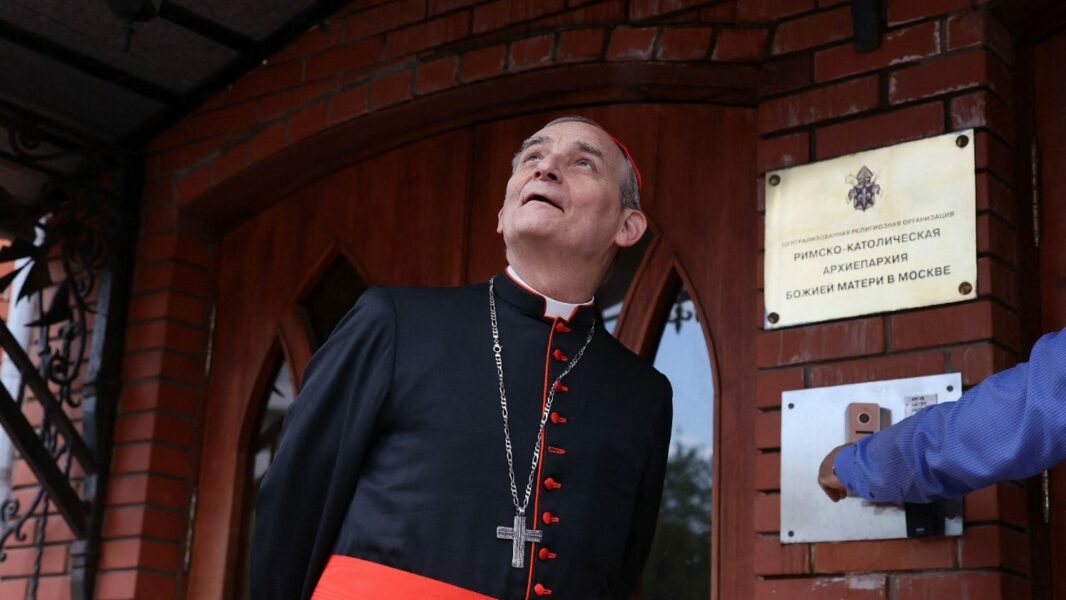
Cardinal Matteo Zuppi has begun a new three-day mission in Moscow this Monday to continue the humanitarian efforts of the Holy See related to the war in Ukraine. The president of the Italian Episcopal Conference will remain in the Russian capital until Wednesday, September 30, with an agenda focused on prisoners of war, minors separated from their families, and the situation of civilians affected by the conflict.
According to Vatican News, this is Zuppi’s third trip to Moscow, following those made in June 2023 and October 2024. The mission, originally entrusted by Francis, has been expressly confirmed by Leo XIV.
A mission confirmed by Leo XIV
“All of this is part of the humanitarian mission that Pope Francis initially entrusted to me and that Pope Leo XIV later confirmed,” Zuppi explained to the Russian agency TASS before beginning his meetings.
The cardinal specified that he has meetings with Russian officials scheduled for Monday, Tuesday, and Wednesday, and that his mandate consists of supporting the efforts of both parties to address “the problems related to children, prisoner exchanges, and civilian issues arising from the conflict.”
Zuppi also assured that the Holy See is examining requests coming from both Ukraine and Russia within the dialogue channel opened in recent years.
“We wish to continue developing this dialogue, aware of the suffering caused by the war, and we seek to contribute to its end,” he stated.
Ukraine has requested an “all-for-all” exchange
The new visit to Moscow comes after the mission Zuppi carried out in Ukraine last July. There he held meetings with Ukrainian authorities and families of military personnel and civilians detained in Russia, and visited a prison in the Lviv region where Russian soldiers were being held.
During those conversations, the families conveyed to the cardinal the request to promote a prisoner exchange under the “all-for-all” formula. According to Vatican News at the time, the estimates presented to Zuppi spoke of around 7,000 Ukrainians held in Russia and approximately 4,000 Russians in Ukrainian custody.
The families also asked that the papal envoy be able to visit prisons in Russian territory, following the gesture made with Russian captives in Ukraine.
The issue of prisoners had already been part of the Holy See’s previous efforts. During Zuppi’s visit to Moscow in October 2024, the Vatican officially reported conversations about the exchange of prisoners and the wounded, the return of the remains of the fallen, and the reunification of minors with their families.
The civilians of Kursk on the table
This week’s talks also include the situation of Russian civilians displaced from the Kursk region during Ukrainian military operations. According to Zuppi’s statements reported by TASS, the parties will verify whether all of them have been able to return to their homes.
Russian Ambassador to the Holy See Ivan Soltanovsky has welcomed the cardinal’s new mission and assured that Zuppi is “always welcome in Moscow.” The Russian diplomat acknowledged, however, that a possible exchange of civilian prisoners is a new matter that will require first determining who can be included in that category.
One of the main issues remains that of minors transferred away from their families. Vatican mediation has allowed, in recent years, a channel to be maintained between both parties to facilitate family reunifications and transmit information about detainees.
During his previous visit to Moscow, Zuppi met with Russian Foreign Minister Sergei Lavrov; Yuri Ushakov, advisor to Vladimir Putin on foreign policy; Maria Lvova-Belova, presidential commissioner for Children’s Rights, and Tatiana Moskalkova, Russia’s human rights ombudsman. He also met with Metropolitan Anthony of Volokolamsk, head of external relations for the Moscow Patriarchate.
Zuppi arrives one month after Gallagher
The mission comes exactly one month after Monsignor Paul Richard Gallagher, Secretary for Relations with States and International Organizations of the Holy See, concluded a five-day visit to Russia marked by political, diplomatic, and ecclesial contacts.
On August 25, Gallagher met with Sergei Lavrov, before whom he defended the need to keep the diplomatic channel open and address “the reality and prospects for peace.” “The world needs diplomacy more than ever,” the Holy See representative stated at the time.
Read also: Gallagher meets with Lavrov in Moscow: “The world needs diplomacy more than ever”
During the same visit, Gallagher held a meeting with Yuri Ushakov, advisor to Vladimir Putin on foreign policy, in which they addressed “current issues on the international agenda.” He also strengthened the Holy See’s contacts with the Moscow Patriarchate through a meeting with Metropolitan Anthony of Volokolamsk and a visit to the Cathedral of Christ the Savior.
Read also: Gallagher meets with Putin’s advisor and strengthens contacts with the Moscow Patriarchate
The final day had a specifically ecclesial dimension. Gallagher presided over Mass at the Cathedral of the Immaculate Conception in Moscow, met with priests, religious, and bishops, and conveyed to Russian Catholics “the closeness and prayers” of Leo XIV.
At the conclusion of that visit, Lavrov stated that Gallagher had acknowledged that the situation of religious freedom in Ukraine “is not good” and that he had committed to conveying that concern in his future contacts with Ukrainian authorities. The statement corresponded to the version publicly offered by the Russian minister.
The succession of both visits shows the two channels the Holy See currently maintains open with Moscow. Gallagher acts from the Secretariat of State on the diplomatic and institutional relations level, while the mandate entrusted to Zuppi remains focused on the humanitarian consequences of the war.
The current mission thus keeps open a channel initiated more than three years ago. In June 2023, during his first visit to Moscow, Zuppi met with Ushakov, Lvova-Belova, and Patriarch Kirill. The Holy See then defined the objective of the initiative as the search for humanitarian measures capable of opening paths toward peace.