


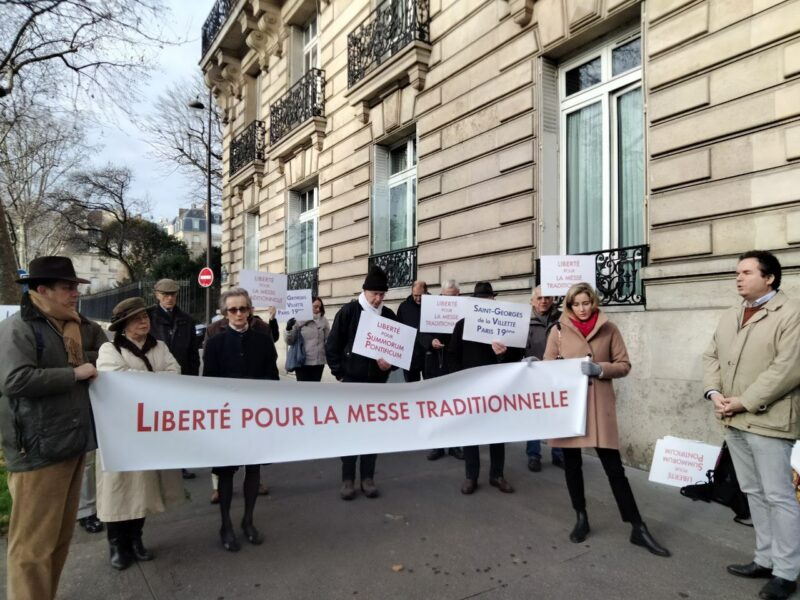
While Leo XIV completes this Friday, September 25, his first day of apostolic travel in France, families and students linked to the traditional liturgy will gather tonight in Paris to pray near the Apostolic Nunciature and present the Pontiff with a specific request: to be able to access the traditional Mass and sacraments “freely and peacefully.”
According to the organizers’ statement published by Riposte Catholique, the vigil will take place between 7:00 p.m. and 10:30 p.m. near Place de la Reine-Astrid and the Pont de l’Alma, close to the Nunciature. The call comes from families and students from various traditional realities and, as its promoters expressly state, is not organized by any fraternity, institute, or community.
Nor do they wish to present the gathering as a protest against Leo XIV. On the contrary: they explain that they will pray “for and in union of prayer with the Holy Father and the Church,” precisely while the Pope participates in another event of his trip. There will be no banners, signs, or flags, and the organizers insist on the peaceful and filial character of the initiative.
At the end of the vigil, a letter addressed to the Pontiff will be delivered to the Nunciature. Its central request will be the same that motivates the gathering: that Catholics linked to the traditional liturgy may access without obstacles the Mass and sacraments celebrated according to the liturgical books prior to the reform.
The scene concentrates in a few hours an issue that Leo XIV knows well and that has been occupying the French Church for months. The Pope arrives in France after having personally acknowledged the growth of these communities, having asked the bishops for concrete solutions, and having entrusted Cardinal Jean-Marc Aveline with the task of studying possible ways to overcome a fracture that he himself has defined as a “painful wound” in the Church.
Leo XIV already asked French bishops for “concrete solutions”
The most important precedent occurred in March, during the Plenary Assembly of the French Episcopal Conference held in Lourdes. In a message sent on behalf of the Pope by the Secretary of State, Cardinal Pietro Parolin, Leo XIV expressly recognized “the growth of communities linked to the Vetus Ordo” and asked the bishops to seek “concrete solutions that generously include people sincerely attached” to this liturgy.
It was not merely a pastoral recommendation. The Pontiff acknowledged that tensions surrounding the celebration of the Eucharist had produced a “painful wound” and called for “a new way of looking at one another,” with greater understanding among the different sensibilities present in the Church.
The issue already had a designated interlocutor at that time. During the consistory held in January, Leo XIV had entrusted Cardinal Jean-Marc Aveline, Archbishop of Marseille and current president of the French Episcopal Conference, with the task of studying possible ways to address tensions surrounding the traditional liturgy, as La Croix later reported.
The matter was subsequently formally included in the work of the French bishops. Bishop Olivier de Cagny, Bishop of Évreux and responsible for liturgical questions in the Episcopal Conference, then acknowledged that behind the conflict there were also theological and ecclesiological problems that could not be reduced to a mere discussion about rubrics or celebratory sensibilities.
Aveline, between welcome and Vatican II
Aveline spoke publicly on the issue a few days later. In an interview given to KTO, he defended that bishops should exercise a true “pastoral solicitude” toward those who remain linked to the ancient liturgy and asked not to begin by judging their spiritual aspirations.
At the same time, he set a condition that continues to occupy the center of the debate: the welcome of these faithful must take place, in his view, within a conception of tradition that expressly includes the Second Vatican Council. “Tradition extends to the last council, including Vatican II,” he stated. For Aveline, the two realities are not necessarily irreconcilable if a “hermeneutic of continuity” is adopted.
Read also: Aveline calls for welcoming the Traditional Mass, but insists: “tradition includes Vatican II”
But the months passed without the main representatives of the French traditional world perceiving any substantial change. At the end of July, Philippe Darantière, president of Notre-Dame de Chrétienté —organizer of the massive Pentecost pilgrimage from Paris to Chartres— warned that the request made by Leo XIV four months earlier had hardly produced practical consequences and that many communities continued to encounter difficulties in developing their liturgical and pastoral life.
“Silence, beauty, and a sense of mystery”
The debate has gained additional interest on the eve of the Pope’s arrival due to recent statements by Aveline himself. On September 13, during the program En quête d’Esprit on CNews, the cardinal was questioned about the desire for unity perceived among different realities of the French Church and about young people returning to the faith.
His diagnosis is significant. Aveline acknowledged that this movement is largely related to a search for radicality understood as a return to roots and admitted that many of these new faithful have arrived through paths that ecclesial structures had not foreseen.
“Even if we had tried to arrange the surroundings of the door, most entered through the window,” the cardinal noted. Many arrived “by paths we had not marked,” he added, before considering the phenomenon a reason for “profound thanksgiving.”
When he tried to describe what these young people are seeking, Aveline pointed to three elements: “silence, beauty, and a sense of mystery.” In the latter case, he spoke of the need to find “something that surpasses the meaning of the words we can pronounce.”
The Archbishop of Marseille finally acknowledged that young people seek all this “as they can” and maintained that this triple aspiration could become “a possible ferment of greater communion in the Church.”
The words have not gone unnoticed among French traditional Catholics. Paix Liturgique has emphasized that the silence, beauty, and sense of mystery mentioned by Aveline are precisely elements that many of these faithful find in the traditional liturgy. Hence the organization has taken advantage of Leo XIV’s presence in France to demand that the diagnosis now be translated into a true dialogue.
“Your Eminence, choose the value of dialogue and encounter,” it has asked the president of the French bishops, inviting him to sit directly with the faithful linked to the traditional rite and listen to their concerns.
The crisis of the FSSPX raised the tension
While France was debating how to respond to the faithful of the Vetus Ordo who remain in full communion with Rome, the relationship between the Holy See and the Priestly Fraternity of Saint Pius X entered a much more serious phase.
On February 2, the superior general of the FSSPX, Father Davide Pagliarani, announced that the Fraternity would proceed with new episcopal consecrations on July 1. He then explained that he had requested an audience with Leo XIV and subsequently had raised in writing the need to guarantee the continuity of his episcopal ministry, but considered that the response received from the Holy See did not provide a solution to his requests.
Read also: The FSSPX announces that it will consecrate new bishops on July 1, 2026
The consecrations were ultimately celebrated on July 1 in Écône. Bishop Alfonso de Galarreta, assisted by Bishop Bernard Fellay, consecrated Pascal Schreiber, Michael Goldade, Michel Poinsinet de Sivry, and Marc Hanappier as bishops without a pontifical mandate.
The following day, the Fraternity itself “sincerely” regretted that the consecrations had to be carried out without the Pope’s authorization and again expressed its regret that Pagliarani had not been able to meet personally with Leo XIV to explain the reasons for the decision.
The situation of the FSSPX is canonically distinct from that of traditional communities fully integrated into the structures of the Church, but the crisis in Écône has once again shown the extent to which the relationship between Rome and the traditional world continues to be one of the open ecclesial issues of the pontificate.
A letter for the Pope while he is in Paris
It is in this context that the vigil called for tonight near the Nunciature takes on meaning. Its organizers have wanted to mark precisely the distances from any gesture of rupture or confrontation: no institutes or fraternities are officially participating, there will be no banners, and the prayer will be carried out expressly in communion with Leo XIV and with the Church.
What there will be is a request.
The families and students gathered in Paris want the Pope to allow traditional faithful to access the traditional Mass and sacraments “freely and peacefully.” This demand will be delivered in writing to the Nunciature so that it reaches the Pontiff.
The initiative adds to a mobilization of prayer that did not begin with the papal visit. For more than five years, faithful linked to the traditional liturgy have maintained periodic vigils before the Archdiocese of Paris to demand the preservation of celebrations according to the ancient rite. This week the so-called “sentinels” have already reached 261 consecutive weeks of prayer.
Thus, while Leo XIV travels through France, the issue that he himself asked to address in March once again presents itself before his eyes. The Pope acknowledged the growth of traditional communities, spoke of a “painful wound,” and asked the bishops for concrete solutions; Aveline received the task of studying possible paths and has just recognized that many young people seek silence, beauty, and mystery; the faithful, for their part, maintain that those solutions have still not arrived.
Tonight, near the Nunciature of Paris, some of them will once again formulate the request, this time with Leo XIV on French soil.