


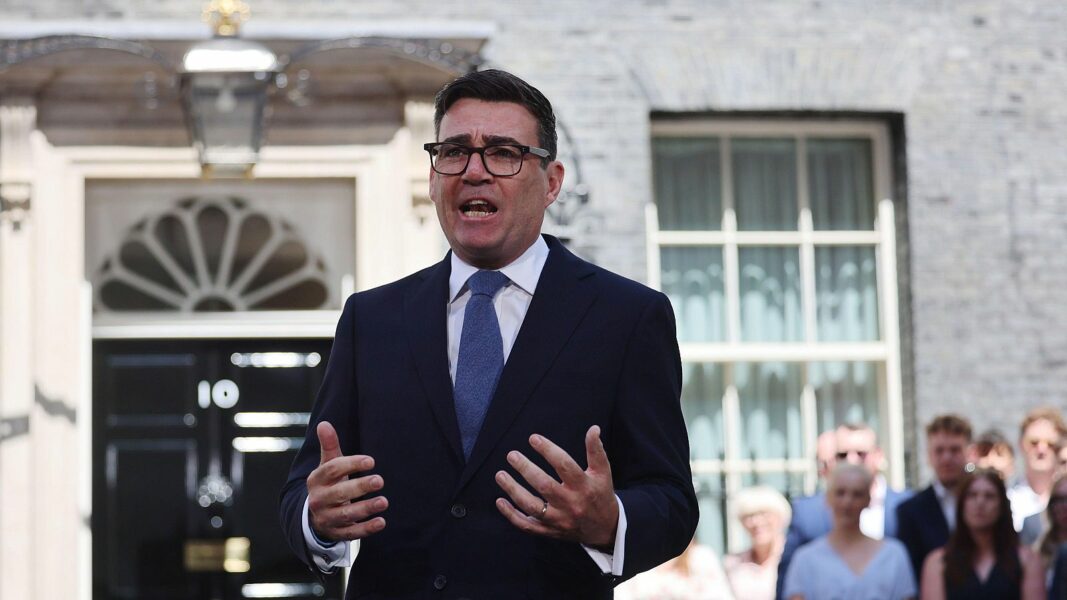
The British Prime Minister, Andy Burnham, has transferred to the Lord Chancellor the constitutional responsibility of advising the monarch on certain ecclesiastical appointments and has announced that his Government will introduce legal reform to remove the restrictions that prevent him from doing so because he professes the Catholic faith.
The decision was announced by Burnham himself in a written statement presented to the British Parliament on 10 September. The restrictions originate from two nineteenth-century texts: the Roman Catholic Relief Act of 1829 and the Jews Relief Act of 1858.
Both laws lifted at the time a large part of the civil disabilities that weighed on Catholics and Jews in the United Kingdom, but retained one exception: neither may directly or indirectly advise the sovereign on certain ecclesiastical appointments of the Church of England and the Church of Scotland.
The prohibition appears, for Catholics, in section 18 of the 1829 Act. The law also establishes that anyone who violates it commits an offence and is disqualified from holding civil or military offices under the Crown. The Jews Relief Act of 1858 contains an equivalent restriction for those who profess the Jewish religion.
Burnham, who continues to profess himself Catholic although for years he has been removed from regular religious practice, cannot personally exercise this function. For this reason he has transferred it to the Lord Chancellor, while his Government processes the reform.
“It is unacceptable that there should be a legislative barrier against people of any faith performing all the functions of my office,” Burnham stated in his declaration. The Prime Minister added that the Government will introduce a bill “at the first possible opportunity to correct this outdated and archaic anomaly.”
For now, the Executive has not set a specific timetable nor detailed the content of the bill.
A restriction that has survived almost two centuries
Burnham’s situation is exceptional because he is the first British head of Government to reach Downing Street professing the Catholic faith.
Other non-Anglican prime ministers did not face the same restriction. Rishi Sunak, a Hindu, was able to hold the office without this prohibition being activated, since the nineteenth-century laws specifically mention Catholics and Jews.
There is also the precedent of Benjamin Disraeli, the only British prime minister of Jewish origin, but he had been baptised into the Church of England as a child and therefore did not profess Judaism when he held the office.
The announced reform has limited practical scope and a significance disproportionate to that scope. In major episcopal appointments, political intervention today is much less than in the past and the Prime Minister’s role takes place after the ecclesiastical selection procedure. Nevertheless, the legislation still constitutionally reserves certain advisory functions to the Crown for him.
Removing the prohibition would thus eliminate one of the normative remnants of the legislation that for centuries specifically distinguished Catholics on account of their religion, a restriction that has survived almost two hundred years beyond the very emancipation law that contains it.
A Catholic identity that does not extend to moral issues
The move also has a less flattering reading for the individual concerned. Burnham reached Downing Street in July claiming his Catholic roots while simultaneously holding positions favourable to abortion and the LGBT agenda, a combination that InfoVaticana documented during the Labour leadership race and that the Bishops’ Conference of England and Wales did not address in its subsequent message of congratulations.
Correcting a legal discrimination that affects him personally is the kind of gesture that allows Burnham to reaffirm his Catholic identity at no political cost and without touching any of the issues on which that identity clashes with the programme he has defended throughout his political career.
Burnham was educated as a Catholic and served as an altar boy, but has for years been removed from regular religious practice. At the same time, he has publicly claimed the influence of his Catholic roots and the Church’s social doctrine on his formation. In the political sphere, however, he has defended positions contrary to Catholic teaching on issues such as abortion, marriage and sexual morality.
Read also: The bishops of England and Wales congratulate Andy Burnham after his election as Prime Minister
The peculiarity of an established Church
It remains to be seen what the Government will do with the underlying asymmetry. The announced reform will remove the specific incapacity of Catholics and Jews to advise the Crown on certain ecclesiastical appointments, but it does not touch the very existence of an established Church whose appointments maintain a formal participation of the Crown and political power.
Nor does it alter other constitutional provisions linked to religion. The British sovereign, for example, must remain in communion with the Church of England, so a Catholic cannot accede to the throne.
Burnham’s reform therefore eliminates a discrimination that affects him personally, but leaves intact the constitutional framework in which it is embedded. Until the bill reaches Parliament, it will be the Lord Chancellor and not the Catholic Prime Minister who exercises the function that a law passed in 1829 still prevents him from performing.