


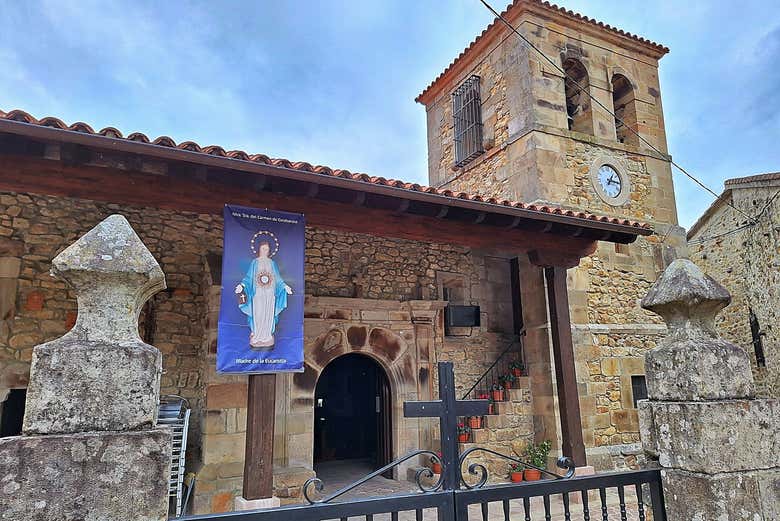
Carlos Balén has published a very suggestive article on Garabandal in InfoVaticana, pointing out as one of the most characteristic features of those events the “physicalism”: the extraordinary concentration of attention on bodily, measurable, visible, surprising phenomena. Christianity does not distrust matter; quite the contrary: the Christian faith is scandalously bodily, the Word became flesh, Christ rose with his body, we await the resurrection of the flesh, water baptizes, oil anoints, hands ordain, bread and wine are sacramentally changed into the Body and Blood of the Lord. A Christianity that wished to rid itself of the physical would cease to be Christian. That is why the problem with Garabandal does not consist simply in the fact that physical phenomena are recounted there, but in the fact that the physical ceases to be a sign subordinate to the mystery and becomes the criterion for authenticating the supernatural, when the extraordinary is identified with the divine, when the inexplicable begins to function as synonymous with the miraculous. There physicalism ceases to be a mere fondness for the prodigious and becomes a metaphysical error. And this is one of the weakest points of the entire Garabandalist construct.
The inexplicable is not in itself supernatural
It is a distinction that the old theology knew perfectly well and that today seems to have been forgotten: supernatural does not mean inexplicable. A thing may surpass our present powers of explanation and still belong entirely to the created order; our ignorance of the cause of a fact does not transform that cause into God. St. Thomas defines a miracle, in the proper sense, not as that which man does not know, but as that which happens outside the causal order of all created nature. God can act outside the order of secondary causes precisely because He is not one more cause within the universe, but the First Cause of all that exists. The Dicastery for the Doctrine of the Faith itself recalled this Thomistic doctrine in 2025: God can produce effects without the ordinary secondary causes or effects that absolutely exceed their capacity. The distinction is crucial. There are phenomena that may be extraordinary with respect to man and yet not exceed the power of all created nature. This is what theological tradition has called, in various senses, preternatural. St. Thomas expressly affirms that created spirits can produce phenomena that seem miraculous to us, although they are not miracles simpliciter. Demons can perform things that appear as miracles “with respect to us,” because we do not know all the possibilities of created nature; but they cannot act outside the total order of creation. This precision radically changes the discussion about Garabandal. Let us suppose, for a moment, and only for the sake of argument, that all the extraordinary phenomena narrated by its defenders were rigorously true; let us suppose that we could not naturally explain some of them: we would still not have demonstrated absolutely anything about the presence of the Virgin. That is the illegitimate leap. From “I do not know how it happened” it does not follow “the Virgin Mary did it.” Between the two statements there is a metaphysical abyss.
A prodigious accumulation of physics
What is surprising about Garabandal is precisely the density and repetition of phenomena of this kind. The favorable sources themselves speak of ecstatic marches begun in August 1961, during which the girls advanced or retreated with their eyes raised, traversed difficult terrain and even ran at great speed; other apologetic pages describe insensitivity to pinpricks, burns or bright lights, bodily rigidity, apparently extraordinary alterations of weight, falls without injury, levitations or positions interpreted as antigravitational. Then come the objects. Rosaries, medals, crucifixes and rings were handed over so that the supposed apparition might kiss them; afterwards the girls, still in ecstasy and looking upward, returned them, according to the testimonies, to their owners. The same sources assure that the apparition distinguished objects already kissed from those that had not been and that it accepted only certain rings, particularly wedding rings. There are also accounts of lost objects whose location would have been indicated by the vision. Father Ramón Andreu recounts, for example, the recovery of the missing cross of a rosary after the supposed Virgin was asked about its whereabouts. And still more is found: the Virgin would sometimes appear with the Child Jesus and hand Him to the girls, who claimed to feel His weight, though in a singular way; they offered Him pebbles to make Him laugh and spoke with Him with the spontaneity proper to their age.
I do not now enter into determining which of these facts are sufficiently documented, which were magnified by later transmission, which may have a psychological or physiological explanation and which continue to seem truly strange. It is not necessary for our argument. What matters is the pattern, because it is the very Garabandalist universe that presents this endless physical phenomenology as an argument of credibility. There are bodies that weigh, bodies that do not weigh, bodies that do not feel; races, eyes, lights, falls; objects that appear, objects that disappear, objects recognized, objects kissed; a Child whose weight is felt; a Host that becomes visible; a future sign that can be seen and photographed. It is an extraordinary invasion of the religious by the verifiable. And here begins the properly theological question: is this the habitual language with which God leads the soul to faith?
The exterior is precisely the least secure
St. John of the Cross would have looked upon all this with formidable reserve, not because he denied visions, or the devil, or miracles, but precisely because he firmly believed in all three. In the second book of the Ascent of Mount Carmel, when treating of supernatural apprehensions received through the senses, he formulates a rule of discernment that becomes almost unsettling when applied to our case: the more exterior and bodily a manifestation is, the less proportioned it is to spiritual union with God and the more easily it can be an occasion of deception. He even writes that bodily things, precisely because they are more exterior, “profit the interior and the spirit less,” and warns of the danger that the soul may judge a thing to be greater simply “because it is more sensible.” This is exactly the temptation of physicalism: to think that some girls are more convincing because they suddenly weigh too much, that an apparition is more indubitably Marian because someone walks backward without falling, that heaven is better accredited because it knows where a lost cross is, that the identification of a wedding ring provides greater certainty than the humble darkness of faith. The Mystical Doctor completely inverts that scale: the sensible is not more secure because it is sensible; it may be precisely the opposite.
The Saint further affirms that both God and the devil can represent extraordinary images in the imagination, and therefore teaches that the Christian ought not to dwell on them even when they seem good. And when it comes to exterior apprehensions he is even more severe: “the devil greatly delights when a soul wishes to admit revelations,” because he thus finds occasion to introduce errors and harm the faith. It is not necessary to declare Garabandal demonic in order to grasp the enormous relevance of this warning.
The prodigy is not the miracle
Here is another essential distinction: prodigy and miracle are not synonyms. The Christian miracle is a signum; it does not merely astonish: it signifies. That is why, in the Gospel, Christ does not perform phenomena to display physical power. He heals the paralytic and that raised body manifests a reality infinitely deeper: “that you may know that the Son of man has power to forgive sins”; He restores sight and leads toward the light of faith; He multiplies the loaves and prepares the mind for the Bread of life; He raises Lazarus and reveals: “I am the resurrection and the life.” Physics is subordinated to theology. The prodigy is absorbed by the mystery.
In Garabandal the opposite movement occurs too often: the phenomenon ends up being interesting for its very phenomenality. How much did the girl weigh? How many men could lift her? At what speed did she run? How could she know who the owner of the medal was? How did she find a lost object? Did the pupil react? Did the feet touch the ground? The human fascination is understandable. What is hard to understand is its theological necessity, because a Blessed Virgin who, during thousands of encounters, needs to multiply those small physical certifications seems to enter a dynamic foreign to the sober manner in which God usually accredits His works. There is no lack of miracles in Lourdes or prodigies in Fatima, but the miracle does not constitute there an endless demonstrative mechanism and, above all, does not turn the Mother of God into the habitual protagonist of experiments on gravity, analgesia, object location or owner recognition.
When the sacramental dangerously approaches the talisman
A theologically peculiar aspect is that of the kissed objects. The Church is very fond of holy things: we kiss relics, venerate images, wear scapulars and medals, bless rosaries, sprinkle with holy water. There is nothing magical in this precisely because everything refers to a reality that transcends the object. The Catechism teaches that sacramentals are signs instituted by the Church that dispose one to receive grace and sanctify the circumstances of life by ecclesial intercession. A blessed medal does not contain an energy. A crucifix is not an amulet. Holy water is not a substance endowed with occult properties. Their efficacy belongs to the order of the Church’s prayer and of believing disposition.
In Garabandal, however, something theologically distinct appears. According to the Garabandalist sources themselves, the apparition would have affirmed that God would work prodigies through those objects kissed by her; it was even transmitted that those who carried them with faith would suffer their purgatory on earth. The problem is serious, because a private experience, not recognized by the Church, is being attributed the capacity to constitute in fact a new category of religiously privileged objects: objects that are not distinguished by a liturgical blessing, by an authentic relic or by the sacramental discipline of the Church, but by having entered physically into contact—an invisible contact for others—with a figure contemplated exclusively during a trance. The resemblance to talismanic logic is almost comical, because the accumulation of religious powers around the material object easily displaces faith from what the sign signifies to the materiality of the sign itself. And that is precisely religious physicalism. If the sacramental says per visibilia ad invisibilia, the talisman affirms: in this thing there is a power. The theological difference is immense.
Neither parapsychology nor the devil is God
The hardly explicable defenders of phenomena denied by the visionaries themselves argue as follows: no one has succeeded in explaining them; therefore they are necessarily supernatural. But the second proposition remains to be demonstrated: even if authentic parapsychological phenomena existed—a question whose scientific status continues to be debated—they would still belong, as capacities of a human creature, to the created order. A real telepathy, a real extrasensory perception or any unknown psychophysical faculty would be extraordinary, but not divine. Much more important is the classical category of the preternatural. Catholic theology has never taught that every phenomenon exceeding ordinary human capacities proceeds from God; on the contrary: precisely because it affirms the existence of created spiritual intelligences, it admits the possibility of actions that surpass our powers without surpassing created nature.
That is why Christ warns about false prophets capable of offering “great signs and wonders” (Mt 24:24), and St. Paul speaks of “lying signs and wonders” (2 Thess 2:9). The devil does not create, does not truly raise the dead, cannot produce a miracle in the metaphysically strict sense; but Catholic theology recognizes his capacity to act upon sensible realities, imagination, local movements and natural forces in a way that can extraordinarily exceed our experience. Again: extraordinary does not equal divine. And this obliges us to formulate with enormous caution a hypothesis that must never become an accusation: if some phenomena of Garabandal were not explicable by ordinary natural mechanisms, that would not prove their heavenly origin. The possibility of a preternatural causality would remain metaphysically open. We do not affirm that it existed; we affirm that the reasoning “it cannot be explained, therefore it was the Virgin” is theologically invalid.
A game can turn into something else
There is also an initial circumstance that must be treated without cruelty toward eleven- and twelve-year-old girls, but also without sweetening it. Conchita’s own diary, reproduced today by pages favorable to Garabandal, recounts that on June 18, 1961 the girls had gone to steal some apples clandestinely, that they later began to throw stones toward the place where they said the devil was, and that they were finally playing with stones as marbles when the first visionary experience began. None of this proves any falsehood. God can choose whom He wills and meet a creature at the moment He wills. But it would also not be serious to ignore the capacity that a childish dynamic, a shared suggestion, a growing expectation and the progressive attention of an entire people have to acquire a life of their own.
The Norms of the Dicastery for the Doctrine of the Faith of 2024 precisely require considering, together with other elements, possible errors about the facts, subjective components unconsciously added, psychic alterations or collective phenomena. The same document recalls that something attributed to divine initiative may proceed from fantasy, the desire for novelty or other human causes. Could a preternatural action later be inserted upon an originally human dynamic? If Catholic theology does not allow it to be excluded a priori, neither does it allow it to be affirmed without proofs. But there is an elementary principle: fascination with the extraordinary constitutes a far less secure terrain than obedience, humility, the sacraments and naked faith. St. John of the Cross knew this very well: diabolical deception does not necessarily need to begin with a possession or a grotesque manifestation; it can begin precisely by taking advantage of a lie, an illusion, a curiosity or a credulity and nourishing them with truths, religious emotions and prodigies sufficiently ambiguous to preserve the fascination. That is why the affirmation is so dangerous: “Since there are good fruits, it cannot be from the devil.” The spiritual tradition has never reasoned with such naivety.
The orthodoxy of the messages does not solve the problem either
The only two brief messages of Garabandal contain Catholic exhortations: penance, prayer, Eucharist, sacrifice, conversion. Bishop Eugenio Beitia acknowledged in 1965 that he found no matter for doctrinal censure in those recommendations, although he maintained the negative judgment regarding the supernatural character of the phenomena. But this also does not prove a divine origin: a message can say true things without proceeding from a heavenly apparition. In fact, St. John of the Cross precisely warned that deception can begin with truths and plausible elements in order to gain credit before introducing other elements. Orthodoxy is a necessary condition for recognizing a private revelation, but it is not a sufficient requirement. “One must pray, do penance and love the Eucharist” is true independently of Garabandal. It was true before 1961 and it will continue to be true independently of the alleged apparitions. Perhaps this is the way to save all the good that may have been produced around Garabandal: to keep what belongs to the Gospel and detach it from everything that needs Garabandal to sustain itself.
The Church does not need to know how much a girl weighed
Since 1961 the successive Ordinaries of Santander have maintained the same reserve regarding the supernatural character of the events; there were even pronouncements that affirmed a natural explanation of the phenomena. The Dicastery for the Doctrine of the Faith recalled in 2024 that Garabandal remains under the ancient non constat, indicating that a similar situation could today correspond to categories such as curatur. And that category in the current Norms applies when there are “several or significant problematic elements” but, given the diffusion of the phenomenon and the existence of certain spiritual fruits, a disturbing prohibition is not advisable; in such a situation the bishop is asked not to encourage the phenomenon, to seek other devotional expressions and, if appropriate, to reorient it pastorally.
It is the wisdom of prudence: the Church does not need to demonstrate how a girl ran backward, nor whether an apparent alteration of weight had a neurological, muscular, psychological, fraudulent, parapsychological or preternatural explanation, because theological discernment does not consist in exhausting all possible causes of a phenomenon before refusing to attribute it to the Mother of God. The burden of proof works the other way around: it does not fall to the Church to prove that Mary did not move that body; it falls to those who attribute an extraordinary intervention to the Mother of the Lord to offer sufficient reasons for such an attribution. And to this day the Church has not found them.
Faith does not weigh
Everything could be summarized in this paradox: Christianity believes in miracles, but does not believe in the miracle as a substitute for faith. The Catechism calls miracles “motives of credibility,” rational signs that accompany Revelation; but the act of faith does not occur because a physical evidence has cornered the intellect, but because the will, moved by grace, freely assents to God who reveals. That is why a spirituality that lives waiting for a definitive physical proof is not very well formed: the universal Warning, the visible Miracle, the date, the hour, the permanent sign, that which will finally force the world to recognize that everything was true.
God can do what He wills, but we cannot recognize as divine everything that dazzles us. The great Catholic mystical tradition moves precisely in the opposite direction: the more the soul advances, the less it needs to cling to voices, figures, sensations and prodigies. St. John of the Cross asks us to turn our eyes away from what can be seen and distinctly understood in order to fix them on what does not fall under the senses: the dark and secure nakedness of faith. Such is the most well-founded objection that can be raised against the physicalism of Garabandal: not that there has been too much matter there, but that matter has been asked to prove what only God can reveal; not that some girls ran too fast, weighed too much, found impossible objects or returned medals without mistake, but that sixty-five years later people continue to speak of those things as if in them were hidden the identity of the Woman who appeared, night after night, without letting anyone sleep, entering every house in the mountain village.
Read also