


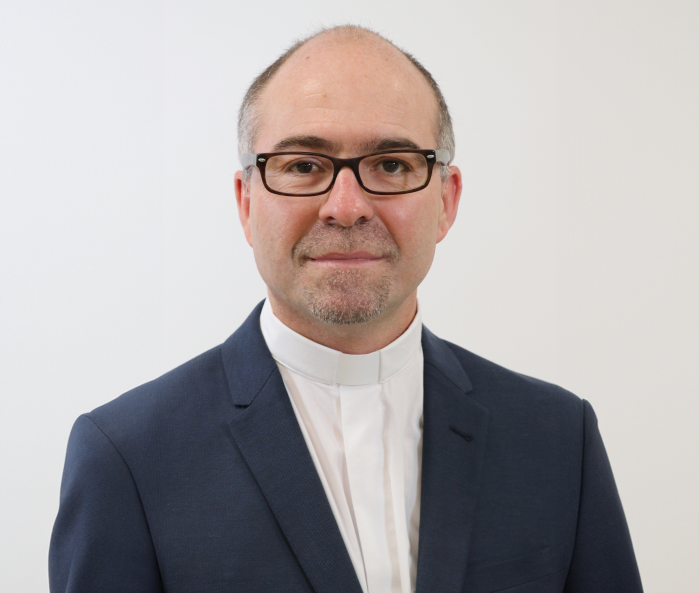
Fernando García Sánchez, Salesian, has held the position of Secretary General of CONFER since September 1. One week later, he already has a diagnosis of Ceuta. He wrote it on his social media, which is where pastoral letters are now drafted, and Vida Nueva elevated it to news this Monday: the crisis has left three fractures—human dignity, coexistence, and trust in the rule of law—which, according to the magazine, now need to be repaired. It is not a document from the General Council nor a note from the Conference. It is a reflection. It is worth reading it in full before laughing, because it has a method.
He says, first of all, that the Department of Justice and Mission of CONFER has maintained this week “conversations with Cáritas” to “join efforts and facilitate help,” and that the organization has placed itself “at the listening” of the congregations that are in Ceuta: Augustinians, Daughters of Charity, Cruz Blanca, Scalabrinians, Adorers, Vedruna Sisters. He says that “what has primarily collapsed is human dignity,” that “concrete and real dignity” that Leo XIV placed at the center in Arguineguín (Vida Nueva writes “Aguineguín”: rigor has also cracked), and that caring for it is for the Christian “a path of holiness and the protocol by which we will be judged,” Matthew 25. He says that “without a doubt, coexistence has cracked,” that “fragile balance of rights and duties” that Ceuta maintained due to its history, its geography, and its religious plurality, a “silent and unknown example” for the majority of Spaniards, and that “trust in the functioning of the rule of law” has weakened, the guarantor “of order, security, well-being, and freedom of citizens.”
And he says that the blame for all this being twisted lies with polarization. He includes the question that the Bishop of Málaga, José Antonio Satué, launched on X on September 3, whether it is so difficult to feel empathy with the people of Ceuta, “and especially with women and children,” and at the same time with “the people who entered the city manipulated,” and he ends it with the prelate’s sigh: “My God, when are we going to overcome this epidemic of polarization!” He denounces a polarization that “simplifies the complex,” calls for an “evangelical language” without “words that humiliate or confront,” recommends not blessing “naive enthusiasms” nor feeding “sterile fears,” demands “criteria of discernment” translated “into practices,” and closes by placing humanity before a choice: “to build a new Tower of Babel or to build the city where God and humanity dwell together.” So far the text. Now what happened.
Between July 30 and 31, according to the Ministry of the Interior’s estimate, around 72,000 people entered Ceuta, most of them swimming, skirting the breakwaters of Tarajal and Benzú. There were deaths in the water: eleven according to Rabat, seventy-two according to the figures handled by Spanish authorities in early August, close to two hundred according to Vida Nueva itself. The vast majority of those who entered were returned to Morocco within days. On August 31, Pedro Sánchez praised Rabat’s “instant cooperation.” On September 1, El Español published the report that the Police sent to the National Court: Moroccan gendarmes guiding people toward the crossing points, plainclothes agents supervising, migration as cover for an operation to collapse Spanish border control. The Director General of the Police said that report does not exist. Interior, a month later, still does not record the entries from those two nights in its official statistics. That is the collapse.
The first thing that stands out in the text is the grammar. Dignity “has collapsed,” coexistence “has cracked,” trust has weakened. Three reflexive passives and no subject. It is the syntax of the seismic report: things fall, crack, give way, and no one has pushed. We already wrote here about the tacit subject of Leo XIV, who at least existed and remained silent. That of CONFER is not even tacit: in the entire reflection, as reproduced by Vida Nueva, the words Morocco, border, or return do not appear. The Police wrote who led the people to the breakwater; its Director General says that document does not exist; the Secretary General of Spanish religious, a week after taking office, already opines like the Director General. And the participle he borrows from Satué contradicts him: if they entered “manipulated,” someone manipulated them. The participle asks for an agent. They deny it to him.
The second is theological and is the serious part. “What has primarily collapsed is human dignity.” To support it, he invokes Arguineguín, where Leo XIV said on June 11 exactly the opposite: that to that pier arrive lives “stripped of almost everything, but never, never, of their dignity.” That repeated never is the entire doctrine. Infinite Dignity, which the Dicastery for the Doctrine of the Faith published in April 2024, distinguishes ontological dignity, which is not lost, does not collapse, does not crack, from its moral and social declensions. Precisely because dignity does not collapse can the Church demand something for the one who swims across. If it came down with coexistence and trust, the Catholic argument in favor of the migrant would fall with it. The Secretary General has repealed in one sentence what took Rome sixty-six paragraphs, and he cites the Pope to do it. Calling Matthew 25 “protocol” I leave to the liturgists: a protocol is what activates an emergency committee. At the Last Judgment, the vocabulary of Civil Protection had not yet arrived.
The third is arithmetic. Ceuta’s coexistence, that “fragile balance” that the Salesian now discovers and that “the majority of Spaniards” did not know (CONFER also, judging by the date on which it has placed itself “at the listening” of congregations that have been there for decades), did not crack due to polarization. It cracked because a city of 83,000 inhabitants received 72,000 people in one night. On a border, a fragile balance of rights and duties is sustained on the border: the breakwater is the condition of Ceuta’s religious plurality, not its enemy, and saying so is not polarizing, it is describing the balance he praises. Among Ceutans, by the way, coexistence remains standing: days ago four young people from the Christian, Muslim, Hindu, and Jewish communities read a manifesto together at the end of a massive demonstration. What cracked was the perimeter. And trust in the rule of law is restored with the rule of law, which in this case has the city’s name written on it: the Immigration Law contains a special provision for Ceuta and Melilla, that of border rejection, and provides for the return of those who enter irregularly. None of that appears in the reflection. The State does not receive in it a single request. The only interlocutor with whom CONFER has “maintained conversations” is Cáritas.
There is another thing: empathy. Is it so difficult to feel it with some and with others? No. And no one has said it was. The Archbishop of Oviedo, who says invasion and hybrid war, calls the young people who crossed “equally victims.” The dilemma between two sensibilities that Satué deplores and García Sánchez makes his own has not been raised by anyone of those mentioned: it must be invented in order to place oneself in the middle. What is indeed difficult, in view of the texts, is naming who made victims of the victims. Moreover, empathy is not a public policy, it is a state of mind. The people of Ceuta are not asking to be understood. They are asking that the law be applied. Replacing the second with the first is the entire operation of the document, and the “epidemic of polarization” is its alibi: an epidemic with the rare property of infecting in only one direction. In that nosology Argüello is sickened by a tweet and Sanz Montes by a letter, and those who have been talking for a month, like Cadiñanos, of “dark interests” remain healthy. The prescribed remedy is to avoid “words that humiliate or confront.” Which ones, it does not say. It is a list of forbidden words without the words, the text’s second silence. Vida Nueva, with its involuntary humor, places on the same page, as related news, the Archbishop of Oviedo speaking of “hybrid war.” The epidemic served alongside the vaccine.
And what was the complex that polarization “simplifies”? Two nights. The complex is the Interior statistics. The simplification consists of saying in one sentence what the Police wrote in a report. That is why the text asks for “criteria of discernment” and gives none, demands translating them “into practices” and the only practice it records is having spoken with Cáritas and being listening. It is a document without verbs: dignity, coexistence, trust, communion, discernment, horizon. Six nouns and a collapse. The criterion exists and is printed, number 2241 of the Catechism, second half, the one that authorizes civil authority to legally condition immigration according to the common good and obliges the immigrant to obey the laws of the country that welcomes him. It is not cited. Matthew 25 is cited, which is Gospel and not immigration law, and therefore says nothing about the breakwater.
Remains Babel, and it is the best. Humanity must choose, he says, between “building a new Tower of Babel or building the city where God and humanity dwell together.” It is worth rereading Genesis before using it. In Babel the sin was a single city, a single language, and a single project not to disperse across the earth, and God’s response was to confuse the languages and disperse the peoples. In chapter 11 of Genesis, the one who sets borders is God. Using Babel against those who defend that of Ceuta is reading the account backwards. And the city where God dwells with men is the Jerusalem of the Apocalypse, which descends from heaven at the end of time and is not the responsibility of the Government Delegation. Meanwhile, the city that exists is Ceuta, it has 83,000 inhabitants and a breakwater.
Everything collapses by itself and no one has pushed. It is the same accounting as that of the Ministry of the Interior, which a month later still does not record in its statistics those who entered on July 30. With that table, dignity has not collapsed. It is not recorded.
Read also