


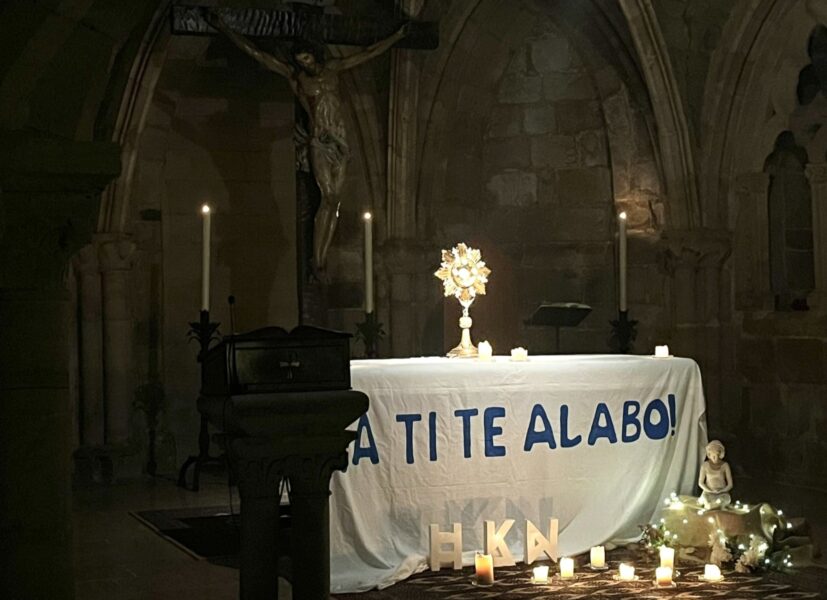
In the crypt of Santander Cathedral, beneath a wooden Christ whose feet are barely visible, someone placed three cardboard letters against the front of the altar last night. HKN. Above them, the monstrance. In front, a white cloth with a slogan painted by hand in the corporate blue. And around it, fifty candles arranged not according to the criteria of the Caeremoniale but according to color temperature: 2700 kelvin, warm, the one that photographs best.
The issue is not taste. Taste is debatable and the writer has little of it. The issue is legal, and then something worse.
Canon 1210 states that in a sacred place only what fosters the exercise or promotion of worship, piety, and religion is permitted, and it prohibits anything not in keeping with the holiness of the place. It does not say “whatever is ugly.” It says whatever is foreign. The General Instruction of the Roman Missal, regulating the altar, establishes that only what is required for the celebration be placed on the table, and it orders moderation in ornamentation, because decoration must lead to what is being celebrated and not distract from it. The Ritual for Eucharistic Worship outside Mass prescribes, for exposition in the monstrance, four or six candles and incense, as in the Mass. In the circulated image, three are counted. Three candles and about fifty tea lights. The rubric lost by a landslide to stage lighting.
And there is canon 838, paragraph four, which attributes to the diocesan bishop the authority to issue binding liturgical norms in the Church entrusted to him. And canon 22 of Sacrosanctum Concilium, which in a phrase often cited in Spain for Latin and never for this, establishes that no one, not even a priest, may add, remove, or change anything on his own initiative in the liturgy. The liturgy does not belong to whoever organizes it. That is exactly the point.
They will say, and it is not a bad argument, that religious orders have been embroidering their coats of arms on frontals for centuries, that Benedictines have their cross and Dominicans their dog with the torch, and that here nothing has been placed on the table but on the floor. The coat of arms of an order identifies who perpetually guards that place, is woven into the fabric, is inherited, and its function is to say who has prayed here every day since 1483. The initials mounted for an event identify the promoter of an event to an audience that is not in the crypt. The first mark says who serves. The second says whose this is. It is not the same preposition and it is not the same sin.
Because here we come to what truly matters, which is no longer rubrical.
Eucharistic adoration is the only act of Catholic worship defined entirely by the disappearance of the subject. Trent, thirteenth session, sixth canon: the Blessed Sacrament is to be given the worship of latria, that which is rendered to God and to no one else. In the Mass there is a minister, there is an assembly, there are readings, there is a liturgy of the word where someone speaks. In the exposition there is none of that. There is a luminous object and a room full of silent people who are getting out of the way. Theologically, it is the moment when one exists the least. To affix to it the anagram of the organizing association is not a lack of decorum. It is a performative contradiction. It labels as property the only act whose grammar consists in owning nothing.
And this is no longer done out of pride, which would be older and more redeemable. It is done because the Holy Hour has ceased to be an act and has become a format. A format has visual identity, has a typeface, has a campaign slogan that this year is “I praise you” and next year will be another, has a color palette, and above all has a relationship of dependence on the camera that is waiting for it. The scene in Santander is not composed for those who were in the crypt. Those who were in the crypt do not need to know where they are. It is composed for whoever sees it vertically, at two in the morning, between a reel from a gym and another from a lunatic explaining cryptocurrencies, and needs to recognize the brand in half a second before the thumb keeps scrolling. Those three letters are, technically, a watermark. They fulfill the exact function of the watermark: to prevent content from circulating without attribution.
There lies the problem with the word “charism.” Christifideles laici, when enumerating the criteria of ecclesiality for associations of the faithful, places first the vocation to holiness and, in a prominent place, the witness of a firm and convinced communion with the Pope and with the bishop. Iuvenescit Ecclesia insisted that the charismatic gift is recognized, among other signs, by its docility to authority and by not constituting itself as a parallel body. Communion is the opposite of product differentiation. A movement whose distinctive sign consists precisely in making the common sacrament distinguishable is not contributing a charism to the Church. It is segmenting the market.
None of this is the responsibility of the young people who placed the cardboard. The young people did what they have seen done and did it with a devotion that is probably better than that of the one signing. It is the responsibility of whoever had the key. Canon 1213 reserves to ecclesiastical authority the exercise of its powers in sacred places, and canon 1220 entrusts it with watching over their decorum. Someone with jurisdiction over the crypt of Santander Cathedral saw the setup and said nothing, or saw it beforehand and said yes, that it was very nice, that it was good that young people were coming. That is the story. Not the logo: the signature that authorized it.
And above all that, almost invisible in the penumbra because no one lit it, there still hung a Christ with his sign. Four letters. There was already a brand nailed in that sanctuary, and it had been there eight hundred years, and it was not theirs.
- Hakuna, or the Catholicism that lets itself be danced
- Hakuna arrives at its tour in Venezuela with its disastrous way of treating the Blessed Sacrament
- Expelled from Hakuna for being gay?
- The Pope congratulates priest José Pedro Manglano for his work with Hakuna
- ‘Hakuna’ is now an association of the faithful represented by Manglano: Osoro approves the statutes