


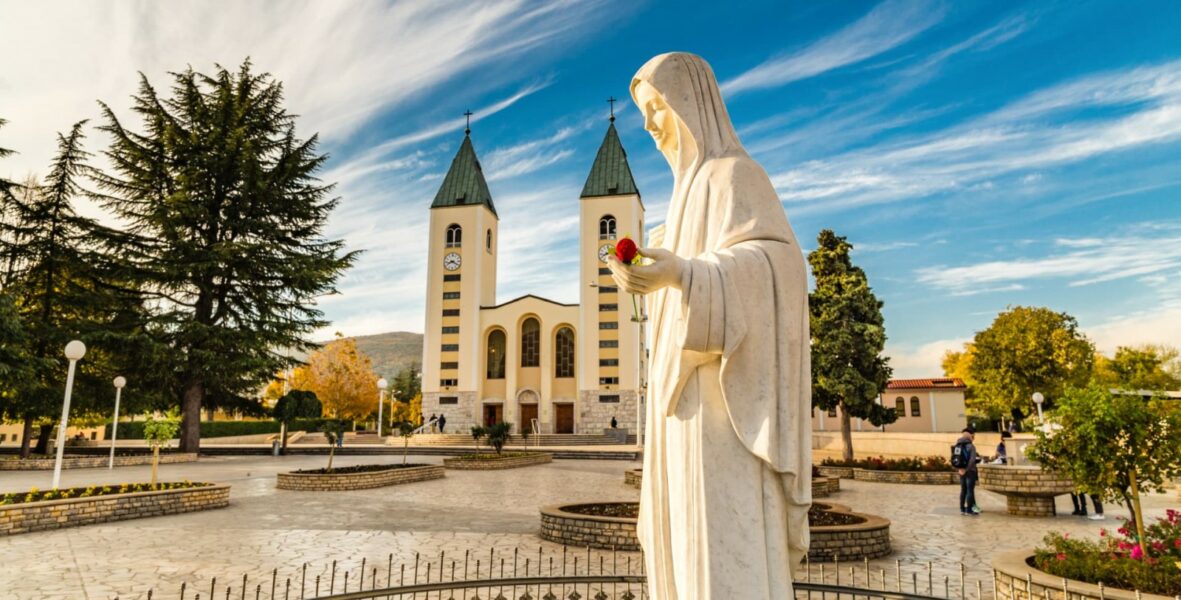
A 2016 consultation among 33 cardinals, bishops, and experts linked to the then Congregation for the Doctrine of the Faith reportedly yielded a broad majority opposed to the supernatural origin of Medjugorje. According to confidential documentation published by Italian journalist David Murgia, 21 of those consulted voted for the constat de non supernaturalitate, nine for the constat de supernaturalitate, and three considered there were insufficient elements to issue a definitive judgment.
The existence of the consultation and the context in which it took place are supported by subsequent statements from Francis and by official information from the Holy See. What has not been publicly confirmed by the Vatican is the exact breakdown of the 33 votes that Murgia now reveals for the first time.
21 votes against supernaturality, nine in favor, and three without a conclusion
Murgia claims that the 33 opinions reached the Holy See on September 17, 2016. Participants were reportedly asked to express in writing and with reasoning their position on the origin of the phenomena that began in Medjugorje in June 1981.
According to the published data, 21 opted for the formula constat de non supernaturalitate, considering that Medjugorje did not have a supernatural origin; nine voted for the constat de supernaturalitate, in favor of supernaturality; and three for the non constat de supernaturalitate, understanding that there were not enough elements to reach a definitive conclusion.
Among the 33 names disclosed by Murgia are some of the main ecclesiastical authorities of those years, such as Cardinals Gerhard Müller, Christoph Schönborn, Antonio Cañizares, Ricardo Blázquez, Angelo Scola, Donald Wuerl, Marc Ouellet, and Fernando Filoni, as well as Camillo Ruini himself and the then Secretary of the Doctrine of the Faith, Luis Ladaria.
Without specifying which option each one voted for, the numbers reveal that nearly two-thirds of those consulted would have leaned toward rejecting the supernatural nature of the phenomenon.
The consultation came after the Ruini report
The result now known corresponds to a different phase of the investigation carried out by the International Commission on Medjugorje chaired by Cardinal Camillo Ruini.
Benedict XVI officially established the commission in 2010 within the Congregation for the Doctrine of the Faith. The Holy See explained at the time that it would work confidentially and that the results of its investigation would later be submitted to the dicastery’s authorities.
The Ruini Commission reached much more favorable conclusions regarding the first alleged apparitions. In 2024, Cardinal Víctor Manuel Fernández made public the results of the vote during the presentation of the Vatican note on Medjugorje: 13 members voted in favor of the constat de supernaturalitate regarding the first seven alleged apparitions, one voted constat de non supernaturalitate, and another considered that the decision should be postponed.
The assessment changed when examining the subsequent alleged apparitions. In that case, two members voted for the constat de non supernaturalitate and twelve considered that a definitive judgment could not yet be issued.
Doctrine of the Faith maintained reservations about the Ruini conclusions
The dossier, however, did not end with the Ruini Commission. The existence of a later and more critical phase is confirmed by the Holy See itself.
During the presentation of the note on Medjugorje in September 2024, Fernández explained that the then Congregation for the Doctrine of the Faith subsequently prepared “a series of in-depth studies” on the entire phenomenon. Two experts were also consulted, whose conclusions, according to the prefect, were “very different” from those reached by the Ruini Commission.
Francis had already spoken publicly about those discrepancies in May 2017, during the return flight from Fatima. The Pontiff explained that, once the Ruini report was received, doubts arose within the Doctrine of the Faith and it was decided to distribute all available documentation among its members, including materials contrary to the commission’s conclusions.
Francis himself decided to intervene in the procedure and requested that the members’ opinions be sent directly to him. The existence of those votes was therefore known; what remained unknown was their specific result.
Francis personally took charge of the dossier
The reconstruction officially provided by the Doctrine of the Faith in 2024 adds another relevant element. Fernández explained that Francis, after receiving all the documentation, decided in December 2015 to personally assume the decisions regarding Medjugorje.
The result, which Murgia now attributes to the 2016 consultation as being predominantly against supernaturality, did not, in any case, become an official declaration of constat de non supernaturalitate by the Holy See.
Rome subsequently chose to separate the pastoral accompaniment of Medjugorje from the judgment on the authenticity of the alleged apparitions. In 2019, Francis authorized pilgrimages officially organized by dioceses and parishes, but the Holy See expressly clarified that the decision should not be interpreted as an authentication of the phenomena.
The 2024 “nihil obstat” did not declare the apparitions supernatural
The definitive change of approach came with the new norms for the discernment of alleged supernatural phenomena promulgated by the Doctrine of the Faith in May 2024.
In September of that same year, the dicastery published the note The Queen of Peace and granted the nihil obstat to the spiritual experience linked to Medjugorje. The document recognizes the numerous spiritual fruits associated with the place and allows the faithful to prudently adhere to this spiritual proposal.
But the Vatican simultaneously established an explicit distinction: the nihil obstat “does not imply a declaration of the supernatural character of the phenomenon.” Nor does the positive assessment of many of the messages mean that Rome directly attributes a supernatural origin to them. The document itself orders that they be referred to as “alleged messages.”
Murgia promises to reveal how each participant voted
Murgia has so far published the names of the 33 participants and the overall result of the consultation, but has not attributed each vote to its author. According to him, he intends to avoid, for the time being, controversies, instrumentalizations, and “witch hunts.”
The journalist assures, however, that he will eventually publish the individual votes “without omissions,” in fulfillment of a promise made to a recently deceased person close to him.
Until those documents appear or there is independent confirmation, the breakdown of 21 votes against, nine in favor, and three without conclusion must be attributed to the documentation released by Murgia. What is officially on record is that the Ruini Commission was followed by new studies and opinions within the Doctrine of the Faith, that there were significant discrepancies regarding the phenomenon, and that Rome has not recognized the alleged apparitions of Medjugorje as supernatural to date.