


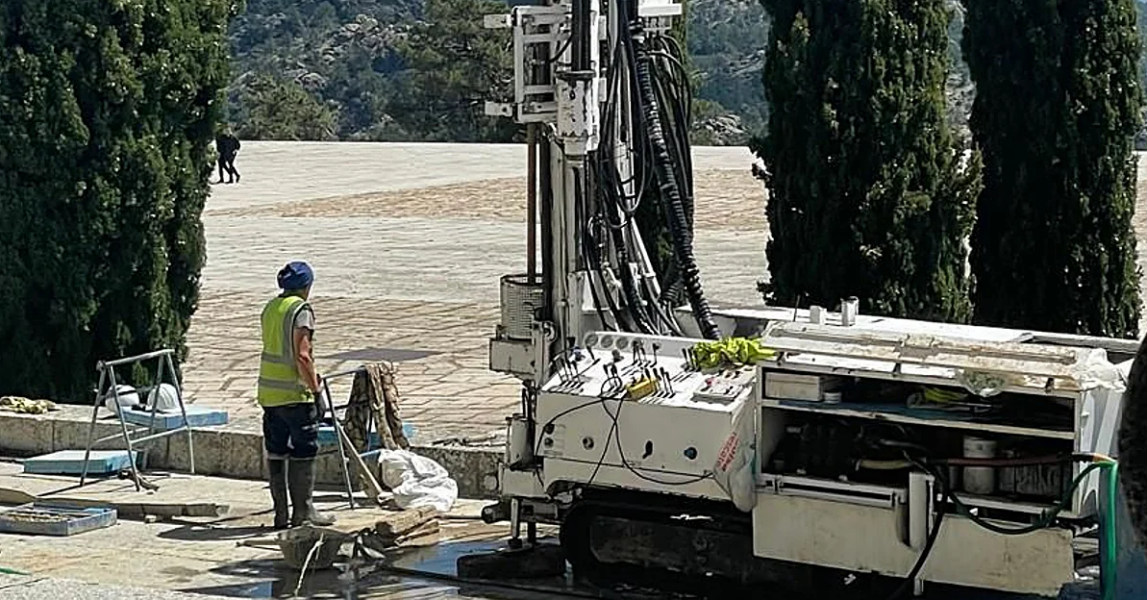
The Superior Court of Justice of Madrid (TSJM) has lifted the precautionary suspension that since mid-June had halted the surveys and test pits promoted by the Government at the Valley of the Fallen. The decision allows these technical works to resume, which began during Pope Leo XIV’s visit to Spain, considered the preliminary step before drafting the resignification project provided for in the Democratic Memory Law.
According to the ruling, published by elDiario.es, the Contentious-Administrative Chamber upholds the arguments presented by the State Attorney’s Office and sets aside the precautionary measure that had been ordered following the appeal filed by the Association for Reconciliation and Historical Truth (ARVH), which in June claimed that the works were being carried out without the necessary permits and could affect the integrity of the monumental complex.
The resolution does not yet address whether the actions promoted by the Administration comply with the law. That question will be settled in the final judgment ending the proceedings. What the court is deciding now is that the circumstances required to keep the works suspended while the appeal is processed do not exist.
The court distinguishes between the surveys and future works
The State Attorney’s Office argued that the authorized works do not constitute the resignification works themselves, but rather a preliminary phase aimed at obtaining information about the characteristics of the terrain. According to the ruling, it involves a limited number of surveys and small test pits, reversible and without impact on the architectural elements of the complex.
Based on these arguments, the TSJM concludes that, at this stage of the proceedings, “there is no indication that the Administration is acting without an enabling administrative title.” It also considers that maintaining the precautionary suspension “could cause harm to the general interest,” recalling that the Democratic Memory Law provides for the development of the resignification process of the site.
The precautionary measure changes after the State’s arguments
The new ruling modifies the situation created on June 16, when the TSJM itself ordered the precautionary halt of the works after admitting the appeal filed by the Association for Reconciliation and Historical Truth.
In the initial phase, the court considered it appropriate to temporarily suspend the actions while the Administration provided the necessary documentation to respond to the appellant’s claims, which maintained that the surveys were being carried out without municipal authorization and without the required sectorial permits.
Now, after examining the arguments of the State Attorney’s Office, the Chamber considers that the precautionary suspension is no longer appropriate, without this implying a definitive ruling on the legality of the project.
The debate on heritage protection
In the ruling that ordered the precautionary suspension, the court had referred to the fact that the complex enjoyed the highest level of heritage protection. However, the new ruling incorporates the documentation submitted by the State Attorney’s Office, according to which the monumental complex has not been declared a Site of Cultural Interest (BIC) by the Community of Madrid.
This point had been one of the arguments used by the appellant association to request the suspension of the works. The new ruling no longer bases the precautionary measure on that consideration, although it does not definitively resolve the question of the site’s heritage protection either.
The situation also keeps open the debate on a possible declaration of the Valley of the Fallen as a Site of Cultural Interest, a possibility that various associations have been demanding for years.
The judicial proceedings remain open
The ruling now made public only allows the surveys and test pits to resume while the processing of the contentious-administrative appeal continues.
It will be the judgment on the merits that determines whether the challenged administrative actions meet the requirements established by the legal system and whether the Government may continue developing the project planned for the Valley of the Fallen.
The decision, therefore, does not resolve the dispute, but only the appropriateness of maintaining or lifting the precautionary suspension ordered during the initial phase of the proceedings.