


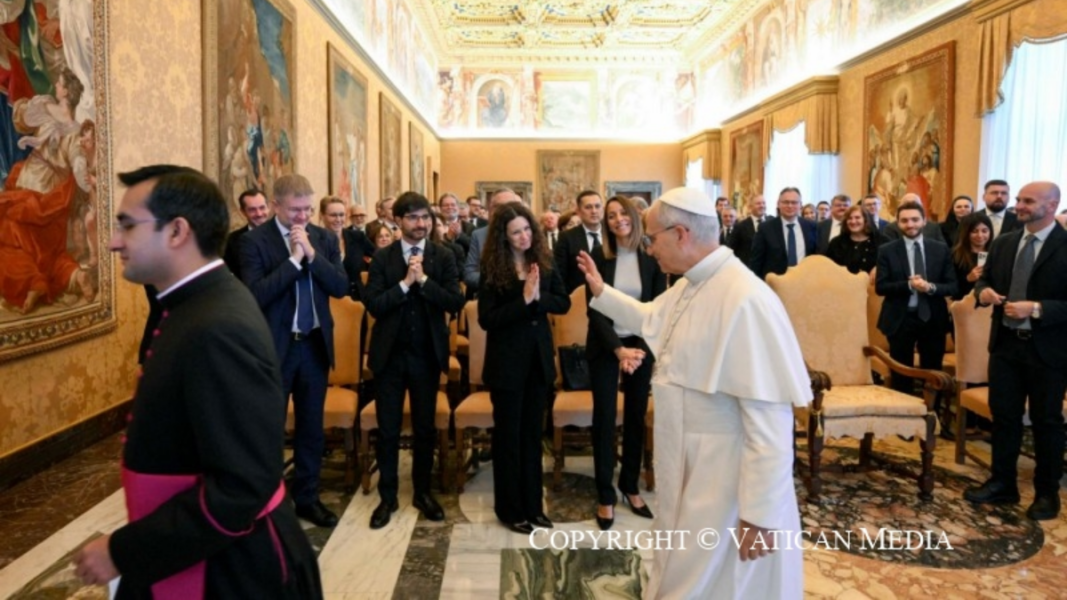
This morning, Leo XIV received a delegation from the Group of European Conservatives and Reformists (ECR) of the European Parliament in the Apostolic Palace of the Vatican. During the meeting, the Holy Father delivered a speech in which he addressed the role of elected representatives, the importance of respectful dialogue in public life, and the value of Judeo-Christian roots in European identity. He also emphasized the need to protect human dignity and to maintain a fruitful dialogue between reason and faith in building the common good.
Below we provide the full message of Leo XIV:
Good morning to all, and welcome to the Vatican.
I am pleased to have this opportunity to greet your Delegation on the occasion of your participation in the ECR Group Conference taking place these days here in Rome.
First of all, I would like to thank you for your work in service not only of those whom you represent in the European Parliament, but of all the people in your communities. Indeed, holding any high office in society entails the responsibility to promote the common good. For this reason, I especially encourage you never to lose sight of the forgotten, those on the margins, those whom Jesus Christ called “the least” among us (cf. Lk 9:48).
As democratically elected representatives, you reflect a range of viewpoints that form part of a broader spectrum of diverse opinions. Indeed, one of the essential purposes of a parliament is to allow such viewpoints to be expressed and debated. However, the sign of every civilized society is that differences are discussed with courtesy and respect, for the ability to disagree, to listen attentively, and even to engage in dialogue with those we may consider adversaries, bears witness to our reverence for the dignity of all men and women, granted by God. I invite you, then, to look to Saint Thomas More, patron of politicians, whose wisdom, courage, and defense of conscience are a timeless inspiration for those seeking to promote the well-being of society.
In this sense, I make my own the appeal of my recent predecessors: the European identity can only be understood and promoted with reference to its Judeo-Christian roots. Protecting the religious heritage of this continent does not simply consist in safeguarding the rights of Christian communities, nor is it primarily about preserving certain customs or social traditions, which in any case vary from place to place and throughout history. It is, above all, a recognition of a fact. Moreover, everyone benefits from the contribution that members of Christian communities have made and continue to make for the good of European society. It suffices to recall some of the great developments of Western civilization, especially the cultural treasures of its imposing cathedrals, its sublime art and music, and the scientific advances, not to mention the growth and expansion of universities. These developments create an intrinsic bond between Christianity and European history, a history that must be appreciated and celebrated.
I think, in particular, of the rich ethical principles and ways of thinking that constitute the intellectual heritage of Christian Europe. These are essential for safeguarding the rights granted by God and the inherent value of every human person, from conception to natural death. They are equally fundamental for responding to the challenges posed by poverty, social exclusion, economic deprivation, as well as the current climate crisis, violence, and war. Ensuring that the voice of the Church—especially through its social doctrine—continues to be heard does not consist in restoring a past era, but in guaranteeing that key resources for future cooperation and integration are not lost.
I would like to reiterate here the importance of what Pope Benedict XVI pointed out as the necessary dialogue between “the world of reason and the world of faith—the world of secular rationality and the world of religious belief.” Indeed, this public conversation, in which politicians play a very significant role, is vital for respecting the specific competence of each, as well as for providing what the other needs, namely, a mutually “purifying” function that ensures neither falls into distortions. My prayer is that you contribute your part by participating positively in this important dialogue, not only for the good of the peoples of Europe, but of the entire human family.
With these brief thoughts, I assure you of a remembrance in my prayers, and I invoke upon you and your families the blessing of God, with wisdom, joy, and peace. Thank you.