


We are living heart-stopping days amid a situation in the Vatican that can only be described as unstable; we are treading on shifting sands. Too many things depend on the figure of the Pope for the subject of a papal illness—especially one as serious as the one we are discussing—to be treated lightly. Without being overly scrupulous with the information, even translations can be treacherous enough to make us wary. We know the information may be dense; the situation demands it, and we are prepared to make the effort. Let us move on to another day, one more day with more than interesting news.
Yesterday we said that the Pope’s doctors had left three questions open in writing on 15 October: the molecular composition of the tumour, whether it had spread beyond the lobe, and whether treatment was needed. Last night, at nine o’clock, they answered them in four sentences. The disease was localised and no further therapy is required.
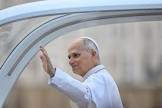
And in the morning he had crossed the square in the popemobile under the rain without saying a word about his illness. That is the day. The rest, which is considerable, follows: the Vatican Court of Cassation orders a retrial of the pre-seminary case, the archiving of Chaouqui turns out to be Italian, and the words of Parolin that have been interpreted for a week were not what we thought. Forty-four links today, which leave this Specola as a solid archive of the day with the important news of the Pope’s treatment. Good reading.
Four sentences at nine o’clock at night
The note is signed by two names, not an office: «Il dott. Luigi Carbone e il prof. Stefano Margaritora comunicano quanto segue». It states that yesterday the definitive reports of the histological examinations and molecular biology studies on the material removed during the operation were issued; that the results confirmed it was a pulmonary adenocarcinoma and that «la malattia era localizzata»; and that a subsequent oncological assessment has confirmed that «non è necessaria alcuna ulteriore terapia». That is all. Four sentences.
The medium also says something. It is not a bulletin: it is not in the Bollettino, which yesterday had four entries and none medical, but in the section of communications to journalists, without a reference number and without a printed time, and it was released around nine o’clock at night. It is the same nocturnal schedule as the medical bulletin of 13 October, which did carry a number.
What the four sentences do not say
Of the three questions the doctors themselves had left open, the note closes one, resolves another in non-technical language, and declares the third fulfilled without giving the result. It says the molecular biology studies have been issued; it does not say what they showed. There is no profile, no mutation, not a single molecular datum. And the words stage, margins or lymph nodes do not appear in the text. The last is the gap that matters, because “localised” is precisely the conclusion that, in a resected adenocarcinoma, depends on the lymph-node result: the note gives the conclusion and withholds the datum on which it depends.
There is also a new absence that did not exist on 15 October: no follow-up, no CT scan, no periodicity, no review. The note ends at “ulteriore terapia” and closes. For an oncology patient operated on nine days ago, no follow-up plan has been published. The standard of proof was set by a surgeon outside the case, Edoardo Mercadante of the Istituto Nazionale Tumori Regina Elena, when he told the newspapers that the lymph nodes and the molecular profile were the data on which everything else would depend. Those are the two that are missing.
The word “localised” is not the doctors’: it is the Pope’s
Before anyone wrote it in a headline, he said it. On 11 October, announcing the operation from the square, he spoke of a nodule found at an early and localised stage. Ten days later, the definitive histology uses the same adjective. The word has not changed; what has changed is that now it is a finding and then it was an expectation.
And for once we must say the opposite of what we have been saying all week: no outlet wrote “cured”, “cure”, “remission”, “stage I” or “prognosis” yesterday, and no one spoke of chemotherapy or radiotherapy ruled out. ANSA reproduced the three sentences without adding anything clinical. AgenSIR did not either. If we publish the yardstick every day, we must also publish that this time almost everyone measured with it.
Three small edits and one that is not
The original contains a spurious comma: “Una successiva valutazione oncologica, ha confermato”. AgenSIR reproduces it; ANSA silently corrects it. It helps to know who copies the document and who edits it, which is more useful than it seems. AgenSIR inserts into the quotation that it is communicated by “la Sala stampa della Santa Sede” and labels the piece “Bollettino medico”. It is not signed by the Press Office; it is signed by the two doctors, and it is not a bulletin. Vatican News, for its part, inserts an “explica la nota” inside the quoted text: an editorial insertion inside a literal quotation.
And Silere non possum publishes the same piece with three different labels at once—one in the web address, another in the headline and a third in the metadata. It is the outlet that explains the most and the one that best points out that the communiqué does not give the stage; also the one that makes it hardest to cite. It adds two things of its own: that convalescence had been shorter than expected, which is its own characterisation, and that the next commitment is the trip to America, which is true but given without citing the Bollettino. From Mondosanità, which asked in its headline how it is possible.
The first audience since 7 October
On 12 October the Prefecture of the Papal Household cancelled all audiences until Tuesday the 20th. Yesterday’s was therefore the first the calendar allowed, and the first since the 7th. He entered the square in the usual popemobile, open on the sides and with only the roof to shelter him from the rain, which was falling heavily over Rome. According to Rai, he greeted the pilgrims and stopped especially with the children, whom he blessed, and the audience proceeded according to the usual programme.
His first words were four sentences: «Cari fratelli e sorelle, buongiorno e benvenuti! La prima cosa che vorrei dirvi è grazie! Grazie per il sostegno delle vostre preghiere. Grazie a Dio per la sua generosità». Askanews headlines with the third, which is an exact quotation but a cut: what is lost is that he thanked the faithful and God in parallel. Rai goes further and merges two sentences into one, suppressing the exclamation and the second “grazie”.
He said nothing about his illness. In the entire text there is no mention of the operation, the tumour or the Gemelli: the thanks for the prayers is the only reference. He did not say a word about the trip to America either. The announcements were a beatification in Ibiza and a Polish concert for the forty-fifth anniversary of the Vatican Foundation John Paul II. L’Osservatore Romano publishes the list of groups present, with newly-weds and delegations from half a dozen countries, and in that list the sick do not appear as a group, although the Pope greeted them in the usual formula.
The catechesis resumed the series where it left off
Yesterday we noted that if it resumed the sixth instalment of Gaudium et spes normality would at least have been restored on paper. It did resume it. The official heading reads «I Documenti del Concilio Vaticano II. IV. Costituzione Gaudium et spes. 6. L’impegno per la famiglia nella società di oggi», with numbers 47 to 52 and a reading of Ephesians 5. The fifth instalment had been on 7 October, on numbers 40 to 45. Constitution and consecutive numbering, without a jump.
An entire catechesis on marriage without citing “Amoris laetitia”
Silere non possum pointed it out yesterday and we have checked it against the official text: it is true. Nowhere on the page does Amoris laetitia appear, nor Familiaris consortio, nor Humanae vitae, nor the Code of Canon Law. The only thing the catechesis cites is Gaudium et spes, numbers 46 to 52, and Scripture: Matthew 19 and Ephesians 5.
On the Synods, the formula is exact and worth reading slowly: «fino alla duplice Assemblea sinodale voluta da Papa Francesco». It names Francis and does not name any document. A catechesis on marriage that reaches the two assemblies of 2014 and 2015 by way of Francis, and stops just before the text that collected them. We note the datum and the context: the tenth-anniversary meeting was held from 7 to 14 October and its conclusions remain unpublished, in the Pope’s hands, as we reported on the 14th.
Where the Pope said “and”, two outlets wrote “as”
The official text says: «Da ciò consegue sia che «la vita, una volta concepita, deve essere protetta con la massima cura», scongiurando «l’aborto e l’infanticidio»». The words in quotation marks are from the Council, from Gaudium et spes 51, and the enumeration joins two offences with a copulative conjunction.
AGI headlined «Papa: scongiurare l’aborto come infanticidio», and in the body writes «scongiurando «l’aborto come l’infanticidio»». The change is inside the quotation marks, which is the only place where nothing may be touched: it turns an enumeration of two offences into an equation of one with the other. Rai prints the same variant.
And here we must say what we do not know. Two outlets with the same alteration may mean that both copied the same wire, or that what was pronounced in the square does not exactly coincide with the text later published. We have no way of settling it. What we do know is where the temptation comes from: the original conciliar text says «l’aborto come pure l’infanticidio sono abominevoli delitti», and that «come pure» is the probable contaminant. Note also that the predicate of the Council, “they are abominable crimes”, the Pope did not pronounce.
And “sexual attraction” is nowhere
The web address of Rai’s chronicle links the words «famiglia, attrazione sessuale, aborto». The live headline says none of that: it says «Papa Leone, ritorno tra i fedeli dopo l’operazione e una bella notizia: «Nessuna ulteriore terapia»». And Rai’s own subhead is correct: «L’amore coniugale non si limita all’attrattiva erotica».
The official term is «attrattiva erotica», erotic attraction, and it appears in a negative, encompassing construction: «Non limitandosi all’attrattiva erotica, che pure integra in sé, l’amore coniugale coinvolge tutta la volontà degli sposi». It is conciliar doctrine on the integration of sexuality into conjugal love. Taken out of context and placed loose in a web address, it says almost the opposite. The fourth time this week that a word lives only in a web address, and this time the outlet is innocent in its text.
The list was published, and we were wrong
Yesterday we wrote that there is no published papal mandate for the work of the International Theological Commission, which remains true, and we assumed there was also no official list of those appointed. There was. The Bollettino of 19 October, in the section on resignations and appointments, lists the names, twenty-four, including the four whom LifeSite’s analysis attacks. It was two days in plain sight and we did not see it. And on that list there is a Spanish name no one has mentioned in the entire controversy: Ángel Cordovilla Pérez, dean of Comillas. The discussion in Spanish has revolved entirely around a Chilean theologian and a Brazilian priest, and the only Spanish member has been overlooked. LifeSite’s analysis, for its part, carries an update stamp of 21 October without a correction note and without saying what changed, and none of those appointed, nor the dicastery, nor any university has responded.
The Vatican Court of Cassation orders a retrial of the pre-seminary case
We published it yesterday: the Court of Cassation of the Vatican City State, the supreme instance of that criminal jurisdiction and not a canonical tribunal, has annulled the January 2024 appeal judgment and returned the case to second instance before a different panel. The panel that ruled is composed of Cardinals Kevin Farrell, Augusto Paolo Lojudice and Ángel Fernández Artime and Judges Patrizia Piccialli and Chiara Minelli.
The annulment is partial and must be stated precisely: it is «limitadamente al delito de corrupción de menores», and the new panel must rule only on the legal classification of that offence. The appeal was lodged by the promoter of justice and the civil party, represented by lawyer Laura Sgrò, who asked that the conduct be assessed as sexual violence. Martinelli’s appeal, which sought acquittal, was rejected.
And what happened in 2021 was not an acquittal
Our own piece calls the 6 October 2021 judgment acquitting, and that is inaccurate. What occurred was a mosaic: Martinelli was found not punishable for the facts prior to August 2008, because he was then under sixteen; acquitted for the subsequent period for insufficient evidence; and the offence of corruption of a minor for the period August 2008 to March 2009 was time-barred. The then rector, Enrico Radice, had a favouritism offence declared time-barred, was acquitted of another because the fact does not exist, and was found not punishable for his statements to the promoter.
On appeal, in January 2024, Martinelli was convicted of corruption of a minor to two years and six months and a thousand-euro fine, acquitted of carnal violence and acts of lust for insufficient evidence, and the civil party’s claim for compensation was declared inadmissible. The 2021 tribunal was presided over by Giuseppe Pignatone and the appeal by Msgr Alejandro Arellano Cedillo. In the difference between acquittal, non-punishability and prescription lies the substance of this matter, and that is why it cannot be summed up in a single word.
No official source has reported it
There is no note from the tribunal on this ruling, no communiqué from the Press Office and no published reasoning, on which the exact scope of the new trial depends. Nor is its date known: 21 October is the date of the news, not of the judgment. And there is a silence that is the datum. Vatican News and L’Osservatore Romano covered the 2021 and 2024 judgments, and have not covered this one. The chain of the news is Il Messaggero first and us at midday. The only party benefited by the ruling is the prosecution; there is no communiqué and no reasoning: that is as far as we get.
The archiving of Chaouqui is Italian, and it is only a request
It is worth establishing the jurisdiction first, because two courts are confused daily here. The request for archiving is formulated by the Rome Public Prosecutor’s Office, ordinary Italian prosecution, not the Vatican Promoter of Justice. And it is a request: «sarà il giudice competente a pronunciarsi», it will be the competent judge who rules.
The reason given by the prosecution is twofold and technical: that no conduct by third-party public officials instigated by Francesca Immacolata Chaouqui emerges, and that the portion reclassified as fraud is «procedibile a querela di parte che nel caso è mancante», prosecutable on complaint by the injured party, which in this case is missing. The Italian proceeding was opened following a complaint by Becciu, Enrico Crasso and Fabrizio Tirabassi in July 2025.
And this is what must not be lost: in June 2025 the Vatican tribunal opened its own file against Chaouqui for influence peddling, false testimony and bribery, and there is no record that it has been closed. An archiving in Rome does not touch that file. Whoever headlines “Chaouqui, archived” is conflating two jurisdictions and two catalogues of offences.
The “disconcerting facts” that are not said
The six lawyers of Cardinal Becciu, Massimo Bassi, Gian Domenico Caiazza, Cataldo Intrieri, Luigi Panella, Fabio Viglione and Andrea Zappalà, responded with a press release, not with a procedural filing: «dagli atti di indagine depositati dalla Procura di Roma abbiamo appreso nuovi fatti sconcertanti», which will be the object of further judicial initiatives.
They do not say what they consist of. They announce that they exist. And the opposition to the archiving has not been filed either: they say they are considering proposing it, «che pure stiamo valutando di proporre», and moreover maintain that the Italian Republic lacks criminal jurisdiction in the matter. So what is publishable is exactly that: an announcement without content, in a press release, and an appeal that does not yet exist.
And the real state of the Becciu case, which is not what is repeated
It continues to be written that Becciu has been convicted at first instance since December 2023. A substantive correction is needed. On 17 March this year the Court of Appeal of the Vatican City State, presided over by Msgr Arellano Cedillo, decreed the relative nullity of the first instance and ordered the renewal of the debate before itself, for a defect in the citation decree: the investigative acts had been deposited incompletely, with documents partially redacted.
Important precision: it is not cassation, it is not acquittal and it is not a new first-instance trial. It is renewal of the debate on appeal, and the 2023 trial and judgment, the ruling itself says, maintain their effects. Avvenire, which reported it correctly in the body, contradicted itself in the headline. The next hearing is on 29 October, in a week, after the defences filed their briefs on 21 September.
«Rimodulerà», not «rimodellato»
We have spent a week writing about a phrase of Parolin, and the phrase was not the one we had. What he said on 15 October, on the margins of an event at the Iraqi embassy in Rome, was: «In base a tutti questi elementi, se necessario, il Papa rimodulerà il suo pontificato». He will remodulate, not remodel. The «rimodellato» that is circulating, and which we gave yesterday without attribution, came from the Italian translation of an English column. And the «pontificate to be remodulated» of the headlines is a press formulation, not his quotation.
Americo Mascarucci published yesterday on Tosatti’s blog that all this stems from an unfortunate phrase and not from a plot, which is reasonable, and adds a hypothesis of his own: an honourable end to his career in Milan, in the chair of St Ambrose, as a «conclusione onorevole». The hypothesis carries no source, named or anonymous, and belongs to the columnist. And there is a datum that dismantles it. Milan is not vacant: Msgr Mario Delpini turned seventy-five in July and submitted his resignation, but Leo XIV accepted it with the formula nunc pro tunc, extending his mandate one year, until July 2027, and he will continue until the appointment of his successor is published. There is no vacancy, no imminence and not a single datum connecting that succession with Parolin. Even the outlets that have been pushing for his departure for months do not mention Milan.
The nuncio confirms the trip; the Holy See has said nothing
Msgr Paolo Rocco Gualtieri, titular archbishop of Sagona and apostolic nuncio to Peru since August 2022, said yesterday: «The trip is confirmed. We await him with great joy». Exitosa headlined «¡Papa León XIV sí vendrá al Perú!» and kept the second sentence, leaving out the one with the verb. The piece attributes the quotations to EWTN News Español and at the same time places them at the National Prayer Breakfast in Lima, without clarifying which of the two things it was.
The body of the text itself concedes the essential: «so far, the Holy See has not officially announced any changes». And that is exact. The last thing the Holy See has published about this trip is from 21 September, three weeks before the adenocarcinoma diagnosis and the operation. We have gone through the indices of the Bollettino for September and October: between 22 September and yesterday there is not a single entry on Uruguay, Argentina or Peru. A nuncio’s word is qualified testimony; it is not an act of the Holy See.
Two itinerary clarifications, one external and one our own. Exitosa lists Lima, Callao, Chiclayo, Cusco and Pucallpa, and Callao is not in the official announcement, which gives four Peruvian cities; most likely it is counted by the airport. And yesterday we wrote that the Peruvian stage is from the 11th to the 16th: that comes from the detailed programme and the nuncio’s own clarification in August, while the official announcement of 5 August brackets «from the 11th to the 17th». Whoever has that announcement in front of them will read 17, and it is worth knowing why we write 16.
From El Telégrafo, the Paysandú daily, which headlined that there is no other visit announced to Uruguay, we can say nothing: its server does not respond. What we can say is what is verifiable: the Uruguayan stage officially in force is from 6 to 8 November, Montevideo, Paysandú and Florida, and nothing published since 21 September alters it. What does circulate, and by Rai’s voice on 19 October, is that the South American bishops declare themselves willing to reorganise or simplify the trip.
The Holy See at the OAS, and an observer who is not a bishop
The person who spoke before the extraordinary session of the Permanent Council of the Organization of American States was Msgr Juan Antonio Cruz Serrano, permanent observer since February 2021. He is a priest of the diocese of Almería, a monsignor, and not a bishop, unlike all his predecessors up to Mark Miles. Vatican News titles it correctly and, instead, leaves a discarded headline in the web address: the published one says «rispettare dignità e cultura dei popoli indigeni».
Of the speech, according to that chronicle: the encounter between Europe and the peoples of America opened new horizons «ma è stato anche accompagnato da sofferenze e ingiustizie che hanno colpito i popoli indigeni, la cui dignità e cultura non sono state sempre rispettate», and recognising those lights and shadows «non significa rimanere prigionieri del passato, ma imparare da esso per costruire un futuro diverso». It cites Pedro Claver, Las Casas and Vitoria, and points to the fifth centenary of the apparitions of Guadalupe.
And a warning that obliges us. The full text has not been published anywhere: neither on vatican.va, nor on a mission site, nor on the website of the mission to the UN, which is another. Only the Italian chronicle exists. Since it is almost certain that the speech was delivered in Spanish before the Permanent Council, any quotation of ours in Spanish would be a retranslation of the Italian of a report, with the original visible to no one. That is why we give it as what it is, what Vatican News reports, and not in quotation marks in Spanish.
Vienna, and the Palermo Convention
The other forum is not UNIDO, nor the International Atomic Energy Agency, nor the OSCE. It is the thirteenth Conference of the Parties to the United Nations Convention against Transnational Organized Crime, the Palermo Convention, meeting in Vienna from 19 to 23 October. The Holy See’s statement maintains that the fight against such crime «deve porre al centro la dignità della persona umana», combining rigorous law enforcement with prevention and protection measures, and speaks of «schiavitù informatica» for those forced to commit crimes. A clarification of positions, which is our obsession and is needed here. The person who read the declaration is Msgr Luca Marabese, presented as a counsellor of the mission, and we have found no appointment for him in the Bollettino. The head of the mission in Vienna is Msgr Richard Allen Gyhra, appointed in July 2024. A counsellor read the text; that is not the same as heading the delegation, and the chronicle allows the confusion. Thursday, memorial of St John Paul II, and we continue to pray for Pope Leo with one less concern.
«I have come to bring fire to the earth, and how I wish it were already kindled».