


Only 29% of Catholics in the United States believe that the bread and wine become the body and blood of Christ, according to a study by sociologists Brad Vermurlen, Mark Regnerus and Anne Morse published in the academic journal Sociological Inquiry (no. 96, 2026) under the title “Belief in the Real Presence Among American Catholics: Prevalence and Patterns”. Regnerus, professor of Sociology at the University of Texas at Austin, presented the results on November 3 on his blog “What We Need Now”. The figure is barely distinguishable from the one obtained by Pew in 2019, which was 31%, and the authors note that the difference is not statistically significant.
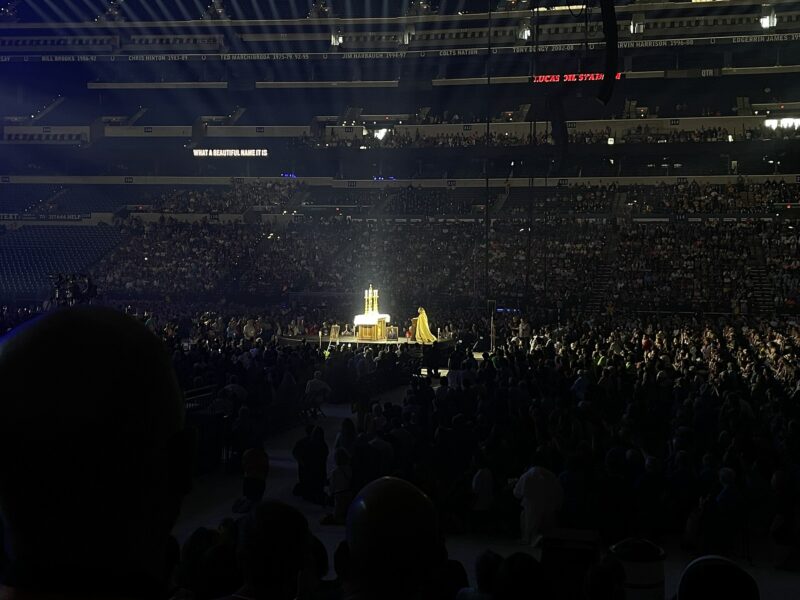
The data comes after the National Eucharistic Revival that the U.S. bishops launched to rekindle faith in the real presence, between 2022 and 2025, and which culminated in the Eucharistic Congress of Indianapolis in July 2024, attended by some 50,000 Catholics. It was the first held in the country in 83 years. The study does not directly evaluate that campaign, but it does measure belief once it had concluded.
More than a thousand Catholics and three response options
The authors worked with a random sample of just over a thousand self-identified Catholics, drawn from a representative survey of 5,400 U.S. adults conducted in September 2025 with Ipsos’s KnowledgePanel. They modified the question from previous polls and added the option “I am not sure,” so respondents could choose among three answers: that the bread and wine become the body and blood of Christ, that they are symbols, or that they did not know. According to Regnerus, for every person who said they were not sure, nearly six chose “symbols.”
Belief increases with religious practice. Among those who attend Mass every week, around 60% claim to believe in the real presence, and the most assiduous reach about 70%. In the strictest group—those who attend Mass weekly, consider faith the most important thing in their life, and attended the previous weekend—the proportion reaches 88%. By contrast, factors such as income, sex, age, race, region or political ideology had little influence, and religiosity indicators explain only a quarter of the variation.
Regnerus adds that in 1992 a Gallup poll recorded 30% agreement with a similar statement. In his view, the low level of belief stems more from general disengagement than from a deliberate rejection of doctrine, and he proposes as a remedy “evangelization, clarity and explanation,” with priests who teach without ambiguity what the Church holds.
Against the bishops’ optimistic assessment
The reading contrasts with the assessment that the United States Conference of Catholic Bishops (USCCB) released on January 15, based on a Vinea Research study with about 2,500 lay Catholics, clergy and church personnel. That report indicated that belief in the real presence exceeded 90% in the three groups analyzed, although the responses were self-reported and the sample consisted mostly of committed Catholics. The campaign’s own leaders acknowledged the difficulty of reaching young people and those who have drifted away.
Kwasniewski: “the elephant in the room”
Theologian and liturgist Peter Kwasniewski, a defender of the traditional liturgy, highlighted the study on X as “new sociological evidence” that the Eucharistic Revival, which cost millions of dollars, “was a failure.” He stressed that the article does not come from a traditionalist outlet and maintained that traditionalists had foreseen it for one reason: the signs that most clearly pointed to the real presence and elicited a response of humble adoration “remain minimized or absent in the new liturgy.” Until that “elephant in the room” is addressed, he concluded, “no catechesis” will make a substantial difference.
This is Kwasniewski’s own interpretation: Regnerus’s study does not attribute the results to the form of the liturgy. InfoVaticana reported in 2021 on the launch of the U.S. bishops’ eucharistic revival plan.