


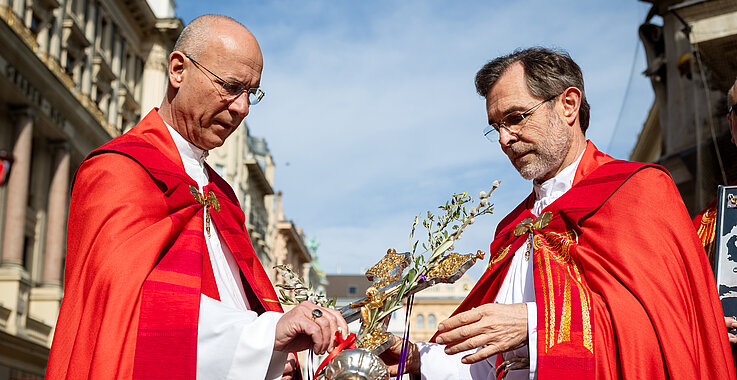
The Archbishop of Vienna, Josef Grünwidl, has said he would like to see the ordination of women, although he acknowledges that only a council of the universal Church could decide on it and that he sees no realistic prospects of that happening soon. He made this statement on the program Im Journal zu Gast on the Austrian public broadcaster Ö1, aired on Saturday, October 31, in an interview with journalist Tarek Leitner, according to the transcript published by the portal AdVaticanum. In the same conversation, he expressed hope that the Austrian Bishops’ Conference would reform its statutes so that a woman could serve as its secretary general.
Asked about the role of women, Grünwidl rejected the idea that their contribution to the Church is lesser and listed the women who work as pastoral agents, in schools, teaching religion, and in hospital chaplaincies, as well as in the administration of the archdiocese. He recalled that he himself has appointed women to the episcopal council and suggested that they do more than just read texts. His remarks on ordination did not appear in the report published by news.ORF.at about the program, nor in the coverage by Vatican News in German, which focused on what the archbishop said about death, dying, and the feast of All Saints.
The public broadcaster did report on the matter of the secretary general. The position will become vacant at the end of November, when Peter Schipka steps down, and the statutes require that it be held by a priest. Grünwidl said that for now it will again be assumed by a cleric, «wieder so wie üblich» («once again, as usual»), but that he expects the rules to change, something that will take time because the modification must be approved by Rome. According to AdVaticanum, he argued that the post should be open to all the baptized, men or women. The Austrian bishops will hold their plenary assembly from November 9 to 12 in Salzburg, and the reform of the statutes would require the approval of the Dicastery for Bishops, according to religion.ORF.at. The candidate is proposed by the president of the conference, the Archbishop of Salzburg, Franz Lackner, whom Grünwidl could succeed in the coming years.
The doctrine on the underlying issue is settled. In the apostolic letter Ordinatio sacerdotalis, dated May 22, 1994, John Paul II declared that «the Church has no authority whatsoever to confer priestly ordination on women» and that this judgment «must be held definitively by all the faithful of the Church». In October 1995, the then Congregation for the Doctrine of the Faith responded, with the Pope’s approval, that this teaching belongs to the deposit of faith and requires definitive assent. Canon 1024 of the Code of Canon Law states that «only a baptized man validly receives sacred ordination.»
Grünwidl had already hinted in that direction the day after his appointment by Leo XIV, in October 2025. At that time, he said he would welcome changes, but that the ordination of women as deacons or priests was not a current issue for the universal Church and would represent a break with its long tradition, so only an ecumenical council could decide on it, according to katholisch.de. He also expressed support for making priestly celibacy optional. A year later, now consecrated as archbishop, the successor to Cardinal Christoph Schönborn has gone from considering it a matter outside the Church’s agenda to saying on public radio that he would like it.
The interview comes just days after seven reformist organizations called on the General Secretariat of the Synod to repeal several canons, including 1024, in order to open ordination to women. That the holder of the See of Vienna should publicly join this desire, even if he defers it to a council, places the issue in the mouth of one of the most prominent archbishops in Central Europe.
Read also
- Reformist groups pressure the Synod to repeal the canon that prevents the ordination of women
- The Irish synodal assembly calls for further exploration of the female diaconate despite the Vatican ruling
- Vienna removes Toni Faber from St. Stephen’s Cathedral, but Grünwidl avoids sidelining him from public life