


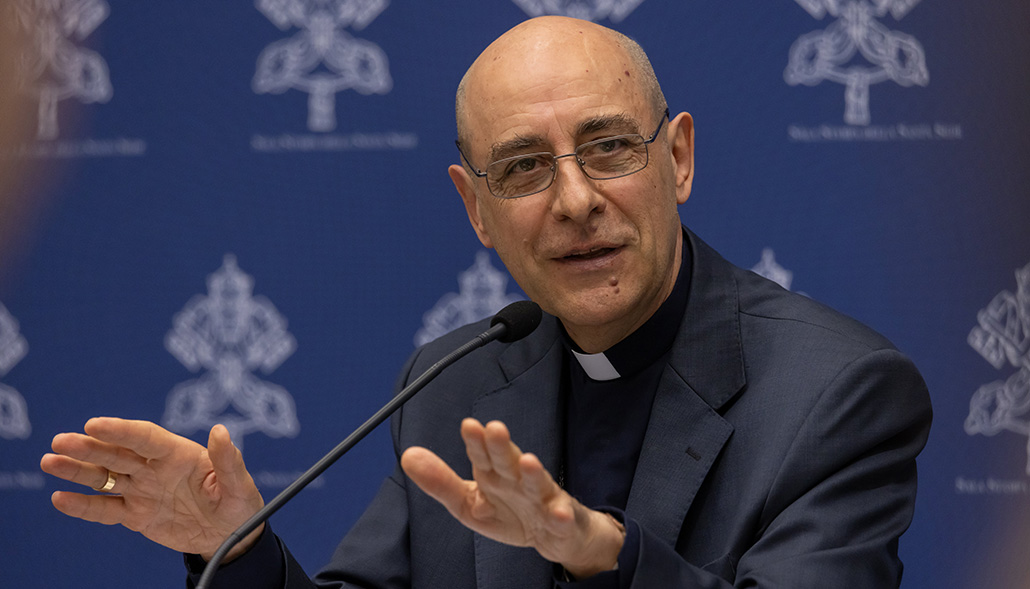
The Dicastery for Legislative Texts has attempted on several occasions to collaborate with the Dicastery for the Doctrine of the Faith to resolve the legal contradictions that arose following the decree of excommunication against the Priestly Fraternity of Saint Pius X (FSSPX), published on July 2. However, Cardinal Víctor Manuel Fernández, Prefect of the Doctrine of the Faith, does not appear willing to accept such collaboration, according to journalist Guido Horst in the German Catholic newspaper Die Tagespost.
In an article published on October 30, Horst maintains that, almost four months after the promulgation of the decree and its explanatory note, important canonical problems affecting both the priests of the Fraternity and the faithful who receive their sacraments remain unresolved.
According to information gathered by the German journalist, there have been “several attempts by the Dicastery for Legislative Texts to find a solution to the ambiguities together with the Dicastery for the Doctrine of the Faith.” Nevertheless, he adds that Fernández does not seem willing to cooperate, a situation that could ultimately require the intervention of Leo XIV.
A decree whose canonical consequences remain unclear
On July 2, the Dicastery for the Doctrine of the Faith published a decree of excommunication after the FSSPX performed new episcopal consecrations without a pontifical mandate.
The document declared that Bishop Alfonso de Galarreta, the four priests consecrated as bishops, and Bishop Bernard Fellay, who participated as co-consecrator, had incurred latae sententiae excommunication, that is, a penalty automatically incurred by the commission of the offense provided for in canon law.
The legal controversy does not focus primarily on that declaration, but on the consequences that the Dicastery drew for the entire Fraternity and for the faithful associated with it.
In an explanatory note published the same day, the Dicastery for the Doctrine of the Faith stated that the sacred ministers of the FSSPX must be considered schismatic and subject to excommunication. Regarding the laity, it established that those who formally adhered to the schism would incur that penalty.
The wording left open a particularly delicate question: determining exactly what constitutes formal adherence and whether simply attending a Mass celebrated by priests of the Fraternity can have canonical consequences.
As reported after the publication of the decree, the document introduced one of the harshest disciplinary measures taken by Rome against the FSSPX in recent decades.
Confessions and marriages, the main legal problem
The most significant difficulty lies in the section of the explanatory note that declares invalid the confessions administered by priests of the FSSPX and the marriages in which they act as qualified witnesses.
This assertion appears to conflict with the faculties granted by Pope Francis during his pontificate.
In 2015, on the occasion of the Jubilee of Mercy, Francis authorized the faithful who attended the priests of the Fraternity to receive sacramental absolution validly and licitly. Subsequently, through the apostolic letter Misericordia et misera, of November 2016, he extended that faculty beyond the Holy Year, until further disposition.
In March 2017, the Pontiff also approved a letter from the Pontifical Commission Ecclesia Dei authorizing diocesan bishops to grant the necessary faculties for the celebration of marriages of the faithful associated with the FSSPX, under certain conditions.
Fernández’s note of July 2, 2026 does not expressly explain whether those pontifical concessions have been revoked or by what legal act such revocation would have occurred.
It is precisely here that one of the main objections of canonists lies: a provision personally approved by the Roman Pontiff cannot be considered annulled without sufficient legal basis.
According to Horst, the Dicastery for Legislative Texts has already intervened to clarify to a pontifical representation that the note from the Dicastery for the Doctrine of the Faith does not imply that the Pope had expressly approved the derogation of the 2017 marriage provisions.
Arrieta had already warned of the contradictions
The legal difficulties of the decree were publicly pointed out by Spanish Archbishop Juan Ignacio Arrieta, former secretary of the Dicastery for Legislative Texts.
In an interview published in July, Monsignor Arrieta explained that confessions administered by priests of the FSSPX would remain valid unless the Pope expressly revoked the faculties granted by Francis.
The canonist distinguished this situation from that of marriages, whose validity depends on the necessary delegation from the competent ordinary. Therefore, marriages celebrated without that faculty could be null due to a defect of form, while those celebrated in accordance with the 2017 pontifical provisions present a different legal situation.
Arrieta also clarified that attending an FSSPX Mass does not automatically imply formal adherence to the schism. For the corresponding canonical sanction to be incurred, the conditions required by law must be met, including the will to adhere to a schismatic position and its external manifestation.
His observations did not question the gravity of the episcopal consecrations performed without a pontifical mandate, which he described as a deep wound to the unity of the Church, but rather the need to correctly apply canonical norms and distinguish the situations of ministers and the faithful.
Four months later, the problem remains unresolved
The information published by Die Tagespost now suggests that the difficulties are not limited to the observations of external canonists, but have prompted actions within the Roman Curia itself.
According to Horst, the Dicastery for Legislative Texts has sought to work with the Dicastery for the Doctrine of the Faith to remedy the ambiguities, but has not found sufficient willingness on the part of Cardinal Fernández.
For the moment, there is no public correction of the decree or the explanatory note of July 2. Nor has a decision by Leo XIV been officially announced to resolve doubts about the validity of the sacramental faculties previously granted by Francis.
The issue is particularly relevant because it affects not only the disciplinary situation of the FSSPX, but also the legal security of the faithful who have received the sacraments in accordance with previous pontifical provisions.
Until Rome expressly clarifies the scope of those concessions and their relationship with the July declaration, the controversy over the validity of certain sacramental acts and the canonical consequences for those who frequent the celebrations of the Fraternity will remain open.