


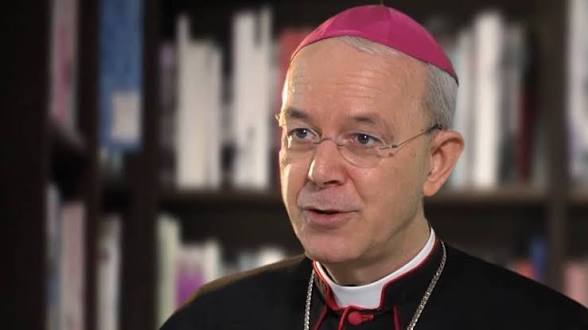
Auxiliary Bishop of Astana (Kazakhstan), monsignor Athanasius Schneider, has once again defended the integration of the Priestly Fraternity of Saint Pius X (FSSPX) into the Church and has questioned positions that prioritize a strictly juridical interpretation of its situation over the defense of the Catholic faith. In an interview granted to AdVaticanum, published on October 30, the prelate maintained that it would be beneficial for the entire Church to gradually incorporate the work of the Fraternity’s priests and faithful.
His statements come four months after the episcopal consecrations celebrated in Écône on July 1 and the excommunications declared by Rome, against which the FSSPX maintains an appeal. The Fraternity has chosen to maintain discretion regarding the procedure, as reported when addressing the continuity of the appeal against the excommunications.
The interview was recorded in Rome on the morning when mons. Schneider celebrated a pontifical Mass in the basilica of Saint Mary Major on the occasion of the traditional pilgrimage Ad Petri Sedem.
«It would be a benefit for the entire Church»
Mons. Schneider reiterated his conviction that there are no compelling reasons to keep the Fraternity outside of full canonical integration.
«It would be a benefit for the entire Church to gradually integrate the work of these priests and faithful», he stated, according to the transcript of the interview published by LifeSiteNews.
The bishop also recalled the request that Archbishop Marcel Lefebvre, founder of the FSSPX, once made to the Holy See: that the Fraternity be accepted «as it is».
This is not a new position for mons. Schneider. The prelate visited the Fraternity’s seminaries in 2015 at the request of the Holy See and has since publicly defended that its priests and faithful should not be considered outsiders to the Church.
In the conversation, he once again vindicated the figure of Lefebvre, whom he described as «a very holy man» and «a man of God», highlighting his actions during a difficult period for ecclesial life.
Mons. Schneider also questioned what he considers a «very narrow and legalistic» vision of the Church, in which the application of canonical norms may end up overshadowing the primary importance of preserving the Catholic faith intact.
The bishop placed the controversy in an ecclesial context that, in his view, is marked by «increasing confusion in doctrine and liturgical anarchy», along with a growing adaptation to the spirit of the world.
The exclusion of traditional pilgrims, amid the discourse on inclusion
The interview took place amid the controversy over the restrictions imposed on the Ad Petri Sedem pilgrimage, whose participants were unable to enter Saint Peter’s Basilica in procession.
Mons. Schneider lamented the decision and pointed out the contradiction that, in his opinion, it entails to exclude these faithful while the Vatican insists on synodality, listening, and inclusion.
The prelate recalled that these are Catholics who recognize the Pope, pray for him and for their bishops, and wish to remain in communion with the Church.
«Precisely this group was vetoed», he stated.
The controversy had been reflected in the efforts made by Father Claude Barthe, head of the pilgrimage, before the Vatican authorities. The correspondence with the Vatican authorities showed the refusals received to the requests related to the celebration of the traditional Mass in Saint Peter’s.
Mons. Schneider’s words once again bring to the table the situation of the faithful linked to the liturgy prior to the reform of Paul VI, especially in light of the restrictions that continue to affect its celebration.
Mons. Schneider disagrees with Koovakad on the interreligious meeting in Assisi
Another issue addressed was the doctrinal scope of the interreligious meeting in Assisi in 1986, convened by Saint John Paul II.
Mons. Schneider questioned whether that initiative can be considered part of the ordinary magisterium of the Church. In his view, there is «a lack of clarity and some confusion» in the use of this concept, which he linked to the constant teaching of the faith transmitted by bishops in communion with the Roman Pontiff.
The prelate maintained that interreligious prayer constitutes «a complete novelty in the Church» and stated that it had not been permitted previously.
His position contrasts with that recently expressed by Cardinal George Jacob Koovakad, prefect of the Dicastery for Interreligious Dialogue, who placed the 1986 Assisi meeting within the ordinary magisterium and linked its rejection to a schismatic rupture.
The discrepancy between the two prelates concerns an issue that continues to spark debate: the relationship between contemporary initiatives of interreligious dialogue and the Church’s traditional teaching on prayer and worship.
Neither sedevacantism nor absolute obedience
Mons. Schneider also rejected sedevacantism, which he described as «completely erroneous», and warned against a conception of papal authority that attributes permanent infallibility to the Pope.
The bishop recalled that papal infallibility is exercised under very specific conditions and that not all statements or decisions of the Pontiff participate in that prerogative.
At the same time, he maintained that absolute obedience to ecclesiastical authority is equally an error, because obedience cannot be separated from fidelity to revealed truth.
In this sense, he defended that, when the clarity of the faith is at stake, the faithful have the right and even the duty to respectfully warn their superiors.
Asked about Leo XIV, mons. Schneider expressed his hope that the Pontiff would fulfill the mission entrusted by Christ to Saint Peter: to confirm his brothers in the faith and strengthen the Church in the truth.
His new intervention comes while Rome keeps open the canonical consequences of the Écône consecrations and the FSSPX awaits a response to its appeal. In the face of that situation, mons. Schneider insists on a solution based on the gradual integration of the Fraternity, a stance he had already defended previously and which he raises again amid the tensions over the treatment given to traditional Catholics.
Read also
- The FSSPX continues to appeal in Rome against the Écône excommunications and will maintain discretion regarding the process
- Barthe asked the Pope to renew the Traditional Mass in Saint Peter’s: Rudelli replied twice that no
- Koovakad places Assisi 1986 in the ordinary magisterium and links its rejection to a schism