


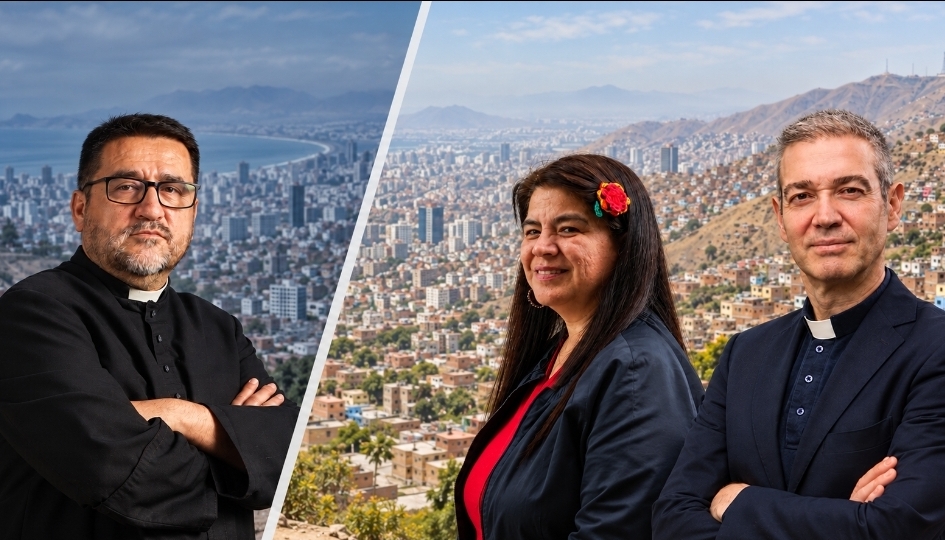
The canonical investigation against Father Omar Sánchez Portillo has been archived, along with the preliminary proceedings opened by the Peruvian Prosecutor’s Office. The priest from the diocese of Lurín himself announced it in a video reported by Expreso, after six months of scrupulous silence. Neither of the two instances found grounds to proceed: the case, in his words, was closed “because no evidence was found.” Sánchez claims to have in his possession all the official documentation that proves it.
Thus ends, without a single piece of evidence, the case that for half a year turned one of the most beloved priests in the slums of southern Lima into tabloid fodder—the director of the Association of the Beatitudes, which shelters hundreds of abandoned people. And it makes painfully clear the sequence that InfoVaticana had already documented: a public criticism of Mons. Jordi Bertomeu, a dormant file that suddenly awakens, and a journalist from the commissioner’s circle ready to publish it.
Twenty-two days
On April 6, Father Omar dared to publicly question Bertomeu’s management as apostolic commissioner for the Sodalitium of Christian Life. Twenty-two days later, Paola Ugaz aired on Epicentro TV a complaint sent in May 2023 to the Dicastery for the Doctrine of the Faith—the same dicastery where Bertomeu works—alleging abuse committed in 2019 against a young man sheltered in the priest’s work. Three years buried in a Roman drawer. It surfaced exactly when the priest raised his voice.
As InfoVaticana revealed, the byline of the report belonged to the journalist who for years has served as the usual media spokesperson for Bertomeu himself. The same one who shared the stage with him in the reading of the papal message dedicated to the “Ugaz Project.”
A victim who never filed a complaint
The building began to crack in May. The young man the report presented as “Rafael,” Nicolás Arosemena, publicly stated that he had never denounced Father Omar, that he disavowed the relative who had signed the document in his name, and that he had come to the association to help the poorest, not as a rehabilitation patient. Three statements that blew apart the portrait of the “vulnerable person” on which the entire accusation rested.
The versions of the protagonists also failed to match. Bertomeu maintained in an interview with Rosa María Palacios that there was no complaint against Sánchez at the Dicastery for the Doctrine of the Faith; Epicentro TV insisted there was one underway; Ugaz herself came to claim the complaint had been withdrawn, as InfoVaticana reported. It is also on record that in September 2023 a relative requested the file be withdrawn. Three incompatible accounts of the same document, and a priest thrown to the lions in the meantime.
The Puente method, Vatican version
Spain has witnessed a similar maneuver this week. Hours after Minister Óscar Puente pointed to human error as the cause of the Urda railway tragedy, cropped audio recordings of conversations between the Atocha control center and the train drivers appeared in the media. The railway unions, unanimously, denounced the leak as a parallel trial against the weakest link in the chain, with the investigation still open and the case file under seal. Power protects itself, the worker is exposed, and friendly journalism does the rest.
The case of Father Omar follows the same script, cassock and all. A reserved document that lay dormant in a Roman office, pulled out at the opportune moment, handed to a trusted journalist, and served to public opinion as proof of guilt before anyone had investigated it. When the Church and the Prosecutor’s Office examined the case calmly, they found nothing. But the punishment had already served its purpose.
The questions no one answers
Who kept that file and who decided to dust it off in April 2026? How did a reserved document from a Roman dicastery end up in a journalist’s hands? Why did a procedure whose withdrawal had been requested by the family itself reappear precisely after the criticism of the commissioner? Will Epicentro TV issue a correction with the same prominence it gave the accusation? Will anyone in Rome answer for the harm inflicted on a priest and on a work that feeds those no one else wants?
For six months, Father Omar’s name ran through headlines tied to the word abuse, and his work remained under a shadow of suspicion that no archive can fully erase. Bertomeu remains in his expectant office and Ugaz at her podium.
The lesson floating over the Peruvian clergy is as simple as it is unsettling. Whoever criticizes Bertomeu must know that their old papers can come out of the drawer, that friendly media will spring into action, and that their name will remain tarnished for months—whether or not there is anything behind it. Father Omar was saved by the fact that there was nothing behind it. Other priests, with less patience or less luck, have already taken note and keep silent.