


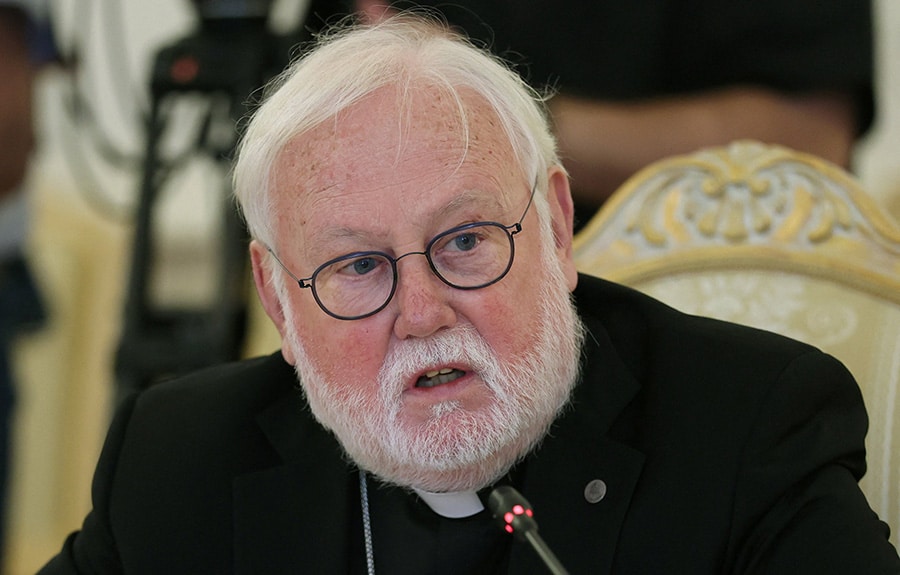
The Secretary for Relations with States of the Holy See, Monsignor Paul Richard Gallagher, has acknowledged that the “imperfections” of the agreement between the Vatican and China on the appointment of bishops are “evident,” although he has defended its continuation. Eight years after its signing, the pact remains secret and the communist regime maintains control over religious life in the country, while reports of persecution against Catholics who refuse to submit to the official structures persist.
The statements were made during a meeting with journalists accredited to the Holy See, according to The Catholic Herald. Gallagher maintained that, despite the difficulties, the current situation is better than the one that existed before the 2018 agreement and confirmed that the Vatican intends to persevere in dialogue with Beijing.
“The imperfections of the agreement are evident”
“It is not easy, dialogue is not easy, the imperfections of the agreement are evident, but there is a commitment to persevere in dialogue and that is what will continue to happen,” Gallagher stated.
The archbishop defended the advisability of maintaining an imperfect agreement rather than abandoning understanding with the Chinese authorities.
“We are pleased that all the bishops of China are now in communion with the Pope, which certainly represents an improvement over the situation before the agreement,” he declared.
The pact was signed in September 2018, during the pontificate of Francis, and renewed in 2020, 2022 and 2024. The latest extension, officially announced by the Holy See on 22 October 2024, extended its validity for another four years.
However, its full content has never been made public. The Holy See presents the agreement as a mechanism to guarantee the communion of Chinese bishops with Rome, while the communist authorities maintain a decisive intervention in the selection of episcopal candidates.
Beijing continues to present the appointments as decisions of its official bodies
The difficulties of the agreement are not limited to the criticisms of its detractors. The very procedures for episcopal appointments have highlighted the differences between Rome and Beijing.
As reported on 15 October, during the ordination of Ignatius Ding Zuyao as bishop of Haimen, the official Chinese ecclesiastical authorities presented the appointment as a decision approved by their Episcopal Conference, without mentioning the Pope or his intervention.
The Holy See, on the contrary, had communicated that Leo XIV approved the candidacy and appointed the new bishop in accordance with the provisional agreement.
This contrast has been repeated in other episcopal ordinations. While Rome highlights papal authority, Chinese communiqués attribute the procedure to the religious structures recognized by the State.
The issue also has a doctrinal dimension. In his 2007 letter to Chinese Catholics, Benedict XVI stated that the College of Catholic Bishops of China could not be recognized as an episcopal conference by the Holy See, among other reasons because its statutes contained elements incompatible with Catholic doctrine.
The persecution of the underground Church remains an unresolved issue
Gallagher also responded to the criticisms the agreement has received since its signing, noting that they were predictable due to differing opinions on the history of China and its Government.
Among the most critical voices is Cardinal Joseph Zen, bishop emeritus of Hong Kong, who has repeatedly denounced the abandonment of underground Catholics who for decades have suffered persecution for remaining faithful to Rome.
Objections to the agreement do not come solely from the ecclesial sphere. As reported in April regarding the complaints of Human Rights Watch, restrictions against Chinese Catholics and pressures to integrate underground communities into state-controlled religious structures continue to be a cause for concern.
The complaints include arrests of priests and bishops, surveillance of communities, restrictions on catechesis and demands for adherence to official bodies.
The policy of “sinicization” promoted by Xi Jinping continues to subordinate religious activity to the guidelines of the Chinese Communist Party.
In this context, Gallagher’s assertion about the improvement in the episcopal situation contrasts with reports about the conditions in which numerous Catholics live and practice their faith.
The Vatican is not willing to pay the price of a presence in Beijing
The head of Vatican diplomacy also addressed the possibility of establishing a permanent representation of the Holy See in mainland China.
Gallagher acknowledged that the possibility of having some type of cultural presence in Beijing has been studied, but pointed out that current conditions prevent progress in that direction.
“The idea is to have some type of cultural presence in Beijing. But, as with everything in a negotiation, there would be a price to pay and, for the moment, we are not willing to pay that price,” he stated.
The archbishop did not wish to specify what the demands would be to reach such an understanding.
Currently, the Holy See maintains diplomatic relations with Taiwan and has a study mission in Hong Kong, but does not have official diplomatic representation in the People’s Republic of China.
Leo XIV maintains the policy inherited from Francis
Asked about the possibility that Leo XIV would give special priority to China, Gallagher responded that the Pontiff has the responsibility of attending to the entire universal Church.
“Pope Leo is very aware that he must care for the entire universal Church,” he noted, ruling out that the Asian country would receive special attention.
Since the beginning of his pontificate, Leo XIV has continued to approve episcopal appointments within the mechanism agreed with Beijing. The Holy See has not announced modifications to the pact nor has it published its content.
Gallagher’s new statements maintain the diplomatic position defended during the pontificate of Francis: to persevere in dialogue despite recognizing its limitations.
Meanwhile, the agreement remains in force, the Communist Party retains its control over the official religious structures and the underground Catholic communities continue to face the restrictions denounced by human rights organizations and members of the Church itself.