


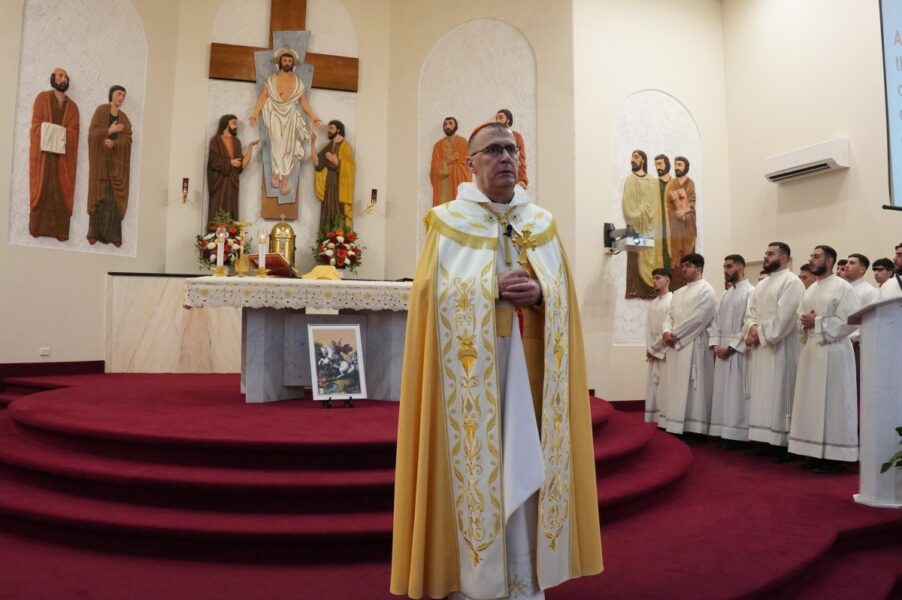
The Synod of Bishops of the Chaldean Catholic Church has agreed to introduce a new procedure for the election of bishops, with the aim of giving its members more time to study the profiles of candidates before proceeding to the votes. The decision was announced by Patriarch Paul III Nona following the synodal assembly held in Rome from October 16 to 19.
In an interview published on October 23 by the Chaldean Patriarchate, Nona explained that the new mechanism aims to favor a more thorough examination of candidates for the episcopate.
“After lengthy discussions, we agreed on a specific procedure that will give Synod members sufficient time to investigate and get to know the candidates better before electing them,” the patriarch noted, according to The Pillar.
The new system will begin to be applied at the next synodal meeting, although the specific details of its operation have not yet been communicated.
Numerous dioceses remain without a residential bishop
The decision comes at a particularly delicate moment for the Chaldean Church, one of the 23 Eastern Catholic Churches in full communion with Rome.
This Church, which has approximately 600,000 faithful spread across different countries, has 23 ecclesiastical circumscriptions. At least one third of them currently lack a residential bishop.
Among the vacant or provisionally administered sees are the eparchy of Alqosh, in Iraq; the circumscriptions of Ahvaz, Salmas, and Urmia, in Iran; the archieparchy of Amida, in Turkey; and the eparchies of Cairo, Sydney, and San Diego.
During the assembly held in Rome, the bishops examined the situation of these communities and their pastoral needs, as well as issues related to the episcopal ministry, retirements, and election procedures.
Nona confirmed that the Synod had made decisions regarding the provision of some vacant sees, but specified that they could not be announced until receiving the corresponding confirmation from the Holy See.
“We debated this matter with total openness and frankness, trying to determine what the Synod considers best for each diocese,” the patriarch explained.
A reform following changes in the Patriarchate
The reorganization of the electoral procedure comes months after a series of events that have affected the governance of the Chaldean Church.
On March 10, Leo XIV accepted the resignation of Cardinal Louis Raphaël Sako from the Patriarchate of Baghdad of the Chaldeans and the resignation of Emanuel Shaleta, until then bishop of the Chaldean eparchy of Saint Peter the Apostle of San Diego, in the United States.
Shaleta had been detained on March 5 at the San Diego airport, accused of embezzlement of ecclesiastical funds and money laundering. The former bishop faces judicial proceedings for alleged financial crimes, of which he has declared himself innocent.
Following Sako’s resignation, the Synod elected Archbishop Amel Shamon Nona as the new patriarch on April 12, who adopted the name Paul III Nona.
During his enthronement, held on May 29 in Baghdad, the new patriarch presented six priorities for this stage of the Chaldean Church, including ecclesial unity, the formation of the clergy, and the preservation of Eastern Christian identity.
The Chaldean Church, of Eastern Syriac liturgical tradition, possesses its own structures of governance and elects its bishops in accordance with the provisions of Eastern canon law, while maintaining hierarchical communion with the Roman Pontiff.
Greater prominence of synodal commissions
In addition to reviewing the episcopal election procedure, the bishops approved new provisions to organize the work of the synodal commissions.
The Synod has nine commissions dedicated to areas such as family and youth, theology and catechesis, Chaldean heritage, liturgy, the diaspora, and the protection of minors.
Each commission will have a bishop responsible for supervising its activities and preparing reports that must be presented with sufficient advance notice to the synodal meetings.
The patriarch explained that this organization seeks to prevent decisions from depending exclusively on individual initiatives and to favor a joint examination of the matters affecting the Church.
Issues related to the Permanent Synod, the revision of particular ecclesiastical norms, and a draft liturgical directory that will continue to be studied in consultation with priests and deacons were also addressed.
Pastoral care of Chaldeans in the diaspora
Another matter addressed was the situation of Chaldean faithful living outside the Middle East, especially in Europe.
The successive wars and crises in Iraq have caused, over the last decades, a significant emigration of Chaldean Christians to countries such as Germany, Sweden, France, and the United Kingdom.
Nona acknowledged that the geographical dispersion of these communities, combined with the shortage of priests and religious, makes their pastoral care difficult.
In some European countries, he explained, a single priest must attend to more than three pastoral centers located at considerable distances from each other.
The patriarch emphasized the need to strengthen ecclesial structures to respond to this situation, while the Synod continues working on the provision of vacant sees and the reorganization of its governing bodies.
The Rome assembly was preceded by the celebrations of ecclesial communion of the new patriarch with the Holy See. On October 14, Cardinal Luis Antonio Tagle publicly expressed the communion granted by Leo XIV to Paul III Nona, during a celebration in Saint Peter’s Square. The following day, the patriarch presided over the Chaldean Divine Liturgy in the Vatican basilica.