


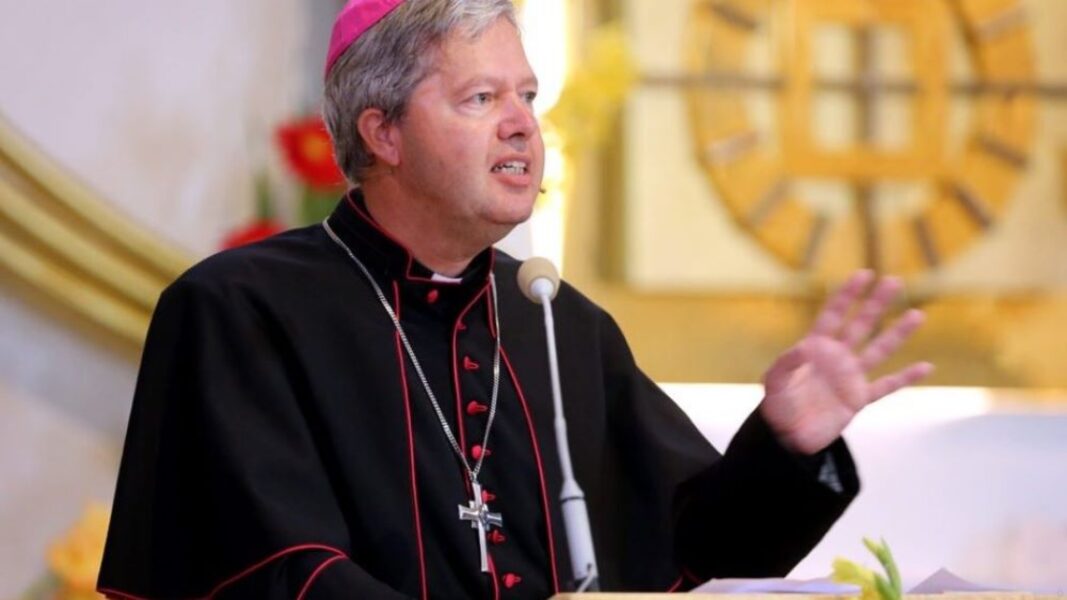
Auxiliary Bishop of ’s-Hertogenbosch (Netherlands), Rob Mutsaerts, has published on his blog Paarse Pepers a response to the statements made by Cardinal Arthur Roche, Prefect of the Dicastery for Divine Worship, regarding the traditional Mass. The text raises a fundamental question: “Why is practically every ancient Catholic liturgical tradition considered a treasure, except the ancient Roman liturgy?”
Mutsaerts maintains that the Church naturally welcomes Byzantine, Maronite, or Armenian liturgies, yet treats the Roman rite celebrated for centuries as a problem. “Suddenly, liturgical diversity becomes a problem,” writes the prelate, adding that the traditional Roman rite “is not a foreign intruder in the Catholic Church; it comes from its own house.” In his view, “Catholic unity has never been synonymous with liturgical uniformity.”
Roche: Traditionis custodes will not change
The reply responds to the interview Roche gave to AdVaticanum, in which he stated that Leo XIV will not modify Traditionis custodes nor return to Summorum Pontificum. The cardinal also warned that rejecting the Second Vatican Council means distancing oneself from the center of Catholicism and that the faithful should not attend that Mass exclusively. Roche also maintained that some groups use the former liturgy to oppose the conciliar reform, which, according to him, can harm ecclesial unity.
Mutsaerts distinguishes between those who reject the Council or the Pope’s authority and those who simply love the ancient form of the Mass. Of the latter he says: “They simply go to Mass.” In his opinion, a father who takes his children to the traditional Mass is not engaging in ecclesial politics.
The Council, Latin, and the young
The bishop recalls that Vatican II foresaw a liturgical reform, but also affirmed the equal dignity of legitimate rites and gave priority to Latin and Gregorian chant in the Latin rite; therefore, in his view, the ancient liturgy cannot be presented as contrary to the Council. He also notes that post-war liturgy has shifted toward the prominence of the community, and that the traditional Mass compensates for this emphasis by underscoring God’s transcendence.
Mutsaerts further points out that many young people are drawn to this form of celebration, which he interprets as a sign that modernization is not always the best path for evangelization. The prelate calls for making room for the ancient liturgy and correcting abuses in all forms of the Mass.
Below we provide the transcription of Msgr. Mutsaerts’ article originally published on his blog:
Cardinal Roche’s threatening language: Do not go to the traditional Mass! But why? The Church does not need to ban its past to secure its future
The Catholic Church prides itself on its universality, treasures an impressive diversity of liturgical traditions, and regards that diversity as an expression of its richness. A Catholic may attend the Divine Liturgy according to the Byzantine, Maronite, Armenian, or Chaldean tradition. No one considers that, in itself, a threat to the unity of the Church. But as soon as a Catholic wishes to attend Mass as it was celebrated for centuries in Rome, Paris, Amsterdam, and practically the entire Latin Church, certain ecclesiastical authorities in Rome begin to worry.
Suddenly, liturgical diversity becomes a problem. Suddenly, attachment to Tradition becomes suspect. And suddenly, the unity of the Church must be protected against people who wish to pray as their ancestors did. This raises a question that is by no means unreasonable: why do practically all ancient Catholic liturgical traditions constitute a richness, except the ancient Roman liturgy?
Cardinal Roche recently stated, in an interview with AdVaticanum published on 13 October 2026, that traditionalist groups sometimes use the former liturgy to oppose the liturgical reform of the Second Vatican Council. According to the cardinal, such an attitude can harm ecclesial unity. He warned that whoever rejects the Council distances himself from the center of Catholicism. He also maintained that, in his opinion, Catholics should not attend the ancient Mass exclusively. An important distinction must be made here.
Whoever, in principle, denies the validity of the new Mass, rejects papal authority, or claims that the post-Vatican II Catholic Church is no longer the Catholic Church does indeed adopt a problematic position. But whoever loves the traditional Mass, deepens his faith through it, accepts Catholic doctrine, and remains faithful to the Pope cannot simply be accused of the same. Attachment to a liturgical tradition does not equate to rejection of the Magisterium. Precisely this distinction risks being lost in the current debate.
The Catholic Church comprises 24 sui iuris Churches: the Latin Church and 23 Eastern Catholic Churches. These possess distinct liturgical traditions. Consider the Byzantine, Alexandrian, Antiochene, Armenian, and East Syriac traditions. Within the Western Catholic world there also exist particular liturgical uses, among them the Ambrosian rite of Milan. And no one need fear for the unity of the Church when a Byzantine Catholic priest stands before the iconostasis, incense rises abundantly, and the faithful participate in a liturgy that differs in many respects from the usual Roman Mass.
For Catholic unity has never been synonymous with liturgical uniformity. Moreover, the Second Vatican Council expressly states in Sacrosanctum Concilium that all legitimately recognized rites possess equal dignity and that the Church desires to preserve and promote them. This is a remarkable statement in light of Cardinal Roche’s declarations. If liturgical diversity does not necessarily harm the unity of the Church, why should the Roman liturgy of so many centuries do so? After all, the Catholic faith is not a set of customs whose expiration date can be determined by an ecclesiastical commission.
Post-war liturgical practice has shown a shift from the transcendence of God toward the community as center. When the Eucharist increasingly resembles a shared meal, a celebration of human bonds, or an occasion for pastoral creativity, the sacrificial dimension risks being relegated to the background. Precisely in the face of this, the traditional liturgy, with its constant orientation toward God, constitutes a visible counterbalance. And perhaps that is part of the discomfort: the traditional Latin Mass continues to proclaim something ancient that is easily forgotten today. Pope Benedict understood something essential: the Church cannot credibly claim that what it considered sacred yesterday must now be seen as a danger.
Is the Second Vatican Council being used as a breaking point? Here the debate touches on a deeper problem. A council stands within that Tradition. It does not inaugurate a new Church. Vatican II foresaw a reform of the liturgy, but at the same time established that Latin must be preserved in the Latin rites and that Gregorian chant occupies a privileged place. Much of what is today considered typically traditionalist was, therefore, something completely natural for the conciliar fathers. That is why it is strange that attachment to the former liturgy is presented as opposition to the Council itself.
Criticism of certain aspects of the post-conciliar liturgical reform does not automatically equate to rejecting the Second Vatican Council. In fact, the liturgical reform was largely developed and implemented after the Council. That does not mean all criticisms are accurate. It merely means that such debate can be legitimate.
When a council is treated, in practice, as an absolute boundary between an ancient Church and a new one, precisely the rupture that one claims to want to avoid occurs. The Catholic Church is not an institution refounded in 1965. It is the same Church that received the apostles, gave rise to the Church Fathers, built the medieval cathedrals, celebrated the Council of Trent, and convoked the Second Vatican Council. Whoever truly believes in the continuity of the Church need not fear its past.
Cardinal Roche constantly appeals to the unity of the Church. That, in itself, is completely legitimate. Unity is not a secondary characteristic of the Church, but belongs to its very essence. The question is what we understand by unity. Unity in the Catholic faith, in the sacraments, and in communion with the successor of Peter is something different from uniformity in ritual expression.
The official argument holds that the traditional Latin Mass, unlike the Eastern liturgies, has become for some groups a symbol of resistance to reform and to the Church’s authority. That argument deserves to be taken seriously. But the problem with that reasoning is that it easily moves from judging certain abuses to issuing a general judgment on an entire liturgical community. Why should families, young people, priests, and religious who desire nothing other than to celebrate the traditional liturgy in full ecclesial communion suffer the consequences?
A father who takes his children to the ancient Mass because there he experiences the holiness of the Eucharist in a particularly intense way is not engaging in ecclesial politics. He is simply going to Mass.
The history of the Church is characterized not only by renewal, but also by preservation. Traditio means transmission: receiving what one has not invented oneself and passing it on to the next generation. Precisely for that reason it is striking that, in an age in which one constantly speaks of listening to the faithful, the desires of traditionally oriented Catholics sometimes meet with so little understanding. A Church that wants to listen to the world should also listen to its own children (or does synodality mean something else?). Especially when those children are not asking for less Catholic doctrine, but precisely for its integral proclamation. Or perhaps that is the problem?
A sensible approach would offer space to the ancient liturgy wherever it is sincerely desired, would at the same time demand fidelity to ecclesial communion, and would correct abuses in all liturgical forms. For the latter also deserves attention. Whoever strictly regulates the ancient Mass out of concern for the holiness and unity of the liturgy must act with the same seriousness toward abuses in the new Mass.
Perhaps most striking is that the traditional Latin Mass does not attract exclusively people who grew up before the Council. Young Catholics are also drawn to it. When young people consciously choose silence, Gregorian chant, ritual precision, and a liturgy that hardly accommodates the contemporary preference for spontaneity and immediate comprehension, that means something. It suggests that modernization is not always the best path for evangelization.
Perhaps modern man yearns precisely for what is not modern. Perhaps he does not seek a liturgy that resembles as much as possible the world in which he lives every day and that has nothing to offer him, but a liturgy that helps him rise above that world. This is not an argument against the new Mass. It is an argument against the idea that liturgical renewal necessarily coincides with adaptation to the spirit of the times.
It would be lamentable if the traditional Latin Mass ended up becoming the victim of an ecclesial struggle in which it is no longer really about divine worship, but about the interpretation of the last sixty years. For then a liturgy that for centuries has formed saints and sanctified countless faithful would be treated as a problem that must be solved. What would be desirable here is less suspicion, more historical honesty, greater theological depth, and, above all, more pastoral generosity.
The Catholic et-et, the celebrated Catholic principle of “both one and the other,” could also constitute a fruitful point of departure here. Tradition and legitimate development. Unity and diversity. Fidelity to the Council and respect for the centuries that preceded it. The new Mass and space for the Roman liturgy handed down by Tradition, within the communion of the Church.
Your Eminence, the Church does not need to ban its past to secure its future. A Church that truly trusts in the living Tradition can afford to love its own history. A Church that joyfully welcomes within its bosom the Byzantine, Maronite, and Armenian liturgies should not feel so threatened by a Roman Mass that for centuries was so dear to it.
After all, the traditional Latin Mass is not a foreign intruder in the Catholic Church; it comes from its own house. And a mother Church should not treat her own children as strangers because they like to pray in the language of their grandparents.
+ Rob Mutsaerts