


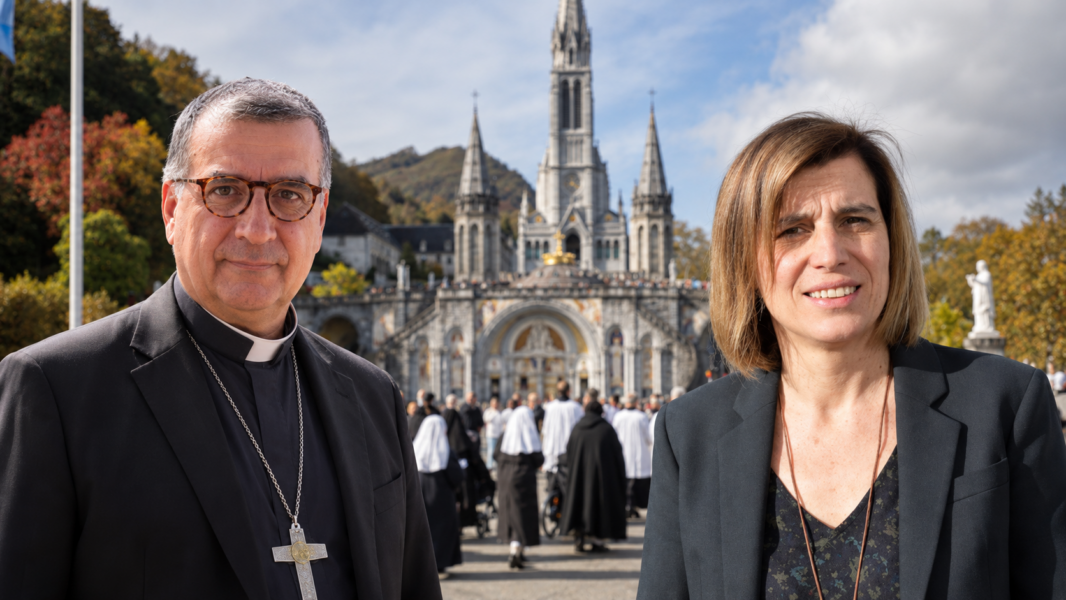
French authorities have banned the two religious processions that the Priestly Fraternity of Saint Pius X (FSSPX) had planned for October 24 and 25 in Lourdes, citing the terrorist threat and the lack of police personnel to ensure the safety of participants. The decision affects the traditional Christ the King pilgrimage, which this year had already been forced to modify its program after the Bishop of Tarbes and Lourdes, Monsignor Jean-Marc Micas, withdrew the Fraternity’s authorization to celebrate publicly inside the Marian sanctuary.
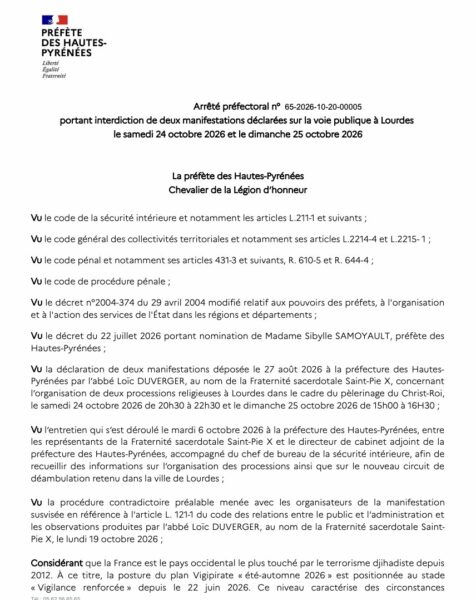
The prefect of the Hautes-Pyrénées, Sibylle Samoyault, signed the administrative order on October 20 that prevents both processions from taking place through the city streets. According to the French local press, the resolution is based on the current level of anti-terrorist alert in France, the high expected attendance, and the difficulties in mobilizing sufficient security personnel.
The situation presents a contradiction: while civil authorities consider that the processions should take place inside the sanctuary for security reasons, the ecclesiastical authority has already prohibited the FSSPX from organizing public acts of worship there.
The terrorist threat as a reason to prevent the processions
The two processions had been officially reported to the prefecture on August 27 by Father Loïc Duverger, on behalf of the Fraternity. The first was scheduled for Saturday, October 24, between 8:30 p.m. and 10:30 p.m., and the second for Sunday, October 25, between 3:00 p.m. and 4:30 p.m.
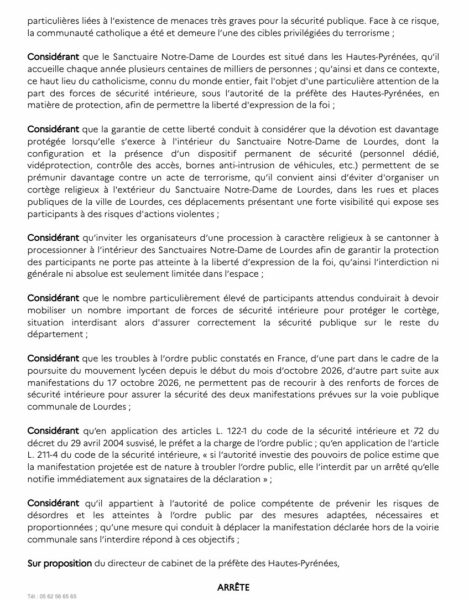
In the resolution, the French authorities recall that the country maintains a high level of anti-terrorist vigilance and acknowledge that the Catholic community has been and continues to be one of the targets of jihadist terrorism.
Precisely because of this risk, the prefecture considers that processions through the streets of Lourdes could expose participants to possible violent actions. The document states that the visibility of religious processions increases their vulnerability and that protecting several thousand pilgrims would require significant police resources.
These circumstances are compounded by the disturbances recorded in France in recent weeks, especially student mobilizations and the demonstrations of October 17, which have required the intervention of security forces.
The order does not mention any specific threat against the Christ the King pilgrimage. The ban is based on a preventive assessment of risks and the availability of police personnel.
The argument has sparked criticism in French Catholic media. Le Catho has questioned the authorities’ response to the danger of possible attacks, which is to prevent religious demonstrations rather than provide the necessary protection to hold them.
The publication recalls that France is a country whose history, culture, and traditions are deeply linked to Catholicism, and considers it especially concerning that two processions are banned precisely in Lourdes, where the Blessed Virgin appeared to Saint Bernadette Soubirous in 1858.
The issue goes beyond the existing differences with the FSSPX. The right of Catholics to publicly manifest their faith does not depend on whether they share the Fraternity’s positions, just as threats from third parties should not automatically become a reason to restrict religious celebrations.
The prefecture proposes holding the event inside the sanctuary, but the bishop has already banned it
The prefecture considers that the Sanctuary of Our Lady of Lourdes offers greater security guarantees thanks to its access controls, surveillance cameras, protection devices, and specialized personnel.
For this reason, it maintains that the processions could take place within the religious enclosure and that banning them in the streets does not constitute a general restriction on freedom of worship.
However, this alternative directly conflicts with a previous decision by Monsignor Jean-Marc Micas.
On August 13, the Bishop of Tarbes and Lourdes withdrew the authorization that until then had allowed the Fraternity to publicly celebrate Mass, administer sacraments, and organize prayers inside the sanctuary.
Micas justified his decision by the episcopal consecrations carried out without papal mandate on July 1 in Écône, Switzerland, and by the excommunication decree published the following day by the Dicastery for the Doctrine of the Faith.
Those consecrations aggravated the canonical situation of the FSSPX and led to sanctions against the bishops involved. The Fraternity subsequently filed appeals in Rome, the procedure for which remains open.
The prelate maintained that, as a result of the Holy See’s provisions, he could no longer authorize “the celebration of Mass or the other sacraments, nor even the public prayers of the Priestly Fraternity of Saint Pius X inside the Sanctuary.”
The measure allows priests and faithful linked to the FSSPX to visit the Grotto of Massabielle and other places within the enclosure individually to pray in private, but excludes any public celebration organized by the Fraternity.
The prefecture’s order now places pilgrims under two different restrictions: they cannot organize their processions inside the sanctuary by episcopal decision, nor hold them in the streets by civil authority order.
Religious freedom and the responsibility of the Bishop of Lourdes
The civil ban introduces a different issue from the canonical controversy facing the FSSPX with Rome.
The decision made in August by Monsignor Micas refers to religious celebrations inside a sanctuary under his episcopal authority. The October resolution, on the other hand, comes from the French administration and limits the holding of religious processions in public spaces.
Both decisions respond to different grounds, but their consequences accumulate on the same pilgrimage.
Until Thursday, October 22, no public request from Bishop Micas for the prefecture to reconsider the ban on the processions has been made public.
The absence of episcopal intervention is especially striking when the French authorities themselves acknowledge that Catholics may be victims of terrorist attacks. The safety of participants is a legitimate concern, but it is also the responsibility of public authorities to protect the exercise of fundamental freedoms.
The situation raises a pastoral responsibility for the Bishop of Lourdes. Canonical differences with the Fraternity do not prevent distinguishing between authorizing celebrations inside the sanctuary and defending the right of Catholic faithful to publicly manifest their religion.
In August, Micas acknowledged the “pain and perhaps the incomprehension” that his decision would cause, but the new civil ban adds a difficulty that was not present then.
The bishop can maintain his position regarding the canonical situation of the FSSPX and, at the same time, demand that civil authorities study the necessary measures to allow a peaceful religious demonstration. So far, there is no public record that he has made such a request.
If his silence continues, a response from the pastor of Tarbes and Lourdes to a restriction on religious freedom affecting thousands of Catholic pilgrims will remain pending, regardless of their relationship with the Fraternity.
A new restriction following bans at other sanctuaries
The ban on the processions adds to the difficulties the FSSPX has faced in recent months in carrying out its traditional pilgrimages.
After the episcopal decision in Lourdes, the authorities of the Austrian sanctuary of Mariazell also did not authorize the Fraternity to publicly celebrate its annual Rosary pilgrimage. In September, participants in the Assisi pilgrimage had to end their journey at the doors of the Basilica of St. Francis, without being able to enter as a community to sing the Creed.
Read also: From Lourdes to Mariazell and now Assisi: restrictions on FSSPX pilgrimages continue
In Lourdes, the Fraternity has maintained the call for its Christ the King pilgrimage and has reorganized the liturgical celebrations at Casa San Ignacio, owned by the Little Servants of St. John the Baptist, who have made their facilities available to the organizers.
Given the expected attendance of several thousand faithful, a covered space has been prepared for the celebrations, and attendees have been divided into different groups. The program includes eight Masses between Saturday and Sunday, as well as confession times and other religious activities.
The prefecture’s order affects the two processions planned on public roads, but does not imply the cancellation of the entire pilgrimage or the celebrations organized on private premises.
Pilgrims will thus arrive in Lourdes this weekend with a program considerably modified from previous years. The celebrations planned at the sanctuary have had to be moved to private facilities, and the two traditional processions have been banned by the French administration, which considers its resources insufficient to guarantee the safety of participants.