


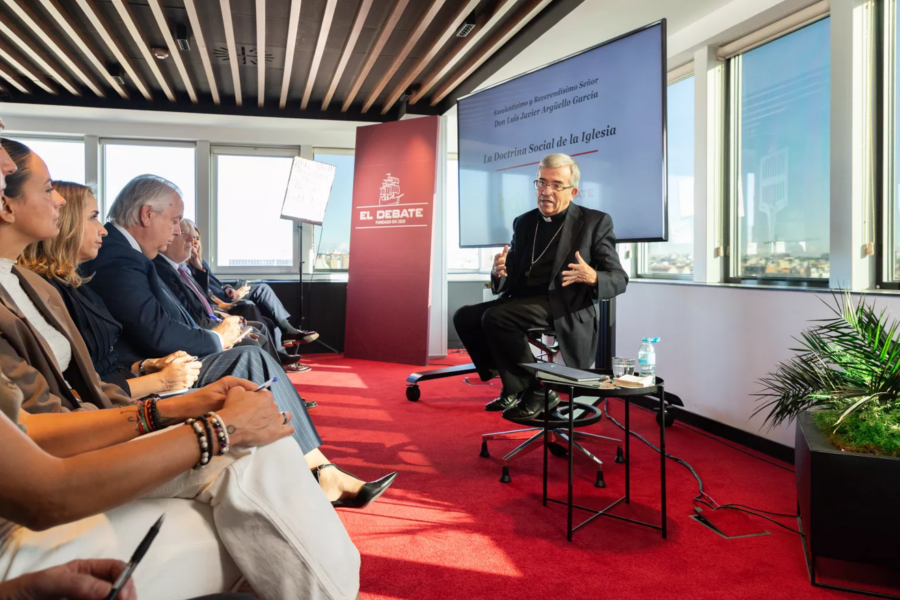
The president of the Spanish Episcopal Conference (CEE) and archbishop of Valladolid, Luis Argüello, has criticized the limited presence of lay Catholics in public debate, especially on issues related to the defense of life, the family, and the conception of the person. The prelate believes there is an excessive dependence on interventions by priests and bishops, while many faithful avoid speaking out on matters that directly affect society.
Argüello made these statements on Tuesday, October 20, during a conference on the Social Doctrine of the Church held at the headquarters of El Debate, in Madrid, before the leaders of the pharmaceutical cooperative Bidafarma. During his speech, he also warned about the influence of gender ideologies, certain reproductive health policies, and radical environmentalism, which he referred to as three major “bioideologies” that are transforming the conception of the human being.
The silence of the laity in public debate
The archbishop lamented that many issues generating social controversy end up being addressed almost exclusively by members of the ecclesiastical hierarchy, when it is also the responsibility of the lay faithful to intervene from their respective professional, political, and institutional responsibilities.
In his view, Catholics working in the media, businesses, or public institutions should actively participate in debates on human dignity, marriage, the family, and the organization of society.
“There is too much of a habit that it is the priests or bishops who speak,” lamented the president of the CEE, who pointed out the lack of more regular participation by Christian laypeople in these matters.
Read also: Argüello, after the clash with Bolaños: “I try to offer an integral Catholic discourse”
As an example of public commitment, he recalled the figure of Ángel Herrera Oria and his promotion of the Catholic Association of Propagandists (ACdP), conceived to encourage the presence of Catholics in Spanish social, political, and cultural life.
Argüello defended that belonging to a particular political current does not prevent believers from expressing their religious convictions and acting in accordance with the principles of the Social Doctrine of the Church, especially on matters related to the dignity of the person and the common good.
Three “bioideologies” that question the Christian conception of man
A large part of the speech was devoted to what the archbishop called the three major “bioideologies” developed during the second half of the 20th century and the first decades of the 21st.
The first is gender ideology, which, he explained, began with a legitimate demand such as equality between men and women and ended up questioning the meaning of sexual difference.
In this context, he criticized Spanish laws on abortion, “homosexual marriage,” and transsexuality, considering that they respond to an anthropological conception promoted by the State in which the body is subordinated to individual will.
The second is related to certain sexual and reproductive health policies, which, according to Argüello, have served to promote legislative reforms favorable to abortion and to spread the contraceptive mentality. The prelate recalled the scientific advances that allow us to better understand the development of human life during gestation and questioned why this knowledge has not led to greater protection of the unborn.
Read also: Argüello: “The bread of our children” does not justify cheating on the tax return
The third is radical environmentalism, which he linked to transhumanist and posthumanist currents. Argüello argued that these three ideological orientations have come to occupy a central place in the program of the political left, displacing traditional demands related to the world of work.
The president of the CEE distinguished between the legitimate objectives that may be found at the origin of these currents—the equality between men and women, the protection of health, and care for the environment—and the anthropological approaches that, in his view, have developed from them.
The Social Doctrine of the Church and the defense of human dignity
During the conference, Argüello also reviewed the historical development of the Social Doctrine of the Church, from the first Christian communities to the teachings of contemporary pontiffs.
He recalled that the Church’s concern for social issues did not begin with the encyclicals of the 19th century, but has its roots in the Gospel, the Acts of the Apostles, and the writings of the Church Fathers.
The archbishop also referred to the transformation of relations between the Church and the State since the French Revolution, as well as the tensions that accompanied the recognition of the autonomy of temporal realities. On this point, he defended the legitimate distinction between both spheres, without this implying the exclusion of Christian principles from the organization of social life.
Read also: León XIV’s first encyclical arrives in Spain with a debate on AI, work, and human dignity
For Argüello, issues related to life, the person, and the family occupy a fundamental place in the Social Doctrine of the Church because they directly affect the structure of society.
The president of the CEE insisted that the defense of human dignity must also guide the activity of Catholics in business, politics, the media, and institutions—areas in which he considers greater involvement of the lay faithful necessary.