


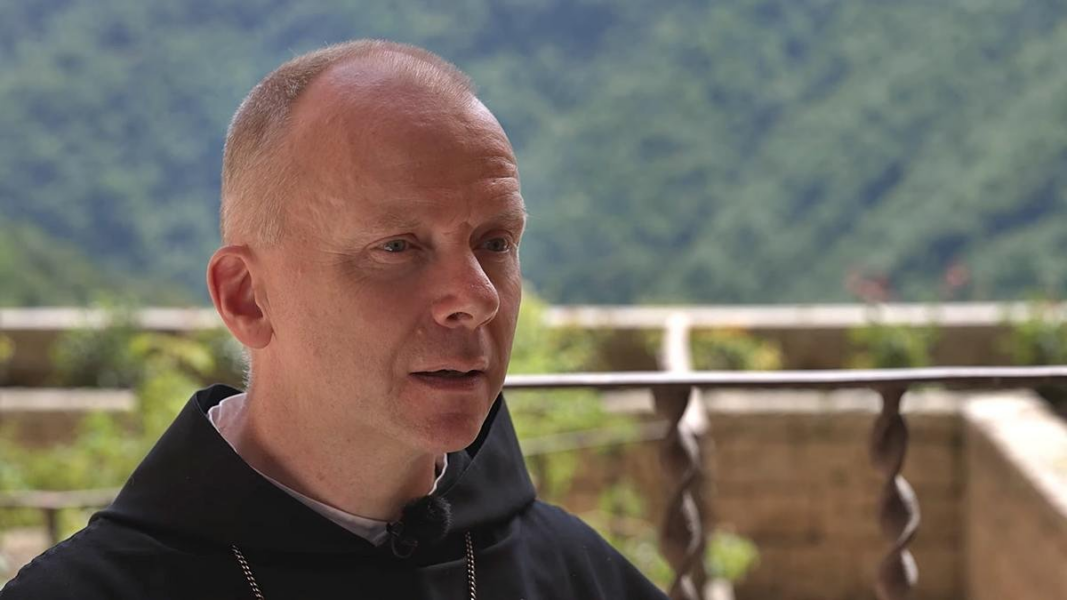
The Bishop of Trondheim (Norway) and President of the Nordic Episcopal Conference, Bishop Erik Varden, published his reflection on the meeting held in Rome from October 7 to 14 on the occasion of the tenth anniversary of Amoris laetitia.
In this address, Varden also develops his considerations on the crisis of the family, chastity, preparation for marriage, the indissolubility of the marital bond, and the evangelizing mission of Christian households.
The prelate clarifies that these are personal reflections and not the official conclusions of the assembly. We reproduce below the complete translation into English of the original text in English, published under the title Laetitiae Amor.
Laetitiae Amor
By Bishop Erik Varden
On the feast of Saint Joseph this year, Pope Leo XIV announced his desire to convene in Rome all the presidents of the episcopal conferences of the world to discuss the repercussions of Amoris laetitia, ten years after its promulgation.
The Holy Father asked us to reflect on how we might more effectively proclaim the Gospel to families.
The meeting, which lasted a week, concluded yesterday. A report will be published once the Holy Father has recovered from his illness—a recovery that we hope, with our prayers, will be swift and complete—but Leo XIV has asked the participants to share without delay their experience of the meeting with their episcopal conferences and dioceses.
The gathering followed a framework structured around five major themes. Each provided material for a full day of exchanges. Below I present my personal reflections on these themes.
These reflections do not speak on behalf of the assembly, whose richness of work everyone will be able to learn in due time. They are simply the contribution of a single voice, a second viola, to this well-composed orchestra.
Families Today
Family life today is subject to pressures of every kind: sociological, economic, and cultural. We are very much aware of them. All deserve consideration.
Yet the most persistent pressure has deeper roots. In a surprisingly short time we have lost our collective understanding of what it means to be human. Except within certain interest groups, it is now difficult to find shared words to describe what a human being is. We no longer agree on what makes a woman a woman, a man a man, or a child a child.
Technological transhumanists project a future in which man will likely be left behind by “progress” unless his nature is “enhanced.” Having abandoned the idea of redemption, we now place our hope in technological upgrades. We assume that today’s parameters will not apply tomorrow. As a result, the very notion of any permanent commitment seems absurd.
Alliances and covenants give way to “deals” in politics and commerce. The same happens with human relationships, increasingly regarded as pragmatic transactions: I remain bound to something, or to someone, as long as I derive some benefit or pleasure from it. Then I move on.
In such a context, the family, as the basic unit of human society, cannot but disintegrate. It no longer seems self-evident that families should be stable units, built on the lifelong bond between a woman and a man, with the hope of begetting children.
A woman and a man may still unite—after all, we live in a free world—but that union is no longer considered categorically distinct from one formed by two women or two men, or by two persons who regard themselves as gender-fluid. Moreover, why restrict that unity to two individuals? Claims for legal recognition of polyamory are spreading.
We find ourselves in a state of metaphysical eclipse.
Faith in God as a benevolent Creator has largely been lost. We no longer believe that our existence was willed. How then can we retain the awareness that our own life is a gift which, in turn, we can hand over, even consecrate, to another person? Ours is an age of desacralization born of a literal hopelessness, of excluding the very possibility of “hope.”
I observe these phenomena in my social environment, in my correspondence and conversations, and in the confessional.
I also note a contrary tendency. I encounter many young people, and not so young, who are weary of the ephemeral. They refuse to abandon “hope.” They dare to think that there might exist something called “truth” on which to build their lives.
If we nurture and support these people, helping them to flourish, we may foster a renewal of family culture. After all, everyone wants to be happy. Many are not. On this sociologists agree. Contemplating a flourishing family will make others wish to flourish as well.
Flourishing does not mean being continually delirious with happiness.
Human life is difficult, whatever its form. I find that most people are quite clear about this. That is why they may grow tired of well-intentioned but repetitive vocabulary about “accompaniment,” “being on the way,” or “being listened to.” Naturally, they wish to be treated with attention and respect, but what they want is guidance, to be shown a goal and taught how to live well.
God became man for this purpose: to show us what life is about and where it is headed, to teach us, through counsel and commandments, how to lead a good and fruitful life.
When Christ met the Samaritan woman at the well, He did not say: “Well, let us sit down and you tell me everything.” It was He who told her “all that she had done” (cf. Jn 4:29).
That was what enabled her to begin a new life.
We need to let Christ tell us who we are, point out our mistaken paths, make us recognize our faults, and direct us toward the end for which we were created.
Christ is our Savior, but not only that. He is also the Image according to which we were created, the Prototype who reveals us to ourselves. We will be pastorally effective to the extent that we remain lovingly obedient to Him.
We may even have the opportunity to restore hope to society.
Young People and the Discovery of Marriage
A study published a couple of years ago by the American College of Pediatricians indicated that 54% of adolescents had viewed pornography before turning thirteen, and 15% before the age of eleven. Those figures have undoubtedly risen since then.
Pornography consumption is fairly widespread among young adults, both men and women, throughout the world. It exerts enormous influence on the way young people relate affectively.
When someone has been harassed since childhood by a universe of lust in which sex is a matter of consumption, where the object of desire can be constantly replaced—though always physically perfect—where romance is absent and there are no rules, taking the step toward a lasting and faithful relationship with a concrete, imperfect, and needy human being, whose otherness cannot be reduced to an abstraction, represents an enormous leap, perhaps insurmountable.
The pornographic universe is transgressive. It suggests limits only to lure consumers into crossing them, hinting at prospects of a power capable of assuming any form.
The classic paradigm of boy meets girl has long been surpassed. Homoeroticism, which not so long ago was linked to the notion of a sexual “orientation,” is now an option available to all, integrated into mainstream entertainment.
Gender-fluidity trends manifest fantasies gestated, often from inner anguish, in the marketplace of an unbound eros, where momentary desire is enthroned as god and objective reality yields to the forms that subjective imagination imposes and provokes.
We lament the seductions of the virtual and the unreal, but that is not enough. We must extend a friendly hand to young men and women trapped in powerful forms of unreality, pull them out of the swamp, and allow them to rediscover the world as it is.
To do so, we must be able to show that this true world is better and, indeed, more interesting, more apt to make a person happy.
Three years ago I published a book titled Chastity. At the time some people mocked me, mainly elderly European men, who assured me that this was a subject that interested no one.
Yet I have been struck to find myself, country after country, speaking before large audiences composed mostly of young people eager to hear what this almost forgotten and seemingly embarrassing virtue consists of.
Far from being seduced by the hyper-eroticized substitutes for relationships, many young people are weary of them. They seek friendship and stable love. I do not say they represent the majority current, but they are numerous enough to indicate a trend.
To help young people discover the value of marriage, we must address this trend, beginning by helping young women and men to be at peace with themselves.
In one of Saint Paul’s principal texts on marriage, in the Letter to the Ephesians, he compares spouses to a body and then observes: “No one ever hated his own flesh” (Eph 5:29).
The problem is that today many people do, and feel estranged from their own bodies.
From a secular perspective, the body is a sack of tendons that can be put to any other use. The extraordinary and liberating Christian message is that I am my body, and that my body, no less than my soul, is made in the image of God and deserves reverence.
If we wish to prepare young people for marriage, we must first help them discover their embodied identity as women and men. Before attempting to help others, we must do this work ourselves.
It may be healthily humbling to discover that, even in maturity, we still have a way to go in this regard.
What language helps young people to mature affectively?
A language of truth that calls things by their name with serenity, without violence, and without ever despairing of God’s mercy. This language recognizes wounds without idealizing the condition of victimhood. It springs from faith in Jesus’ saving will.
Marriage manifests salvation. To be prepared for it, one must first discover that one can be saved.
The Early Years of Married Life
A couple I know told me of a decision they made when they realized their courtship was beginning to get serious.
They went together to a cabin in the woods for a long weekend. During that time, they told each other their life stories.
Both wanted the other to know their entire history, with its lights and shadows, its triumphs and failures. If they were going to commit their future to one another, they wanted to make sure that no obstacles would arise later because of an unrecognized past.
Such an initiative is both courageous and wise.
The essence of love consists in knowing that I can be who I am, without masks, and still be loved. God loves us in that way. Learning to love as He does means doing the same.
Marriage will flourish if both parties can entrust to the other their deepest intimacy.
At the beginning of the marriage rite, the priest asks: “Have you come here freely and of your own will?”
The freedom on which the validity of the sacrament depends requires that the spouses know to whom they are marrying.
Many difficulties that commonly arise during the early years of marriage can be avoided if sincere transparency is sought before ratifying the marital covenant.
The spouses themselves are the ministers of the sacrament. Yet they celebrate it in the church, before the cross.
Answering affirmatively the question “Will you love and honor each other all the days of your life and accept with love the children God sends you?” means consenting to share in the cross.
All conjugal and parental love involves suffering. It will pierce the heart. It will require one’s own life to be poured out so that others may live.
Embracing this reality consciously from the beginning, accepting to share in Christ’s life-giving cross, will give the spouses strength to carry their burdens and will make even heavy things seem light.
The horizontal relationship between husband and wife, between parents and children, will be sustained by a secure and reliable vertical axis.
I love the rite permitted by the Latin liturgy when the priest, after witnessing the marriage vows, wraps the joined hands of the spouses with his stole and says: “What God has joined together, let no one separate.”
Each time he puts on the stole, the priest recites the beautiful vesting prayer: “Lord, restore to me the stole of immortality, which I lost through the action of our first parents.”
The marriage covenant allows us to glimpse the glory that rested upon Adam and Eve before the fall.
In some Eastern rites, the spouses are crowned in recognition of their royal dignity as children of God, recovered by grace.
In our hyper-secularized climate, which sentimentalizes marriage and maintains a consumerist view of children, regarded as goods that can be ordered for a convenient moment, preferably produced according to certain specifications, this supernatural perspective is of great help.
It reminds us that marriage is not only about a woman and a man. It incorporates both into a living communion with God; moreover, it constitutes them together as an image, as a living icon, of the holy Church of God.
Knowing that Christ is constitutively present in their union inspires them in the arduous task of abandoning the first person singular for the first person plural: ceasing to say “I want” and saying “we want”; ceasing to say “I have” and saying “we have.”
This can help them face the elemental force and profound vulnerability of sex, properly integrating its unitive and procreative dimensions.
It will also prepare them to receive children with reverence, as generous gifts from God.
A marriage needs to be sustained by a community.
It is false to regard the couple as self-sufficient, expecting them to generate by themselves all their resources and all their satisfaction. That vision merely applies secular individualism to a collective unit that will end up staggering under such a burden.
This is where the Catholic community and the parish acquire all their importance, called to provide the care, practical help, humor, and compassionate counsel that extended families, now practically vanished, could once offer.
Families in Complex Situations
We speak of the “joy and beauty” of marriage. We do well to do so. These qualities certainly represent an ideal. But we must also be prudent and avoid platitudes.
It suffices to read Anna Karenina or watch Bergman’s Scenes from a Marriage to understand that a couple can make life impossible for each other. We must remember that too.
Before taking the monastic habit, the postulant usually reads a passage from Sirach: “My son, if you come forward to serve the Lord, prepare your soul for testing.”
Engaged couples might do the same. Trials will come.
Pope Francis wrote about Evangelii gaudium, but about Amoris laetitia. It is an interesting semantic distinction.
The basic meaning of the Latin root laet-, from which laetus and laetare derive, is “happiness.” Yet already in classical Latin that root had an agro-ecological meaning indicating the “flourishing” of plants and the “fertility” of the soil.
This makes much sense. “Happy” vegetation grows in soil that has been worked to make it nourishing.
That is why the root laet- could also produce the noun laetamen, “fertilizer.” In antiquity, fertilizer was equivalent to manure, which smells bad.
The laetitia of love presupposes a ground from which stones have been removed, well plowed and provided with a sufficient quantity of nutrient-rich manure.
Pointing this out does not mean taking joy away from marriage and family, but insisting that such joy springs from work, and that this work is hard and often seems unrewarding.
The monastic and marital states of life presuppose and reflect each other.
I believe, and I verify, that families can receive help from the wisdom and experience inherited from monastic life.
Monks live according to a rule that consecrates the covenant of common life and makes explicit its purpose and end.
When husband and wife agree on the purpose of their family, they will be better prepared to face obstacles than if they have not formulated their union as a task.
This is especially true when their shared purpose is transcendent. Then they will allow God to act in them. They will see difficulties as occasions for conversion, for leaving the moldy cell of the self.
Monks and nuns are realistic about the struggles that belong to their vocation.
The earliest monastic literature, the Sayings of the Desert Fathers, addresses directly the usual combats.
These sayings allow monks to seek ways to resolve the concrete problems with which they struggle, under headings as direct as “Detachment,” “Patience,” “Lust,” or “Forbearance.”
The practical applicability of this counsel after fifteen hundred years remains astonishing.
I believe much could be gained by compiling a third collection of Apophthegmata for families, based on experience and illumined by faith, showing how to face trials constructively in the clarifying light of Christ’s commandments and His efficacious grace.
When things get difficult, we narrow our perspective. We see only our present pain, not the path that may extend beyond it.
A fundamental pastoral concern in such situations is to recall the broader picture, allowing those who suffer to discover the potentially fruitful meaning of their difficulties, which can serve to diminish selfishness and purify love.
Marriage, no less than monastic life, is a school of conversion.
As for “irregular” relationships, I find that our Catholic communities usually welcome them in a mature and appropriate manner.
It can be liberating for people in such situations to be in an environment where their “irregularity” is recognized, not relativized, and where, nevertheless, they are welcomed with Christian friendship and allowed to contribute to the community.
I think of the example of many faithful I know who, Sunday after Sunday, come forward to receive a blessing at the time of Communion, knowing that they cannot access the sacrament, but entrusting themselves to the mercy of God at work in the Church.
Their example of fidelity contributes greatly to building up the Christian community. It bears witness to the vital realism of the sacrament and to the virtue of hope.
A sacramental exile sustained over time can prepare a joyful return home.
Christ gave us His demanding commandments to educate us and free us from ourselves, “so that we might no longer live for ourselves but for Him who died and rose for us” (Eucharistic Prayer IV).
His intention is to make us grow into a new, divinized life.
That life must always be the goal we propose to people, not simply human affirmation, though we all also need some of that.
Families as Agents of Mission
What separates the Christian vision of the world from that of secularists?
The conviction that, through all the vicissitudes of history, through all the changes brought about by the evolution of nature and human ingenuity, God’s fidelity to humanity, created in His image, remains absolute.
Whatever happens, the love of God, definitively revealed in Jesus Christ, is secure. It is the rock on which a life, a society, can be built.
Storms may come, winds may blow and strike hard, but this foundation remains.
The first mission of the family is to bear witness to this stable love.
That is why the indissolubility of marriage must be understood as a gift and an exalted task, as a vote of confidence on God’s part (cf. Amoris laetitia, 62).
By promising fidelity to each other until death, husband and wife make present in history the reality of God’s love.
Human nature, wounded by sin, is marked by selfishness and promiscuity: we seek our own advantage and do not mind pursuing it in many directions at once.
In that way we may experience some intense emotions, but we will hardly find serene satisfaction.
We continue to long for a unique and definitive love. There is evidence of this in popular songs of every age, including those of our own age, generally far from God.
Therefore, a family is missionary primarily through its fidelity.
Precisely now, when so many traditional structures of social cohesion are crumbling around us, this mission has vital importance.
A second form of family mission is hospitality.
Just as a monastery “is never without guests” (Rule of Saint Benedict, 53)—it must not be a self-referential club for the exclusive benefit of its members—a Christian family invites others to enter.
“I was a stranger and you welcomed me” (Mt 25:35).
Through a prudent and responsible commitment to this ideal, the cohesion of one’s own family can be strengthened in a spirit of service and courtesy.
Sometimes the question arises: how can families contribute to the formation of priests?
Not primarily by descending en masse on the seminary armed with PowerPoint presentations about family life, but by inviting seminarians and priests—who knows, perhaps even bishops—to share in their lives.
The celibate priest faithful to his vocation reminds the family of its supernatural dimension; the family reminds the priest that his celibacy is ordered to fruitfulness.
From this arises a mutual and joyful benefit.
It is necessary to bear witness to fruitfulness.
Birth rates are falling throughout the world. Our species is not reproducing itself.
Thirty years ago, sociologists were worried about overpopulation and leveled harsh criticism against Catholic teaching on birth regulation.
Now we see that the opposite trend prevails. The determined desire to have children is rapidly declining on every continent.
Catholic family planning must now focus on making it possible for families to say yes to children.
This requires practical measures: affordable housing, childcare services, and schools. Mission has a political dimension.
But above all, it concerns the conversion of hearts.
Wishing to found a fruitful family is today something countercultural, equivalent to wanting to be punk in the turbulent seventies.
The Church is called to support this healthy revolution, enabling young people to choose life and commit to it.
Naturally, any attempt to speak of the family as a missionary agent encounters an exegetical difficulty.
Christ’s attitude toward the family can be demanding.
He calls James and John to abandon their family ties, leaving poor old Zebedee bewildered in his boat (Mk 1:19-21).
The healing of Peter’s mother-in-law leads us to wonder what happened to Peter’s wife when Cephas was called (Mk 1:30-31).
We shudder at these words: “Whoever loves father or mother more than me is not worthy of me; whoever loves son or daughter more than me is not worthy of me” (Mt 10:37).
These statements do not diminish the value of the family, but exhort us to consider it in the light of radical discipleship.
“Seek first the Kingdom of Heaven!” (Mt 6:33).
That principle also applies to families. When it is realized, a family can manifest that Kingdom in a mystical yet recognizable way.
The day after the Roman assembly, while those of us who had the blessing of participating in it remember it with gratitude, the Church celebrates, as Providence has willed, that incomparable Doctor of the Church, Saint Teresa of Ávila.
Today’s Office of Readings offers us a passage from her Autobiography that begins thus:
“Whoever has Jesus Christ with him as friend and noble guide can endure all things. Christ helps and strengthens us, and never abandons us. He is a true friend. And I see clearly that, if we hope to please Him and receive abundance of His graces, God wills that those graces come to us from the hands of Christ, through His most holy humanity, in which God takes delight.”
This is a wonderful perspective from which to consider the graces and challenges of family life.
In the collect prayer of today’s feast we pray: “Kindle in us the desire for true holiness.” Amen!
But is not such a call too lofty for us, poor ordinary people?
No, if we allow God to accomplish His redemption in us and remember the great importance of the ordinary, everyday acts of fidelity that realize and renew a decision made once and for all: to love faithfully.
The last word belongs to Tevye and Golde.