


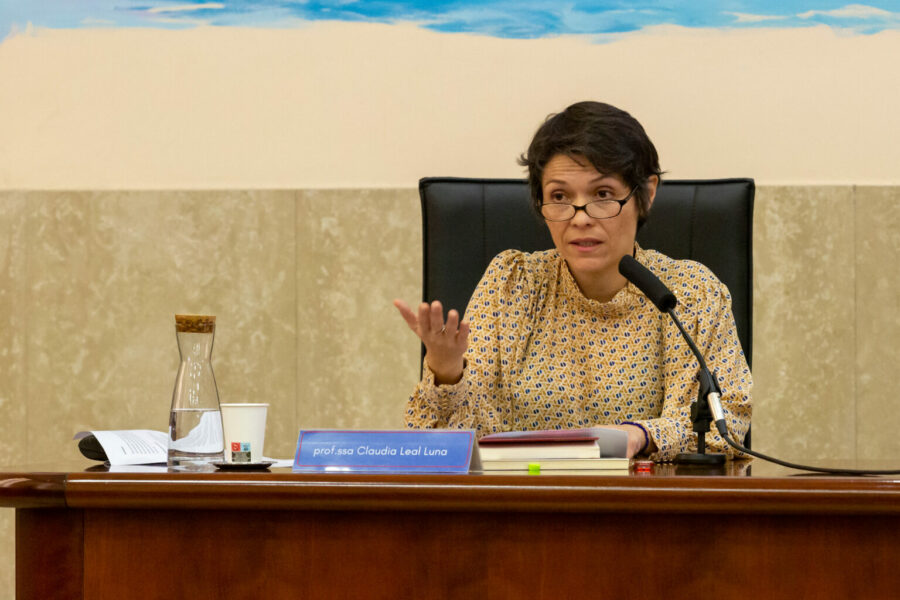
Pope Leo XIV on Monday, October 19, appointed Chilean lay theologian Claudia Leal Luna, ordinary professor at the Pontifical Theological Institute John Paul II for the Sciences of Marriage and Family in Rome and consultant to the Dicastery for the Doctrine of the Faith, as a member of the International Theological Commission. Her name appears among the 24 new members published that day in the bulletin of the Holy See Press Office. According to the Commission’s statutes, the Pope appoints them at the proposal of the prefect of the Dicastery for the Doctrine of the Faith, currently Cardinal Víctor Manuel Fernández. Leal is the theologian who in March 2021 publicly criticized the document with which the then Congregation for the Doctrine of the Faith declared that the Church has no power to bless same-sex unions, and which she described its anthropology as “somewhat taxidermic.”
She said so in an interview with Radio Universidad de Chile published on March 17, 2021, two days after the Vatican text was released, when she was a faculty member at the Faculty of Theology of the Pontifical Catholic University of Chile. The station headlined her main thesis: “Christian tradition’s sexual morality still needs to take some steps.”
The document she was responding to was a Responsum ad dubium dated February 22, 2021, signed by Cardinal Luis Ladaria, then prefect, and by Archbishop Giacomo Morandi, secretary, and published with the assent of Francis. To the question of whether the Church has the power to bless same-sex unions, it answered “negatively.” The explanatory note clarified that God “does not and cannot bless sin: He blesses the sinful human being, so that the person may recognize himself or herself as part of His plan of love and allow Himself to be changed by Him.” The text also clarified that the response “does not exclude blessings being imparted to individual persons with homosexual inclinations” who manifest the will to live in fidelity to God’s designs, and that the declaration of unlawfulness was not “unjust discrimination.”
Leal stated in the interview that the document had left “a bitter taste in a great many people” and that she had no doubt that the current sensibility of Catholics around the world was experiencing “an epistemological shock upon reading this.” Her fundamental objection was directed at the distinction between the person and his or her relationships on which the text rests. In her view, a personalist anthropology such as that of John Paul II would hardly make that distinction, “because these are constitutive of what we are as persons.” Hence her description: the document had “a somewhat taxidermic anthropology.”
In the same conversation she maintained that Catholic social morality has engaged in dialogue with the human sciences, but that sexual morality “still needs to take some steps with philosophy, psychology, sociology.” She interpreted the Responsum as having “not the LGTBI world as its privileged interlocutor, but priests and bishops,” and as saying “nothing new about sexual diversity.” She added that what Catholics can demand is that “we not only be told what is excluded, but also what is included.” She also warned that in pastoral care with homosexual persons “gays cannot be turned into a banner.”
The teaching applied by the Responsum is contained in the Catechism of the Catholic Church. Number 2357 recalls that Tradition has always declared that homosexual acts “are intrinsically disordered” and cannot receive approval in any case. Number 2358 asks that persons with this inclination be received “with respect, compassion and sensitivity,” and 2359 calls them to chastity. The distinction between the person, who must be received, and the acts or unions, which cannot be approved, is the one the Responsum transferred to the realm of blessings and which Leal considered incompatible with a personalist anthropology.
Nine months later, on December 23, 2021, Leal granted an interview to El Dínamo in which she declared herself in favor of feminism: “Anyone who has studied social ethics cannot refuse the cause of feminism.” She explained that she teaches a semester-long course titled “Sexuality in the Christian Tradition,” which, in her words, shows that this tradition “is much less monolithic than is thought.” Asked about the Constituent Convention that was then drafting a new Constitution for Chile, she said she had “enormous expectations” for it and valued its inclusion of concern for the environment, for gender equality and “for the rights of LGBT+ groups.” In the same interview she recounted that her students had made her see that, when she spoke of sexual diversity, she did not include asexual people, and she acknowledged that that group was not on her “mental map.”
Before those statements, Leal had been a regular voice in the Chilean press during the abuse crisis that shook the Church in the country. In May 2018 she asked on Radio Universidad de Chile for “courageous leaders”; in September of that year she maintained that the figure of Cardinal Francisco Javier Errázuriz did not lend credibility to the council of cardinals advising Francis; and in February 2019, ahead of the Vatican summit on abuse, she warned that one should not have “great expectations.” In El Dínamo she stated that the institution had not had “a culture of accountability” and that the crisis had not ended. She was part of the Catholic University’s committee for the Church crisis in Chile and has researched sexual abuse against adult women in ecclesial contexts, a topic on which she published a chapter in 2021 with Daniela Bolívar and, later, an article in the Journal of Moral Theology that proposes understanding abuse “from a gender perspective.”
Her curriculum vitae, published by the John Paul II Institute, details a formation that began in law. She earned a degree in Legal and Social Sciences from the University of Chile, obtained a bachelor’s degree in Theology from the Pontifical Catholic University of Chile, and completed her licentiate and doctorate in Moral Theology at the Alphonsian Academy in Rome, where she received her doctorate in 2012 with the thesis “Ethics in Search of an Anthropology. Redefinitions for a Paradigm of Plural Human Identity.” From 2012 to 2022 she taught at the Faculty of Theology of the Chilean Catholic University, where she directed general theological formation beginning in 2017.
The same document records her membership, since 2010, in Catholic Theological Ethics in the World Church (CTEWC), the international network of moral theologians founded by Jesuit James Keenan, and since 2012 in Teologanda, a collective of women theologians that emerged in Argentina. She is also listed as a member of the Chilean Society of Theology and of the Italian association of moral theologians. In 2017 she wrote the chapter on Chile for the German volume “Gender studieren. Lernprozess für Theologie und Kirche,” edited by Margit Eckholt. According to theologian Gerhard Marschütz’s review, the book aims to de-ideologize the debate against those who speak of “gender ideology” and maintains that the ontological-substantial approach with which the Magisterium thinks about sexual difference cannot continue to develop. This outlet has not been able to consult Leal’s chapter.
In 2022 she joined the Pontifical Theological Institute John Paul II as a tenured professor, the center that Francis refounded in 2017 with the motu proprio Summa familiae cura on the former John Paul II Institute for Studies on Marriage and Family. In July 2019, after the approval of the new statutes, professors Livio Melina and José Noriega were removed, and moral theology disappeared from the study plans in its previous form. Leal is now ordinary professor of Fundamental Theology of Marriage and Family. In the Institute’s profile she lists as her research lines Christian sexual ethics applied to the couple, the family and culture, and the ethics of care, feminism and narrative ethics. Her curriculum vitae also presents her as a visiting professor at the Faculty of Missiology of the Urbaniana University.
That same year she participated in the international congress of moral theology “Pastoral Practices, Life Experience and Moral Theology: Amoris laetitia between New Opportunities and New Paths,” held in Rome from May 11 to 14, 2022, by the Pontifical Gregorian University and the John Paul II Institute at the request of the Dicastery for Laity, Family and Life. It was organized by Jesuit Miguel Yáñez and priest Maurizio Chiodi, and James Keenan was on its scientific committee. Leal spoke on May 11, still as a professor at the Catholic University of Chile, in the session on the reception of Amoris laetitia in pastoral practices. Francis received the participants on the 13th. Her chapter, “La recezione di Amoris Laetitia in Cile,” was published in 2023 in the congress proceedings, edited by Chiodi and Yáñez at San Paolo.
A text in Spanish with the same title, “La recepción de Amoris Laetitia en Chile,” signed by Leal as doctor from the Alphonsian Academy and tenured professor at the John Paul II Institute, is hosted on the website of Crismhom, the association of LGTBI Christians in Madrid, in a September 2022 folder. In it she records the initial disappointment of those who expected more from the exhortation, because “there was no innovation whatsoever regarding the situation of sexual diversities,” and highlights that Amoris laetitia gave legitimacy to the “Pastoral Care of Sexual Diversity” of several Chilean dioceses, which work with those who “identify with dissident sexual identities” and with their families. Among the issues that, according to her writing, the exhortation reopens, she lists “fecundity, pleasure, courtship, fatherhood, gender justice.” The same text states that “it is not a matter of renouncing the doctrinal truths that Tradition must safeguard.” It is not known whether Leal authorized its publication on that website.
On September 23, 2024, the Press Office bulletin published the list of 28 new consultants to the Dicastery for the Doctrine of the Faith. Leal appeared on it as ordinary professor at the John Paul II Institute. On the same list were Maurizio Chiodi, professor at the same Institute; priest Aristide Fumagalli, of the Theological Faculty of Northern Italy; and Monsignor Carlo Dell’Osso, secretary of the Pontifical Institute of Christian Archaeology, who now also joins the Theological Commission.
Chiodi had been at the center of a controversy in December 2017 when, in a conference at the Gregorian on Humanae vitae read in light of Amoris laetitia, he maintained that there are circumstances in which artificial contraceptive methods can be the responsible option. According to EWTN’s report on his appointment as consultant, in another conference in Rome that same year he stated that a homosexual relationship could be, “under certain conditions,” the most fruitful path for persons with that attraction. Fumagalli is the author of “L’amore possibile. Persone omosessuali e morale cristiana” (2020), a book which, according to the review published by Avvenire, maintains that homosexual acts can be an expression of personal Christian love when they are not marked by idolatry or hedonistic selfishness.
Between Leal’s interview and her appointment as consultant, the dicastery changed prefect and pastoral criterion. On December 18, 2023, already with Fernández at the head, it published the declaration Fiducia supplicans, approved by Francis, which authorizes spontaneous and non-liturgical blessings for couples in irregular situations and for same-sex couples, with the clarification that the union is not blessed and that the doctrine on marriage is not modified.
The International Theological Commission is governed by the statutes of the motu proprio Tredecim anni, of 1982. Its article 1 entrusts it with “studying doctrinal questions of special importance” to assist the Magisterium and, in particular, the Dicastery for the Doctrine of the Faith. Article 3 requires that its members be distinguished by their “learning, prudence and fidelity to the Magisterium of the Church.” Article 4 establishes that they are appointed by the Pope at the proposal of the prefect of the dicastery, after consulting the episcopal conferences. The previous composition was appointed in 2021, with Ladaria as prefect; that of 2026 is the first to be formed since Fernández took office, in September 2023. According to Vatican News, the 24 new members join six who continue, to complete the maximum of 30, and the number of laypersons and the number of women rises to eight in each case.
The appointment comes five days after the conclusion in the Vatican of the meeting that Leo XIV convened from October 7 to 14 with the presidents of the episcopal conferences and the heads of the Eastern Churches for a synodal discernment on the proclamation of the Gospel to families ten years after Amoris laetitia. Its synthesis report has not been made public: according to The Boston Pilot, the Pope wants to review it personally first. According to Europa Press, Ángel Cordovilla, dean of Theology at the Pontifical University Comillas and another of the new members, anticipates that the Commission will work on the family on the occasion of that anniversary, the subject Leal teaches in Rome.
This outlet has not found public statements by Leal on Humanae vitae, on Fiducia supplicans or on the female diaconate. Nor is it recorded that she has retracted her 2021 statements on the Responsum. Her most recent publications include an article on liberation theology as a search for social justice (Studia Moralia, 2024), a chapter on Gaudium et spes in a volume on modern Catholic teaching about the family (Georgetown University Press, 2024) and an article titled “The Public Face of Motherhood. A Christian Perspective” (Anthropotes, 2025).
Read also
- Leo XIV renews the International Theological Commission with 24 appointments, including the dean of Comillas
- The Pope appoints the heterodox Maurizio Chiodi as consultant to the Dicastery for the Doctrine of the Faith
- Melina dismantles Paglia’s account of the John Paul II Institute: “It was an ideological operation”