


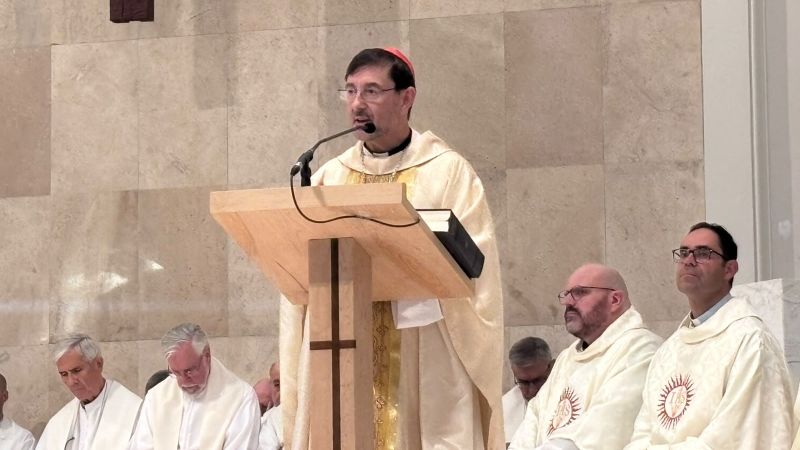
Cardinal José Cobo devoted nearly an hour to explaining in Barcelona that synodality is “an old novelty,” but the real information came during the Q&A. Before the conciliar-minded Catalan Catholics gathered at the XIV Joan Carrera Tribune, the Archbishop of Madrid and Vice-President of the Spanish Bishops’ Conference, a member of the Dicastery for Bishops since September 2023, described how episcopal shortlists are drawn up, spoke of 800-page dossiers, assured the audience that Leo XIV, operated on two days earlier at the Gemelli Polyclinic, was still signing documents, and called for a revision of the Code of Canon Law in a synodal key that, in his words, “is already urgent.” When the moderator read out a question that took for granted the “danger of the far right coming to power,” he responded with a plea against polarisation and did not challenge the premise.
The lunch-colloquium took place on Thursday 15 October, six weeks before the general election on 29 November. That morning Cobo had visited the Sagrada Família and arrived at the Tribune—convened by Catalan Christian organisations—to deliver the lecture “The call to walk in synodality: an old novelty.” The welcome made the setting clear. “You’re playing at home, even though we’re Barça fans,” the organisers told him, because he was addressing “a decidedly conciliar Church,” “a Church of the poor and for the poor,” and a Church “also in dialogue with the political world.” According to the Catalan press, the Justice Minister Ramon Espadaler, the auxiliary bishop of Barcelona Javier Vilanova, the bishop of Sant Feliu de Llobregat Xabier Gómez and the Abbot of Montserrat Manuel Gasch were all in the hall. Cardinal Juan José Omella, Archbishop of Barcelona, was absent because he was leading a spiritual retreat in Marseille. The moderator was Glòria Barrete of Catalunya Religió.
Cobo was introduced by his pastoral vicar, José Luis Segovia, who ran through the cardinal’s biography in a friendly tone: his birth in Sabiote (Jaén), the family’s move to Madrid, his Salesian schooling, his law degree at the Complutense, his seminary years under rector Juan Martín Velasco, his ordination in 1994, his time as vice-chaplain of the Workers’ Guilds, as parish vicar at San Leopoldo and as parish priest and dean. Then came the episcopal vicariate, the auxiliary bishopric, the archbishopric and the cardinalate—all, Segovia said, “at enormous speed.” He described Cobo as a “pastoral animal” with “a vision of the game that anticipates the future by a long way” and presented the government of Madrid as an echo of two lines Leo XIV had set out at the last consistory: Evangelii gaudium and the synodal Church. Cobo began by apologising for not being able to speak Catalan and thanked Segovia with a joke: as his pastoral vicar, he had “already earned his dessert.”
The lecture opened with two images. The first was of the Titanic’s musicians continuing to play as the ship sinks. Read as a parable, Cobo said, it teaches that “it is possible to do very well what we have always done and yet fail to respond to reality.” The Church can celebrate well, maintain its structures and sustain prestigious institutions without noticing “that the ship is changing.” The question, he added, is “whether we are still listening to what God is asking of us now.” The second image was Jonah, the prophet who resists going to Nineveh because he believes effectiveness depends on him. “Jonah’s problem is that he has already passed judgement on Nineveh before God has,” Cobo summarised. The city converts and the book ends with a conversion still pending—the prophet’s. From this Cobo drew the first call of the afternoon: “to stop asking ourselves in the Church only what we have to do and start asking what God is doing.” Thinking that “we are the ones who bring God” is, he said, “rather presumptuous.”
Cobo acknowledged that the word makes people uneasy. “When we talk about synodality, some people here get very nervous,” he said, while others receive it with enthusiasm, weariness or as “a one-day flower.” His thesis is that it is not an invention but something “in the Church’s DNA since it was born at Pentecost” and that in certain periods it weakened until it became inoperative. “We do not move forward by inventing, but by renewing and returning to our origins,” he maintained. To support this he cited St Vincent of Lérins, the fifth-century monk who formulated the classic criterion of doctrinal continuity, and his idea that the true development of doctrine consists in “growing while remaining identical.” Cobo applied it thus: the Church changes “only to remain itself,” and synodality does not consist in “changing identity, as some may say,” but in “a change of style,” a change “in the ecclesial way of proceeding.” He also stated that “synodality does not alter the hierarchical nature of the Church.” What it does, he explained, is oblige us to understand the Church as the people of God and to articulate the ordained ministry, the sensus fidei and the charisms under what he called “differentiated co-responsibility.”
The biblical journey was long. Cobo presented communal walking as the “original experience” of the people of Israel and slipped in a passing criticism of a certain spirituality currently in vogue: “Our God is not an introspective God, even if some now want to say that is all he is.” He saw in Emmaus “the prototype of synodality,” with a sequence he summarised in five words—“listening, discernment, word, celebration and mission”—and in the Council of Jerusalem in Acts 15 the formula for ecclesial decision-making, which he quoted as: “It has seemed good to the Holy Spirit and to us.” He stressed the order of the factors: first the Spirit and then discernment, not that “the majority has voted.” From Vatican II he highlighted the recovery of the Church as the people of God and affirmed that we are living today “a new reception of the Council and a new practical application.” He recalled that Francis placed synodality at the centre of ecclesial life and assured that Leo XIV has taken the same path: at the consistory, he said, one of the emphases was “to cultivate the synodal style based on encounter, listening and shared discernment.”
He organised his proposal around four words. The first, people of God, with the quotation from Lumen gentium 9 and the reminder that the Council placed that chapter before those devoted to the ministries. The second, baptism: “Before being lay people, religious, priests or bishops, we are all Christian faithful.” The third, the “mutual need” between pastors and faithful in Lumen gentium 32, which he distinguished from mere collaboration, because the Spirit “has not given all gifts to one ministry.” The fourth, discerning together, because the Spirit acts “in the whole people of God,” not only in “those who have more time.” Here he placed his approach to authority. Decisions are prepared through listening, experience, competence, prayer and discernment, and “afterwards, the one who has ministerial responsibility assumes the decision that corresponds to him.” He condensed it into a phrase: “Not all of us have to decide everything, but no one should decide in solitude what we need to discern together.”
The second part, which Cobo called “the second course,” listed six challenges “from the pastoral experience of a diocese like Madrid.” The first is “the urgent need to recover a baptismal culture,” that is, to move from a Church sustained by “sociological inheritance” to one formed by baptised people aware of their vocation. “Baptism does not generate individuals. Baptism generates an ecclesial we,” he said. He recounted that Madrid has opened eight pilot adult catechumenate centres in different neighbourhoods, because “it is not the same to make a Christian in the north of Madrid as in the south of Madrid,” and that lay formation should not serve to “form collaborators” but Christians who live their vocation in the family, work and society.
The second challenge is to move from collaboration to mutual need. Cobo admitted that “there still persists a vision according to which the priest has a greater mission” and the laity help him, and he placed it in his diocese with irony: “it still happens in Madrid; I can’t imagine it here.” “The lay person is not important only when he occupies clerical spaces,” he added, but because of his “family, professional, political, social” experience. His formula was “no one is superfluous, but no one is sufficient.” He explained that Madrid is redesigning a territorial structure conceived for “a Madrid of the 1950s,” in order to reduce it, strengthen the deaneries and promote transversal work between delegations, parishes, schools and movements.
The third consists in “making decisions together, exercising authority in a new way,” with special emphasis on “accountability, not only financial.” “Whoever exercises authority must listen, decide, explain and review,” he said, adding that transparency “is not simply an economic or social category” but an ecclesial one, because it obliges us to say “why decisions have been taken and how they have been taken.” As a thermometer he pointed to pastoral councils and described a governance decision with consequences for the Madrid clergy: the statutes approved in Madrid make them obligatory and provide for a lay coordinator in each council. He acknowledged that the measure has caused “some difficulty” because “there are some who did not want it.”
The fourth challenge is what he called “listening to concrete persons.” Cobo criticised speaking of young people, women, the poor, migrants or the distant as faceless collectives, and of speaking much about them and little with them. “It is not enough to constitute a Church for the poor. We need the poor to speak,” he affirmed. He proposed as a method the conversation in the Spirit and recounted that he had just come from the Rome meeting marking ten years of Amoris laetitia, which he attended as a personal guest of the Pope: “We have spent a whole week every day […] practising the conversation in the Spirit.” He contrasted it with debates and round tables “where each person goes and convinces himself and his own,” and announced parish assemblies and a forthcoming youth assembly with the same dynamic.
The fifth challenge, which he described as “very much the Pope Leo’s,” is to move “from polarisation to polyphony” and from juxtaposition to network. “Pentecost did not eliminate languages,” he recalled. He asked that we maintain “that disagreement is legitimate, but it must not break communion and still less persons,” and lamented that parishes, schools, Caritas, consecrated life and movements each work “in their own sphere.” At this point he took stock of the papal visit in June, which he said had given “an important boost” to the encounters the archdiocese had been holding “with universities, with business people, with trade unions, with Christians from other political sensibilities.” “If the Church has a mission in the public world it is to provoke these encounters,” he said, “even if sometimes everyone gives us a bit of a slap each,” because “that is what those who set the table have to do.”
The sixth challenge is to form missionary disciples. “It is not enough to put a subject in the seminary,” he warned, nor to “produce documents, which is a temptation.” He gave as an example Convivium, the presbyteral assembly Madrid held in February. The priests, he said, did not ask for documents or new structures, but discovered “the joy of the encounter of the different,” priests who “because of ideology” or trajectory had never coincided before. Of the Madrid seminary he recounted that it already functions with “new governing bodies,” with “lay advice” and with “the presence of families.” He closed the block by defining synodality as “a personal, institutional, structural and heartfelt conversion.”
He ended in the Sagrada Família. He recalled Valentina, the blind girl who during the Pope’s visit explained the tower of Jesus Christ with a tactile model: “A girl who cannot see could help those of us who can see to contemplate better.” The basilica, he said, is the work of Gaudí and also of architects, anonymous workers and even the glass taken from bottles. “Nothing is superfluous.” He returned to Jonah to say goodbye with a confession: “We walk without knowing what the map is. I don’t know it. And they ask me a lot, what do we have to do? I say, I don’t know.” The final question, he proposed, is not what structures need to be changed, but “what Church we are generating with our way of relating to one another.”
The cardinal asked the audience to stand so he could see the whole hall, and Barrete grouped the questions into blocks with a warning about the brevity of the answers, because there were many. The first touched on seminaries. An attendee said he had the impression that they do not form people in synodality, “judging by what we see in some young priests.” Cobo, who explained that he had coordinated the Synod’s fourth group, devoted to formation, replied that “there are experiences of all kinds.” What is sought, he said, is not a subject, but “that formation have a synodal structure,” with families and laity involved, and that the seminary not be “a college where a staff is formed.” Of the seminarians he said they are children of their time and added: “We would like young people to be different. Well, they used to say the same about us.” He admitted that seminaries are adopting the model “with a certain slowness” and hoped they would do so “with a little more grace.”
Another question asked whether fear of ruptures, “of others leaving,” slows reforms. Cobo essentially admitted it. “The trauma the Church has had from the beginning is rupture,” he said, because what hurts a mother most “is the departure of her son.” He contrasted the logic of a boss who fires at the first opportunity with that of motherhood: “the mother is the one who takes longest to throw you out of the house.” He named no group. As an example of the opposite, of a return, he recounted that the day before he had attended “the incorporation of the Chaldeans after many centuries.” The Chaldean Church has been in communion with Rome since the mid-sixteenth century. What was celebrated on Wednesday 14 in St Peter’s Square, at the closing Mass of the meeting on Amoris laetitia presided over by Cardinal Luis Antonio Tagle in place of the hospitalised Pope, was the public manifestation of the ecclesial communion that Leo XIV granted in April to the new Patriarch of Baghdad of the Chaldeans, Polis III Nona.
On the role of women, Cobo rejected framing it as a division of roles or as a quota issue. Against those who demand that there be “as many women,” he proposed: “let us have baptised people and respect one another.” He went further in his diagnosis. The Church’s problem, he said, has been to adopt categories from one era and transfer them to itself, and “that has been our sin.” He thanked “our culture” for having “woken up” the Church, which he described as “an institution that has a lot of time and that has to wake up a lot.” He affirmed that the dignity of women in the Church “is indisputable” and asked for patience with the comparison of a family, whose structure does not change because someone arrives to impose it. Even so, he concluded that we must “change the score” to address “a deficit we have just discovered.”
He was then asked whether, despite the advances, priests and bishops continue to take far-reaching decisions unilaterally. Cobo replied that this ends “by conviction, not by imposition,” distinguished between decision-making and its execution, and downplayed the weight of Roman texts, because documents of the Holy See, he said, have “their own journey.” What is decisive, he maintained, is a “conversion of relationships” that allows the community to hold accountable whoever decides, whether “an authorised lay person or a minister or a presbyter who does not want to consult anyone,” with a simple question: “listen, why did you take this decision?” He even proposed “a Lent so that this conversion of relationships can take place.”
The question the hall had been waiting for came next. How and when will synodality, or accountability, be applied to the election of bishops? The questioner made it concrete: he did not know if there would be many people in the hall who could raise their hand to say they had been consulted in the election of the next Archbishop of Barcelona. Someone added “Pontifical Secret” and there was laughter. “Well, here is the million-dollar question,” Cobo admitted, warning that he would be brief. From the table they reassured him (“The restaurant doesn’t close”) and he replied: “I won’t be quick.” It was the longest and most informative answer of the afternoon.
Cobo started from a principle: the election of a bishop “is not simply a parliamentary election,” but a double dialogue between the local community and the rest of the Church, which Peter harmonises so that no particular Church chooses its own pastors for itself. From there he spoke from within. “It falls to me to be in the Dicastery for Bishops,” he said, and in the “two and a half, three years” he has been there he has seen how “the procedure is continually changing.” He explained that the consultation is coordinated by the nuncios and is not limited to the vacant diocese. In the case of Madrid, he gave as an example, people outside are also asked who could go to the see. The nuncio systematises the candidacies, counts who appears “twice, three times, eight times,” studies the difficulties and sends a first study to the dicastery, which does its own and sometimes asks for more information. “I know, I say it because we have the 800-page reports,” he specified.
He defended secrecy with a personal argument: the processes are long and reserved because “we are talking about people’s lives,” and a report may contain data that do not need to be public. “We are talking about persons, not about positions,” he summarised. He recounted that the dicastery aspires to a consultation “equal between laity and ministers,” with the same number of consulted from each group, but that many responses do not arrive. For a small diocese, he detailed, there may be about 80 initial reports and a second round if they are not enough, directed to the governing bodies, to the most relevant groups in the diocese, to the ecclesiastical province and to the dioceses through which the candidate has passed. What there will not be, he clarified, is an open consultation: “We are not going to put it in the parish or cathedral square, whoever wants to report.”
He also described the final phase. A rapporteur from the dicastery, “a person who is a hero,” reads the complete file and summarises what has been received about each candidate: the opinion of the area, that from outside and that of the nuncio. Then the plenary discusses it. “There are 18 of us,” he specified, and recalled that until recently Cardinal Omella was part of it, who “has already said goodbye.” Omella turned 80 on 21 April, the age at which cardinals cease to be members of the dicasteries of the Curia. To the Pope, Cobo explained, three names arrive, although the candidates could be fifteen. He said the dicastery’s task is to guarantee that the process is consultative and to enrich it “with criteria of synodality,” although he admitted that changing things in the Vatican and in Rome goes “a little more” slowly than in other places. He attributed to Leo XIV, who was prefect of the dicastery before his election, direct knowledge of those difficulties and assured that “he has already begun to incorporate changes,” without specifying which. Cobo spoke of three years of Prevost at the head of the dicastery. It was a little more than two, between 2023 and his election in May 2025.
He concluded the explanation with a definition. What is sought is not “a leader or a parliamentarian,” but “a pastor,” and at the end of the process “Peter decides,” after listening to everyone. He added a wish directed at the hall: “I hope the Pope will present you with a magnificent bishop.” The figure of 800 pages provoked a comment from the table and Cobo returned to it to explain the consultations. He acknowledged that in Spain there are many open processes and joked that they will have to open in the dicastery “a department just for Spain.” According to the count this portal published in July, there were then four vacant dioceses and six bishops over 75.
The hall wanted a date for Barcelona and did not get one, but it did get a signal. Amid jokes about whether the appointment would be “very good” or “very soon,” Cobo insisted that the final decision and the timing belong to the Pope, and ruled out that the hospital admission would paralyse appointments: “Don’t think it’s going to stop because he is already […] receiving and already taking and signing papers.” Leo XIV had been operated on Tuesday 13 at the Gemelli, where the lower lobe of his right lung was removed, and the Vatican confirmed that the lesion was an adenocarcinoma. On Barcelona, the cardinal added that the archdiocese has “some very good auxiliary bishops who in the meantime are there.” “We will not put anyone in a difficult position,” they cut in from the table before moving to the next question. Off microphone, according to Jordi Llisterri in his column in Catalunya Religió, Cobo told some attendees that the appointment would not take long.
The next question was presented by Barrete as “complicated because it is a reality” and she read it as it arrived: “Spain is in a moment of great polarisation. There is a danger that the far right will come to power. What can you tell us about this?” It was accompanied by another on immigration and whether the Church can help avoid polarisation. Cobo did not question the premise nor name any party, and the migration part went unanswered. He began with Leo XIV’s speech in the Congress of Deputies, which he described as a parable of politics: words that everyone applauded “not because they agree, but because they were disarming words,” and the image of the skylight of the hemicycle, through which light enters for all. “We are at a moment where the value of the disarmed and disarming word is crucial,” he said. He added that it is not “simply” fear or opposition, in a sentence he left unfinished, and that “the Church can never be in this”: “They cannot force us into with me or against me.”
He asked two things for the campaign. The first, to value the word and dare to “speak of politics but with a capital P.” The second, not to cross a frontier he defined precisely: “the risk is the denigration of the person.” “We can discuss ideas and it is good to discuss ideas. The problem is when we already want to annihilate the person,” he said, and described that drift as “a red line we must not allow.” “The other, even if he does not agree with me at all, does not deserve an insult from me,” he added, before the phrase that made the day’s headlines: “I am afraid that this polarisation we are living in will lead to a drift of […] a game of daggers crossing.” He claimed that the Church has at other times been an “instrument of consensus, instrument of dialogue” and addressed the hall: “some of you here have been and have participated in it.”
Several questions coincided in that ordinary people do not understand the word “synodal” and proposed replacing it with “participation.” Cobo defended keeping it, as “agape” or “eucharist” are kept, because it is the original word, and recalled that the documents accompany it with the formula “communion, participation and mission.” His underlying argument was generational. In a world that promotes individuality, he said, young people speak of “God and me,” and that is why synodality “is very disruptive.” He also responded to those who maintain that it is “an invention”: “No, well look, it is there,” from the beginning of the Church.
The question on Canon Law received the most concrete answer. Does synodality require a thorough revision of the Code? “I think that is the next step,” Cobo replied. The difficulty, he explained, is that a synodal spirituality and organisms are being worked on, “but we lack […] the canonical structure to develop it.” He gave the example of pastoral councils, which “canonically are not obligatory,” and to which Madrid has had to give “a canonical structure of obligation.” He said he has raised it “in different forums” and that “that revision of canon law in a synodal key is already urgent.” The current Code leaves the diocesan pastoral council to what pastoral circumstances advise (c. 511) and the parochial one to the judgement of the bishop, having heard the presbyteral council (c. 536 §1), so that the obligation decided in Madrid falls within the faculties of the archbishop. The same canon establishes that the parish council is presided over by the parish priest and has a merely consultative vote (c. 536 §2), a framework with which the lay coordinator described by the cardinal will have to coexist.
Representatives of the Fundació Escola Cristiana de Catalunya asked about the role of the Catholic school in the face of secularisation. Cobo replied that the school “cannot be alone,” that before it could because society was homogeneous and that now it needs the family and the parish, in a village that educates as a whole. His warning for the future was an education that is not “dehumanising” and does not let the pupil “be educated by artificial intelligence,” and that can say that “the person is at the centre.”
The question on the peripheries, on where the Church does not want to go today and how the wear and tear of always being on the frontier is borne, drew applause from the hall. “The frontier is our place, it cannot be wear and tear. If the frontier wears us out, we are in trouble,” said Cobo, who cited Paul VI and his “primarily Samaritan” Church. He accepted the diagnosis of decline (“We are fewer, we are few and many say we are older”), but offered another reading: “I do not know a reality of exclusion where there is not something of the Church,” at least in Madrid. What has saved the Church, he maintained, has not been power or numbers, nor having reason: “That we have reason, well neither, because maybe we don’t have to have it.” What saves is charity. “The day we lose that, the Church ceases to be the Church.”
The last question came from Madrid and was about Convivium. Cobo explained that the Madrid clergy never met, that at most 500 priests from a presbyterate of about 1,800 “of all kinds” would gather, and that the previous process was organised by age and not by vicariates. He recounted that at a conversation table in the Spirit priests of very different positions coincided who asked him for a photo because they had never imagined sitting together, and he presented it as proof that it is not the idea that unites, but that “the Church is the bond.” He spoke of priests who confront each other on social media and then embrace, and summarised the experience as “an important shot in the arm for the Church of Madrid.” The youth assembly, he announced, will follow the same style.
Barrete closed the colloquium with an embrace “from a distance” and a welcome to Catalonia. Cobo said goodbye asking those present to continue adding challenges to his list and to be “good disciples of synodality,” and compared the pending work with the analysis of Amoris laetitia ten years after its publication. The organisers announced that the XV Joan Carrera Tribune will have as speaker, on 2 February, Andrea Tornielli, editorial director of the Dicastery for Communication. By then, judging by what the Archbishop of Madrid let drop in Barcelona, the succession of Omella should be resolved.
Read also