


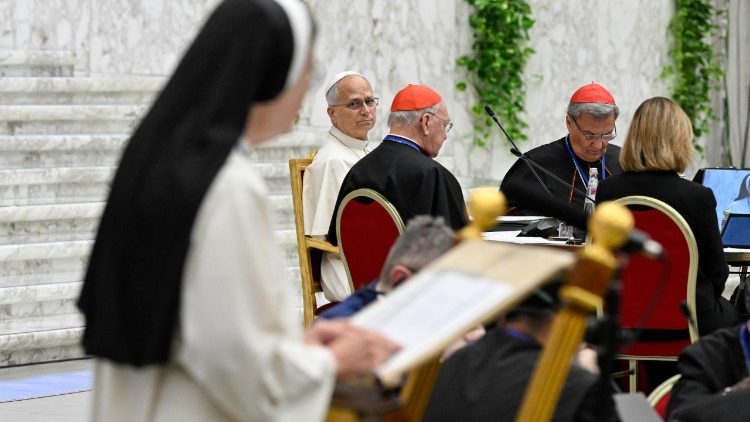
The two speakers at the session dedicated to young people and marriage at the meeting convened by Leo XIV for the tenth anniversary of Amoris laetitia asked the bishops gathered in the Vatican this Friday to accompany couples who live together without being married and to ask themselves “what is good” in their relationships. The Archbishop of Perth, the Salesian Timothy Costelloe, and the auxiliary bishop of Bombay, Stephen Fernandes, developed the second of the five thematic cores of the meeting, “Young people and the discovery of the vocation to marriage,” before the presidents of the episcopal conferences and the heads of the Eastern Catholic Churches.
The day was opened by Cardinal Kevin Farrell, prefect of the Dicastery for the Laity, the Family and Life, with a starting diagnosis: the number of marriages, both civil and religious, is decreasing worldwide. Farrell noted that the issue also concerns Christian parents whose children suffer from loneliness, hesitate before any lasting commitment, or reject the path they themselves took, and invited an examination of the number of divorces, the variety of forms of couple life, and the weight of dominant cultural trends. According to the report by Europa Press, the cardinal also raised, on a deeper level, the question of whether God no longer speaks to the hearts of young people or awakens in them the desire to marry.
Costelloe, who spoke after hearing the testimony of several families, ruled out easy answers and simple institutional solutions and maintained that the problem is, above all, cultural. In his view, in Australia, and probably in many other countries, the link between sexual activity and procreation and its place in Christian marriage is no longer generally understood or accepted, and the frequency of divorces leads many young people to doubt that a lifelong commitment is possible or even desirable.
Referring to young couples who live together before marriage, the archbishop stated that the fact that they do not live up to the ideal of Christian marriage does not mean that there is nothing good in their relationships, and proposed welcoming them in their current situation and accompanying them as they move toward a fuller expression of that ideal. He argued that Catholicism has always sought to reconcile fidelity to its ideals with respect for those who fail to achieve them or, at certain stages of their lives, consider them unrealistic, and called for presenting the Church’s teaching on marriage not as a list of rules and prohibitions, but as an ideal worth living.
Fernandes described young people who reject relationships marked by domination, manipulation, or inequality and who expect mutual respect and equal dignity between men and women. Regarding couples who live together, he warned that their situations are diverse and that both indifference and condemnation must be avoided. The first task, he explained, is to know their story: why they have chosen to live together, what they expect, what fears or obstacles they encounter, what is good in their relationship and where signs of generosity, fidelity, responsibility, and grace can be glimpsed. The bishop added that this accompaniment requires true discernment, because the question is not only how to help the couple move toward marriage, but whether those two people are truly called to it and prepared for a lifelong covenant.
This approach was already included in the thematic itinerary published in July to prepare for the meeting, which proposed reflecting on how to accompany cohabiting couples in discerning a path that leads them to mature the decision to marry and to welcome children. Amoris laetitia itself had pointed out, in paragraph 78, that a cohabitation that achieves notable stability through a public bond can be seen as an opportunity to accompany toward the sacrament of marriage.
Familiaris consortio addressed the same reality in other terms. In paragraph 81, dedicated to de facto free unions, John Paul II asked pastors and the ecclesial community to know these situations case by case, to approach couples with discretion and respect, to enlighten them with patience, to correct them with charity, and to smooth their path toward the regularization of their situation. In paragraph 34, the same exhortation warned that the so-called law of gradualness cannot be identified with a gradualness of the law, and that spouses cannot view the moral law “as a mere ideal that can be achieved in the future.”
Among the Spanish participants in the meeting are the president of the Spanish Episcopal Conference, Luis Argüello, and the cardinal archbishop of Madrid, José Cobo. The work will continue until Wednesday, October 14, when Leo XIV will preside at ten in the morning, in St. Peter’s Square, at the closing Mass.
Read also