


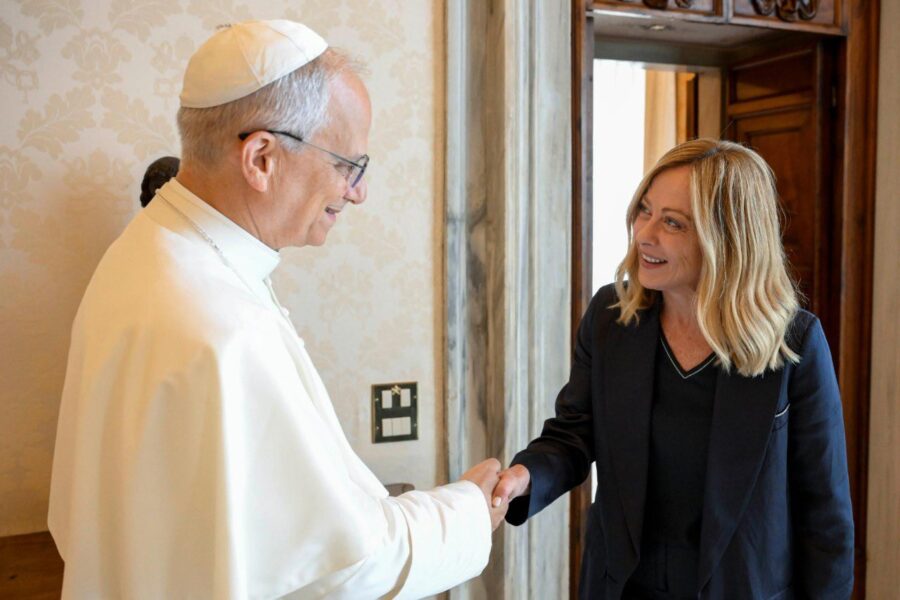
On Saturday, October 10, at six minutes to six in the morning, the bishops’ radio station quoted the Pope against “the temptation to build collective identity against an enemy” and, forty seconds later, found one. It happened in the editorial that COPE broadcasts just before La Mañana de fin de semana and that, at ten-twenty, it posted on its website, in the “Editorial line” section, under the title “War of interpretations”. After reviewing Leo XIV, the text reached the point it wanted to reach: “It is easy, in these circumstances, for citizens to turn their backs on the traditional parties and opt for radical ones. In Spain an imperfect two-party system has been maintained with parties that operate within the constitutional framework. It would be a disaster if the war of narratives ended up provoking what has happened in France, in Italy and what is happening in Germany.” With five days of pre-campaign under its belt and the general election set for November 29, the Conference of Bishops’ station has already decided which country it does not want to be.
What has happened in Italy has a first and last name. In September 2022, Fratelli d’Italia won the election with around 26 % of the vote, and since October 22 of that year Giorgia Meloni has governed—the same woman who, in 2019, stood in Saint John Lateran Square and declared “I am Giorgia, I am a woman, I am a mother, I am Italian, I am Christian.” Her government passed, in October 2024, the law that makes surrogacy a universal crime, punishable even if committed abroad, and on September 4 it surpassed the 1,412 days of Berlusconi’s second government to become the longest-lasting in the history of the Republic. In the country that turned government crises into a national genre, disaster has remained in place for almost four years.
The diagnosis, moreover, does not survive the map. In Italy, the lifelong center-right, Berlusconi’s Forza Italia, governs within Meloni’s coalition, and its leader, Antonio Tajani, is vice-president of the government and minister of foreign affairs. In Germany, where according to COPE trust in the center has also been lost, the CDU and the SPD—the textbook center-right and center-left—have governed together since 2025, with a Christian-democratic chancellor. What worries the station is not that the center disappears, but who commands it (in Italy, a woman who says “I am Christian” at rallies, a habit that, judging by the editorial, is considered radicalism on Calle Añastro).
To get there, the Pope was needed, and the Pope had to be adjusted a little. Magnifica humanitas, Leo XIV’s first encyclical, published on May 25, deals with artificial intelligence, and the phrase about the enemy belongs to the chapter on the culture of power, in a passage on relations between countries. The original reads: “Simplification into schemes—‘me first,’ ‘friend-enemy,’ ‘us-you’—facilitates decisions, often irresponsible ones, that undermine mutual trust between nations.” In COPE’s version, read on air and published in quotation marks on its website, the three schemes disappear without warning and the sentence ends at “mutual trust.” The nations stayed in Rome. It was the only way to turn a reflection on coexistence between states into a slogan for the Spanish general election, in an editorial that opened by reproaching, with the Pope, the habit of “constructing biased narratives” “mixing facts and opinions.”
The other half of the reasoning remains: the imperfect two-party system that must be protected from the radicals, with their parties “within the constitutional framework.” COPE itself portrayed one of them that same morning. At eight-oh-six, Fernando de Haro denounced that Pedro Sánchez “has launched into exploiting a populist discourse that questions the mechanisms of democratic representation”; at ten-twelve, Cristina López Schlichting placed him “very close to the edge of the unconstitutional”; at ten-twenty, journalist Antonio Jiménez attributed to him, on the same program, “anti-democratic and autocratic” behavior, “more typical” of “a Bolivarian leader like Maduro” than “of a democratic European state.” At six minutes to six, that same party was half a wall against the radicals. The station’s editorials, it seems, are written before the house wakes up.
No bishop signs the editorial, and none needs to: the network explains it in the mission statement reproduced at the foot of every page of its website, where it reads that “the origin and ownership of COPE mark its identity and its purposes.” On the Church’s purposes in politics, the Council was more succinct: the Church, says Gaudium et spes, “is in no way confused with the political community nor is it bound to any political system.” Not even to the imperfect two-party system. The president of the Conference of Bishops, Luis Argüello, suggested in December that the government’s situation be resolved with a vote of confidence, a motion of censure or “letting the citizens speak,” and Sánchez replied that “the time when bishops interfered in politics has ended in this country.” He was half wrong. The bishops continue to interfere; it is only their radio that does so to ask that the system of which Sánchez is half be preserved, and to warn Catholics who might vote as Italy voted that their vote would be a disaster.
Next to the editorial, among the page’s advertisements, COPE’s website offered the only Italy the house seems willing to admit without risk of disaster: “New Fiat 500 Hybrid. An Italian icon with hybrid technology to enjoy the city your way.” Small, hybrid and without surprises. Like an imperfect two-party system.
“COPE, the bishops’ radio” is a daily section of InfoVaticana. We listen attentively to our bishops’ radio and tell you what we find: advertising, guests, language, what is said and what is left unsaid. COPE belongs 75 % to Ábside Media, the company the Conference of Bishops created in 2020 with its own shares and those of most dioceses. The Jesuits and Augustinians are also shareholders.
Every Spanish bishop is personally responsible for what is broadcast on it.