


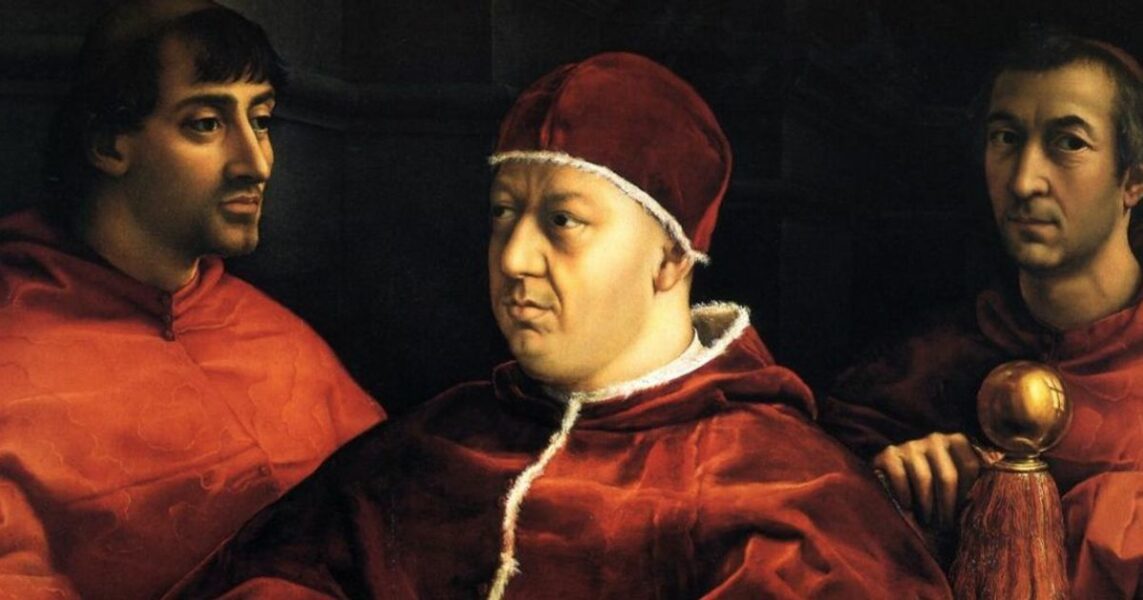
When Rafael decorated for him the third of the Vatican rooms, Leo X had two Popes from this series painted on the walls: Leo III crowning Charlemagne and Leo IV extinguishing the fire of the Borgo and defeating the Saracens at Ostia. He wanted to be seen as the heir of those Leos, and in a way he was: he received a Church richer, more obeyed, and more brilliant than that of any of them. What he did with it is the subject of this installment. Leo X was the Pope who had Luther before him, condemned him and excommunicated him, and was right in doctrine. He was also the Pope under whom half of Europe ceased to obey Rome. Both things are true and this series does not choose between them.
Giovanni de’ Medici was born in Florence on December 11, 1475, the second son of Lorenzo the Magnificent and Clarice Orsini, and from the cradle he was destined for the Church as one destines a son to a career. He received the tonsure at six. At seven he was abbot of Font-Douce, in France, and apostolic protonotary by concession of Sixtus IV. At eight he held the abbey of Passignano and at ten that of Montecassino, the mother house of the Order of Saint Benedict, because all the benefices the Medici could obtain went to him. In 1489, through pressure from Lorenzo and his ambassadors, Innocent VIII created him cardinal at thirteen, on condition that he not wear the purple or exercise the office for three years. He received the insignia at Fiesole on March 9, 1492, at sixteen. His father then sent him a letter of advice that the Catholic Encyclopedia praises for its good sense: it urged honesty and example, all the more necessary, it said, because the College of Cardinals was short of those virtues. A month later Lorenzo had died. It is worth retaining the entire career, because what brought Luther to the door of Wittenberg was exactly this: sees, abbeys and red hats obtained by pressure, by money or by blood, and accumulated in a single head. The future Leo X did not fight that system. He was its product.
In the conclave of 1492 he voted against Rodrigo Borgia, who was nevertheless elected as Alexander VI, and withdrew to Florence until in 1494 the fall of the Medici forced him to flee in a Franciscan habit. He spent years as a dilettante of letters and arts, generous and a poor administrator, two traits he would never lose. Julius II made him legate in Bologna and the Romagna in 1511; the following year he was taken prisoner by the French at Ravenna, escaped while being taken to France, and in September 1512 saw his family recover Florence. Julius II died on February 21, 1513. In the first ballot of the conclave the cardinal de’ Medici received one vote. His supporters, the young cardinals, waited for the right moment, and in March he emerged Pope at thirty-seven with a fistula that had to be operated on during the enclosure. He was a deacon. He was ordained priest on March 15, consecrated bishop on the 17th and crowned on the 19th. He is the last Pope in history elected without being a priest.
He is attributed with having said upon being elected that he should enjoy the papacy, since God had given it to him. The phrase is due to a Venetian ambassador who was not impartial and was not in Rome, and there is no reason to attribute it to him. Nor is it necessary. The facts replace it. Julius II had left a considerable treasury; in two years nothing remained. In the spring of 1515 the coffers were empty and never filled again. The revenues of the Holy See amounted to five or six hundred thousand ducats a year; the pontifical household, which his predecessor had maintained with forty-eight thousand, now cost twice as much. In less than nine years he spent some four and a half million ducats and left at his death a debt of four hundred thousand that ruined his creditors. To plug the hole he created new offices and sold the greater ones, and turned jubilees and indulgences, as his own Catholic biographer writes, into operations that were almost entirely financial. He hunted on a large scale every year, gave banquets, had comedies performed in the palace that no moralist would have approved, and laughed with the jesters. He also distributed more than six thousand ducats annually in alms, heard Mass daily, recited the breviary, fasted three times a week and as Pope led the same irreproachable private life he had led as cardinal. He was not a Borgia. He was something more difficult to judge: a pious and orthodox man who did not govern.
Rome became with him the capital of letters and the arts. Bembo and Sadoleto wrote his letters in Ciceronian Latin; Aldo Manuzio printed the Greeks under his protection; he recovered his family’s library, sold in 1494, and brought it to the Vatican. Raphael, whom Julius II had called to Rome, under Leo X produced the rooms, the cartoons for the tapestries of the Sistine, the loggias and the Transfiguration, and died in 1520 without having been able to advance much in the building of St. Peter’s, because there was no money. The poets who sang of him number over a hundred. The Catholic Encyclopedia, which does not stint his merit, concludes that as a patron he has been overvalued and that he was at bottom a dilettante. The judgment matters less than the order of priorities: the Pope who left Raphael without funds for the basilica found money for the carnival of 1520, the year of the bull against Luther.
He also inherited a council. The Fifth Lateran had been open since May 1512, convoked by Julius II against the conciliabulum of Pisa, and Leo continued it until its twelfth and final session, on March 16, 1517. From it came texts that the Church still cites. The bull Apostolici regiminis, of December 1513, condemned against the school of Pomponazzi the thesis that the individual soul is mortal, or that one may hold as true in philosophy what faith declares false. Pastor aeternus, of December 1516, affirmed that the Pope is above the council and abrogated the Pragmatic Sanction of Bourges. There was also an extensive bull of reform: that abbeys and benefices be given only to worthy persons and according to law, that commendams, unions and dispensations be restricted, that cardinals and clerics live as they should, that blasphemers, incontinent persons and simoniacs be punished, that the revenues of the Church not be destined to profane uses. None of that was fulfilled. Leo himself repeatedly dispensed the decrees of his council. Toward the end, in 1517, a layman, Gianfrancesco Pico della Mirandola, delivered before the fathers a discourse on the moral state of the clergy and ended by warning that, if the Pope left those wounds without remedy, it was to be feared that God himself would cut off the rotten members and destroy them with iron and fire. That same year, seven and a half months after the council closed, an Augustinian of Wittenberg sent his theses to the archbishop of Mainz.
Before that came Bologna. Francis I, king of France since January 1515, won at Marignano on September 13 and 14, and the Pope, who had played both sides with him and his enemies, threw himself into the arms of the victor. He ceded Parma and Piacenza, met with the king in Bologna from December 11 to 15, and from those conversations came the Concordat of 1516, promulgated as a bull on August 18. Rome obtained the revocation of the Pragmatic Sanction of 1438, which had subjected the Church of France to the conciliarist decrees of Basel, and the recognition of the primacy. In exchange, the king of France received the right to appoint all the bishops, abbots and priors of the kingdom; the Pope reserved canonical institution. The French clergy and parliaments protested for centuries. The Catholic Encyclopedia, written under Pius X, describes the price as very high and the result as a France bound to the Holy See, and adds that the way the crown used that power later produced great evils. The agreement lasted two hundred seventy-five years, until the Revolution, and that of 1801 with Napoleon reproduced it in essence. It is the mold of all subsequent concordat diplomacy, including that which today governs in China: the State proposes, Rome confirms and the Church survives with bishops it owes to a prince. In Bologna the Pope did not buy the peace of the Church. He bought the peace of the papacy.
In 1517 his own college tried to kill him. Cardinal Petrucci, resentful because Leo had removed his brother from the government of Siena, tried to poison him through a physician. The plot was discovered by a letter. Petrucci was executed; Cardinals Sauli, Riario, Soderini and Castellesi, whose complicity was never proved, paid fines, and Riario one hundred fifty thousand ducats. On July 1, 1517 the Pope created thirty-one cardinals in a single consistory. Some were men of merit. Not a few entered for the sums they advanced, and the combined effect was a submissive college and a momentarily relieved treasury for the war of Urbino, which Leo waged to give the duchy to his nephew Lorenzo. That same autumn he was preparing the crusade against the Turk, which he preached in 1518 with a five-year truce proclaimed throughout Christendom and which no prince seconded. In Germany, where it was also preached, the people understood that Rome was asking for money again. A pamphlet said that the real Turks were in Italy.
The matter of Luther began with money. Albert of Brandenburg, archbishop of Magdeburg, wanted to be also of Mainz and keep Halberstadt, and Rome granted him the three sees in exchange for ten thousand ducats above the ordinary confirmation fees. So that he could pay them he was allowed to preach in his territories the plenary indulgence destined for the building of St. Peter’s, keeping half of what was collected. The Catholic Encyclopedia calls this transaction a disgrace for all who participated in it. The Dominican Tetzel went out to preach it, the collection passed from accessory to principal object and the indulgences for the dead became the vehicle of inadmissible doctrines. On October 31, 1517 Martin Luther sent his ninety-five theses to Archbishop Albert. What followed was a three-year process that Leo conducted as he conducted everything: at a distance, by delegation and with his attention elsewhere.
In July 1518 the Master of the Sacred Palace, Silvestro Prierias, answered the theses with a dialogue that reduced the question to the authority of the Pope; in August Luther was summoned to Rome. Frederick of Saxony, his prince, obtained that he be heard in Germany. From October 12 to 14, 1518, in Augsburg and in the house of the Fuggers, the bankers who had lent Albert the money for Mainz, Cardinal Cajetan interrogated him with instructions to receive his retraction or condemn him. Luther did not retract and left the city at night. On November 9 Leo signed Cum postquam, which fixed the doctrine of indulgences and corrected the excesses of the preachers, and in which Luther noted that not a line of Scripture was cited. The chamberlain Miltitz later attempted an arrangement and brought Frederick the Golden Rose, the same one instituted by Leo IX. In July 1519, in Leipzig, Johann Eck dragged Luther into denying the authority of the Popes and also that of the councils, and from that moment the dispute over indulgences was something else. Meanwhile Maximilian had died and the Pope was devoting the best of his ingenuity to the imperial election: he sailed, as was then said, with two compasses, negotiated at the same time with Francis I and with Charles of Habsburg and went over to the second when his election became inevitable. Luther’s process waited.
The bull arrived on June 15, 1520. It begins with the psalm: arise, O Lord, and judge your cause, for a wild boar has entered your vineyard. It condemns forty-one propositions taken from the theses and other writings of Luther, orders his books burned and gives him sixty days to retract. Luther responded with three treatises in which the entire Reformation was already present, and on December 10, 1520, the deadline having passed, he burned the bull together with the books of canon law before the Elster gate in Wittenberg. On January 3, 1521 Decet Romanum Pontificem declared him a heretic and excommunicated, him and those who followed him. In April he appeared in Worms before the emperor and did not retract. On October 2 the bishop of Bath presented to the Pope the treatise of Henry VIII in defense of the seven sacraments against Luther, and on the 11th Leo granted him the title of Defender of the Faith. The kings of England still bear it. Henry broke with Rome thirteen years later.
What the Catholic Encyclopedia says of Leo in this crisis admits no mitigation: he recognized neither the gravity of the situation nor the causes of the revolt, let the imperial election eclipse it and gave himself to his pleasures without fully understanding the duties of his office. The datum worth adding is that of doctrine. Rome has never withdrawn the condemnation of 1520, and Trent, twenty-five years later, returned to grace, the sacraments and penance with greater rigor and better argument. Leo X was right in what he censured. He lost in everything else because the problem was not a list of errors but a Curia that sold what was sacred, and the Curia was he. When the wild boar entered the vineyard, the keeper was out hunting.
He died on December 1, 1521, at forty-five, of a malignant malaria, in the midst of the celebrations for the taking of Milan, which his alliance with Charles V had just wrested from the French. His enemies were accused without foundation of having poisoned him. The Pope of the feasts was given a poor funeral, and his tomb in Santa Maria sopra Minerva was not raised until Paul III, the Pope who convoked Trent. A pasquinade said he had consumed three pontificates: the treasury of Julius II, the revenues of his own and those of his successor. The successor was Adrian VI, an austere Fleming who reigned twenty months and whom Rome detested. Afterwards the Medici returned.
This series measures each Leo by what he did with what he had. The three of the tenth century had nothing, and one of them, with only a signature, protected the reform of the monasteries. Leo IX had five years and changed the Church of the West. Leo X had almost nine, the treasury of Julius II, an ecumenical council with its reform decrees already voted, Raphael, Cajetan and the obedience of all Latin Christendom. He is the one who received the most and the one who left the least. His pontificate teaches something the series had not found until now: that orthodoxy, private piety and even doctrinal correctness are not enough when the Pope does not govern his own house. Whoever bears that name today also inherits this one, and the lesson is the inverse of that of Leo IX: the rupture did not begin by what Rome taught but by what Rome charged, and no document repaired what a Pope refused to repair in person.
The next Leo, another Medici, reigned twenty-seven days.
Read also
- Three Leos caged: the see of Peter had an owner and Christ did not let go of the helm
- Bonaparte with mozzetta
- China consecrates a new bishop under the agreement with the Vatican: Rome highlights the papal appointment and Beijing omits it
- Catholics and Protestants ask the Pope to lift Luther’s excommunication