


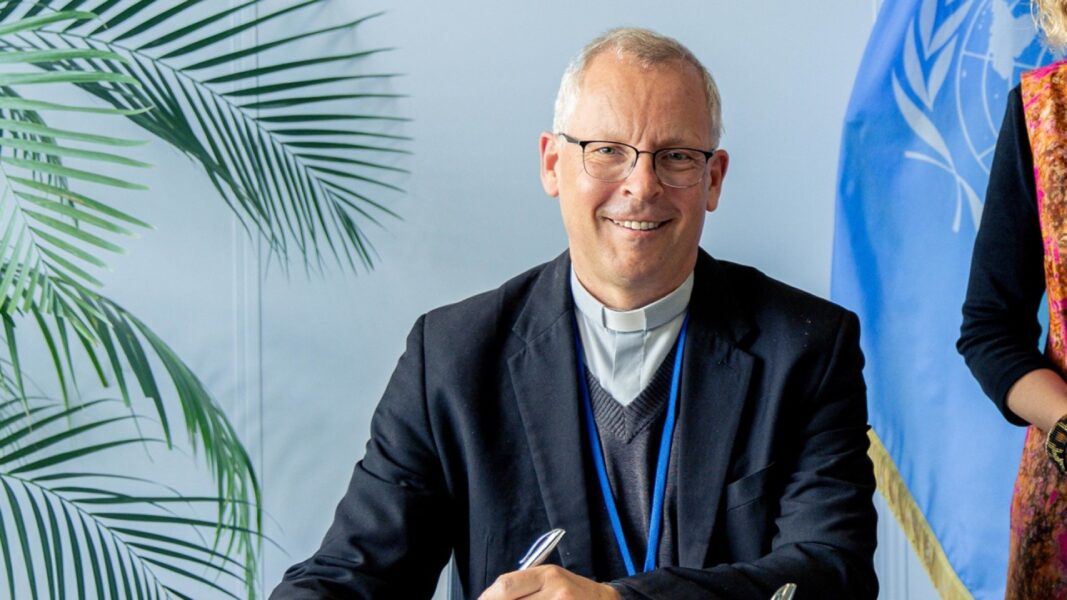
The apostolic nuncio in Germany, Mons. Hubertus van Megen, has questioned the idea that structural reforms or greater adaptation of the Church to society can halt secularization, and has warned about some of the approaches that have marked the German Synodal Way. In an extensive interview given to Katholisch.de, the representative of Leo XIV also addresses the future of the Synodal Conference, the German process’s insistence on the issue of “power,” and the growing difficulties in finding candidates for the episcopate.
Van Megen, who has been in Germany for just over three months after nearly 16 years of diplomatic service in Africa, observes parallels between the current situation of the German Church and the process of secularization experienced decades ago in his native Netherlands. His diagnosis runs throughout the interview: the Church’s problems will not be solved simply by modifying its structures to bring them closer to society’s expectations.
“Adapting to society will not save the Church”
The nuncio acknowledges that German Catholicism is undergoing a profound transformation. He cites among the causes of the decline in the number of faithful the sexual abuse scandal and the drop in birth rates, but adds an even more basic element: a growing part of society has lost interest in what the Church proclaims.
“We must not delude ourselves that if the Church adapts sufficiently to society, it will be saved. That will not happen,” he states.
For Van Megen, the starting point remains different: “The Church has a message, the message of Jesus Christ. But society —we must be honest— has almost no interest in that message anymore.”
The archbishop believes that Germany is experiencing, with some delay, processes similar to those previously lived by the Dutch Church. “The process of secularization continues to advance,” he notes.
The Synodal Way seen from outside Germany
From this diagnosis, Van Megen addresses the reform process promoted in recent years by the German Bishops’ Conference and the Central Committee of German Catholics (ZdK).
The nuncio begins by acknowledging a positive aspect: the German proposals have been submitted to Rome rather than applied unilaterally.
“In principle, it is good that the Church in Germany has always presented its reform wishes to Rome. This shows that the Church in this country does not want to act on its own. It is aware that it is part of the universal Church,” he states.
But he immediately recounts the reaction he encountered in Africa when it became known that he would be transferred to Berlin.
“When it was known in Africa that I was going to Germany, there were many reactions from priests, but also from laypeople. They said, more or less: ‘Oh, you’re going to Germany. Be careful! They want a Church that cannot exist.’”
Van Megen does not present that reaction simply as an anecdote. “This tension surrounding the Synodal Way runs through the entire universal Church,” he adds.
Read more: The new nuncio of Leo XIV in Germany presents his credentials to President Steinmeier
“Germans often want too much and too quickly”
The African experience reappears when the nuncio analyzes the priorities of the German process. Van Megen recalls the great differences between local Churches and warns against the temptation to turn German concerns into universal problems.
“The problems we have here in Germany, for example, do not exist at all in many countries in Africa. There they have completely different problems,” he explains.
His conclusion is direct: “Germans, in my impression, often want too much and too quickly.”
Van Megen then poses a question he considers prior to the discussion of each specific reform: what is intended by reforming the Church.
“From what motivation does one want to reform the Church? Does one think: if we carry out this or that reform, we will save the Church? As I have already said, I would consider that an illusion.”
The statement connects directly with his initial diagnosis: secularization will not disappear because the Church adapts its structures or teachings to the expectations prevailing in society.
“Power, power, power”: the nuncio’s criticism of synodal language
Asked about some of the demands of the Synodal Way, including the treatment of power and the question of women, Van Megen does not respond by listing which reforms he considers admissible. Instead, he questions the language used to frame the debate.
“Allow me to ask you a question. You speak of the ‘exercise of power.’ As a foreigner and as someone whose mother tongue is not German: why say ‘power’ and not ‘authority’ or ‘service’?”
For the nuncio, the concept used by the Synodal Way already introduces a certain way of understanding relationships within the Church.
“For me, power has something negative, something oppressive. I also see it in many documents of the Synodal Way: power, power, power. The question is always: who has the power? It seems to me that this word is almost dangerous.”
The issue of power has occupied a central place in the German process, which in recent years has proposed reforms on the exercise of episcopal authority, the participation of the laity, and the creation of permanent structures of shared decision-making.
Read more: The German bishops approve the statutes of the “Synodal Conference” despite warnings from Rome
Rome is still studying the Synodal Conference
Van Megen also provides information on one of the main pending issues between Rome and the German Church: the statutes of the future Synodal Conference, conceived to give institutional continuity to the Synodal Way.
The statutes were sent to the Holy See to obtain the necessary recognitio, but have not yet been approved. The delay forced the postponement of the first meeting of the new body, which was initially scheduled for November 6 and 7 in Stuttgart.
“As far as I know, the statutes are currently being studied in several dicasteries,” the nuncio explains.
Van Megen expects to travel to Rome at the end of October. One of the main objectives of the trip will be precisely to learn firsthand how the German proposal is being received.
“I hope to be able to travel to Rome at the end of October. One central reason is to listen a bit and perceive where we are in this discussion and how the Curia views the matter.”
Asked directly whether he expects Rome to finally approve the statutes, he avoids anticipating an answer.
“Rome is not Berlin; some things simply take a little longer in the Vatican. Germany, after all, is not the only country the Curia has to deal with.”
And he adds a fundamental element: “It also depends to a great extent on how the Pope sees this issue. That is precisely why I want to travel to Rome as soon as possible, to understand it better.”
The nuncio also confirms that Mons. Heiner Wilmer, current president of the German Bishops’ Conference, maintains constant contact with Rome on the matter.
His recommendation, for now, is simple: “If you ask me today, regarding the statutes I would say: let us wait calmly.”
Read more: Germany postpones the first Synodal Conference due to lack of Vatican approval
From 30 candidates in Africa to ten in Germany
The interview also reveals how Van Megen approaches another of the main responsibilities of an apostolic nuncio: the search for candidates for vacant dioceses.
The contrast with Africa is again significant.
“In Africa, in vacant dioceses, I sometimes easily had 30 suitable candidates for a bishop’s post. If here in Germany I have ten, that is already a lot.”
And those ten do not necessarily mean ten viable candidates: “Of those ten, perhaps five are ruled out immediately because, after all, they are not suitable.”
Van Megen points to the decrease in the number of priests as one of the causes. He adds that some candidates may reject the episcopate due to the responsibility and pressure associated with the position.
“It can happen that a candidate who is asked if he wants to be a bishop says: ‘It is too much responsibility, too much pressure. I prefer to remain a parish priest.’ That happens.”
The nuncio defends the confidentiality of appointments
Van Megen also responds to criticism about the secret and hierarchical nature of the procedure for selecting bishops.
He explains that confidentiality protects sensitive information about possible candidates.
“One of the reasons for secrecy is surely that, throughout the procedure, sensitive information about the candidates is known that one does not want to reach the public. It is also about protecting the privacy of the candidates.”
But he recalls that the preliminary investigation includes consultations with numerous people who have known the priest.
“For example, one goes to a professor with whom he was at university, to a teacher he had in school, or one asks members of the parishes where he worked. So one speaks with many people who had direct contact with the candidate.”
From this he draws a striking conclusion: “In that sense, the procedure is quite democratic.”
“A bishop cannot be a gray man”
Van Megen’s answers also reveal what qualities he considers priorities in future German bishops.
His first criterion is not administrative capacity or economic management.
“According to my conviction, he must above all have charisma. He must know how to inspire people. That is important.”
The nuncio also considers it essential that candidates be able to look beyond German borders and understand the universality of the Church.
“We should not make a bishop of someone who is sitting with blinders on and does not know what is happening outside the limits of his own diocese. We are a universal Church.”
That is why, he adds, “a bishop in Germany must also understand what it means to be Church in Africa, Latin America, or Asia.”
Nor does he grant decisive importance to the candidate being a great manager. For those tasks, he points out, there are numerous specialists capable of better administering economic matters.
His priority is another: “I repeat: for me, the most important thing in a bishop is charisma. A bishop cannot be a gray man.”
A German Church under strong pressure
Van Megen acknowledges, however, that the German episcopate is under considerable pressure. He compares the expectations placed on bishops with those borne by politicians.
“From politicians, as from bishops, it is expected that they know everything, that they can do everything, that they are perfect, and that they speak well.”
The nuncio therefore understands that some prelates may end up recognizing that they can no longer continue, especially when they reach advanced ages.
Regarding the possibility of merging dioceses in light of the decline in faithful, priests, and economic resources, he still avoids taking a position. He acknowledges that the union of dioceses is possible and that there are precedents in other countries, but considers that he has been in Germany for too short a time to assess specific cases.
The statements thus outline the priorities with which the new papal representative begins his mission: a German Church immersed in strong secularization, a Synodal Conference whose future still depends on Rome, and a search for new bishops in which Van Megen intends to privilege candidates capable of inspiring, looking beyond national borders, and understanding that the German Church is part of a universal reality.