


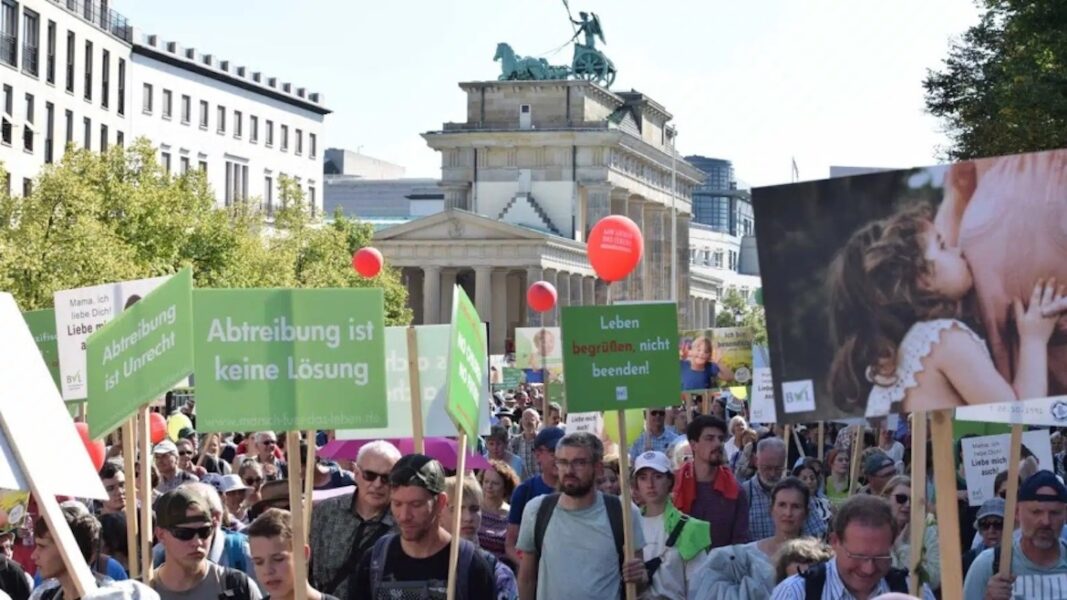
More than 6,000 people took to the streets of Berlin and Cologne on Saturday, September 19, to defend human life from conception until natural death. The two Marches for Life brought together families, priests, religious sisters, Christians from various denominations, and six Catholic bishops in an event also marked by paint attacks, smoke, and attempts to block the rallies by opposing groups.
According to the Bundesverband Lebensrecht (BVL), the marches’ organizer, 4,200 people participated in Berlin and 2,100 in Cologne. The capital’s figure differs from the police estimate, which placed attendance at around 2,200 people. In Cologne, the police did not provide a final figure.
Days before the marches, several German bishops had publicly confirmed their support for the events. Also, the president of the German Bishops’ Conference, Heiner Wilmer, expressed his support and recalled that “a society is humane when it makes room for unborn life.”
Six bishops alongside the demonstrators
Five Bavarian bishops attended the Berlin rally: the Bishop of Regensburg, Rudolf Voderholzer, accompanied by his auxiliary Josef Graf; the Bishop of Passau, Stefan Oster; the auxiliary of Augsburg, Florian Wörner; and the Bishop Emeritus of Eichstätt, Gregor Maria Hanke. Priests, religious sisters, and Christians from various denominations walked alongside them.
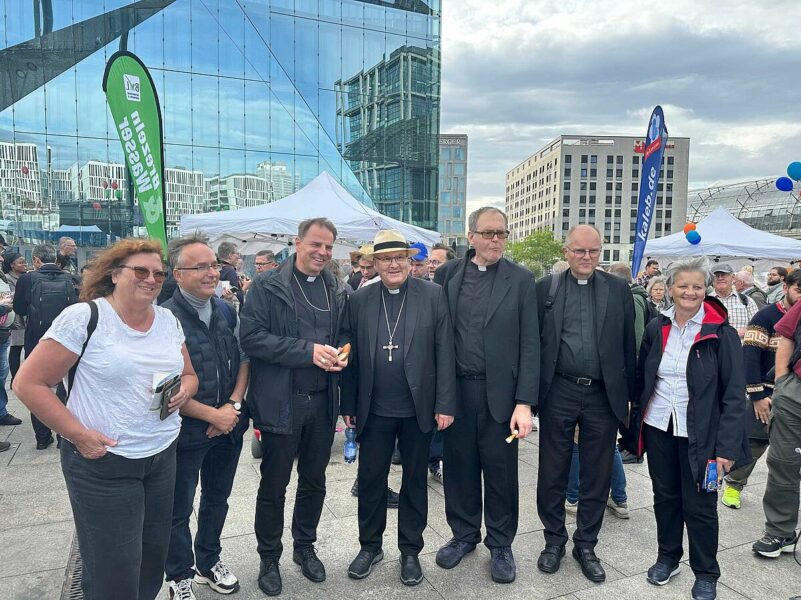
In Cologne, auxiliary bishop Dominikus Schwaderlapp was present. In addition to Wilmer, written messages of support were sent by the Archbishop of Cologne, Cardinal Rainer Maria Woelki, and the auxiliary bishop of Münster, Stefan Zekorn, among other Catholic and Protestant representatives.
The Berlin demonstration began at 1:00 p.m. at Washingtonplatz, in front of the central station, and proceeded through the city center before returning to the starting point. At the same time, the Cologne rally began at Neumarkt.
“We are not demonstrating against anyone. We are demonstrating for life”
Voderholzer, who for years has reserved the third Saturday of September to participate in the Berlin march, emphasized one of the fundamental principles of defending life: lending one’s own voice to those who cannot defend themselves.
The bishop explained that the rally is one of the few occasions when the Church, together with citizens from different sectors of society, takes to the streets on a socio-political issue to speak for those who “do not yet have a voice” and for those who “no longer have a voice.” He considered solidarity with the weakest a necessary condition for a healthy democracy and stated that participating in the march is for him both a civic duty and, even more so, a Christian duty.
“God is a friend of life. Every life deserves protection, including and especially unborn life and, of course, also life already born,” Voderholzer affirmed.
The prelate also recalled that the defense of the unborn child is not a recent addition to Christian thought, but has accompanied the Church since its earliest centuries. Already during the Roman Empire, he noted, Christians distinguished themselves by rejecting both abortion and the abandonment of newborns.
“We are not demonstrating against anyone. We are demonstrating for life, which is a gift from God,” he summarized.
Paint, smoke, and attempts to block the march in Cologne
The Cologne march took place under a principle that summarized the reason for the rally: “The right to life is a human right”. In the face of the thousands of participants who came out to defend that right, groups opposed to the mobilization carried out several incidents.
Two counter-demonstrators managed to obtain green vests similar to those used during the march and approached the stand of the pro-life foundation Stiftung Ja zum Leben, against which they threw paint. During the day, purple smoke bombs were also set off.
Several opponents also managed to position themselves near the front with a banner. One of them sprayed paint on another banner and faces a complaint for property damage.
The police had received a forecast of 3,000 participants for both the March for Life and the counter-demonstration. Officers used drones to monitor the route and had to deal with two sit-in blockades. Despite attempts to obstruct it, the march was able to continue and ended without major incidents.
From abortion to surrogacy and assisted suicide
Defending the unborn child against abortion is not the only front on which the German pro-life movement is currently working. The protection of life against assisted suicide, the consequences of prenatal diagnosis, and opposition to surrogacy were also among the concerns raised during the rallies.
In Cologne, Ludwig Brühl, a member of the federal leadership of Aktion Lebensrecht für Alle (ALfA), summarized the reason for his presence with a simple phrase: “We are here today because there are people who need our help.”
Brühl particularly denounced the existence of services related to surrogacy in the center of Cologne. According to him, pro-life activists conducted undercover investigations and confirmed that there are people who profit economically from this practice and know ways to circumvent German legislation.
The federal president of ALfA, Cornelia Kaminski, also addressed surrogacy during the Berlin rally. For her part, the president of the BVL, Alexandra Maria Linder, had called for its prohibition, arguing the need to protect women from exploitation and to prevent children from being turned into instruments to satisfy the desires of third parties.
The BVL has also focused part of its activity this year on counseling for women with crisis pregnancies, non-invasive prenatal testing (NIPT), and assisted suicide. These are different scenarios that raise the same underlying question: the protection due to human life when its fragility makes it especially dependent on others.
25 years defending human life
The 2026 marches coincided with the 25th anniversary of the Bundesverband Lebensrecht, founded in 2001. A year later, the organization held the first demonstration in Berlin under the name “1,000 crosses for life”. After new rallies in 2004 and 2006, the march began to be held annually from 2008 onward.
This year’s edition was the 22nd in Berlin. Cologne joined as a second venue in 2023 and held its fourth simultaneous rally this Saturday.
The BVL brings together organizations such as Aktion Lebensrecht für Alle, Ärzte für das Leben, and Christdemokraten für das Leben. Since its founding, it has maintained as its principle the defense of all human life from conception until natural death, precisely in the stages when a human being may be most defenseless and in need of protection.
On the occasion of the organization’s 25th anniversary, Voderholzer expressed a wish that went beyond the continuity of the demonstrations themselves: that the time would come when the March for Life would no longer be necessary “because the whole of society would be a march for life.”
The Berlin day ended once again at Washingtonplatz with an ecumenical prayer led by Bishop Emeritus Gregor Maria Hanke and Protestant pastor Albrecht Weißbach, who finally imparted the blessing to the participants.
Read also
Berlin and Cologne to host the March for Life with the public support of several German bishops
The March for Life brings together thousands of people in Switzerland amid attempts to block it