


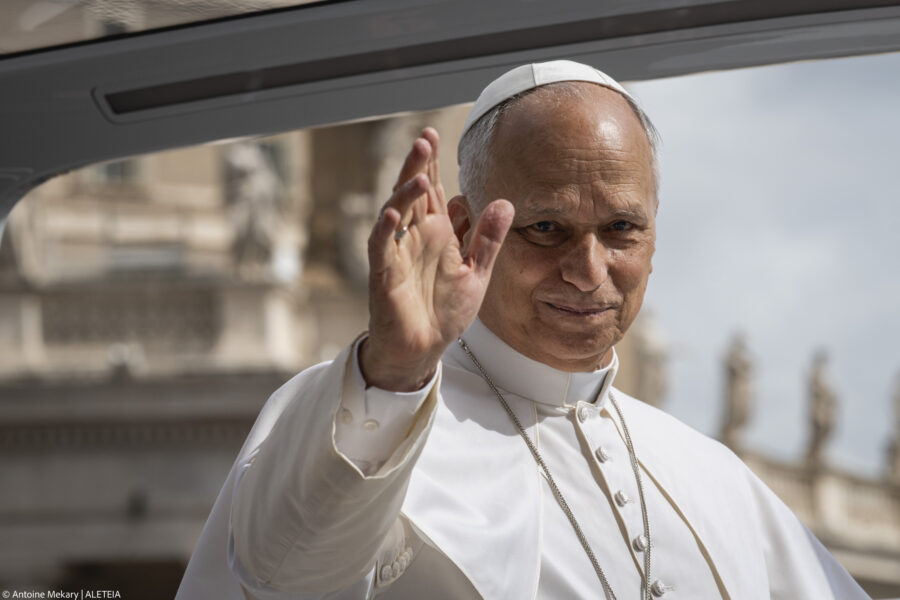
Leo XIV has a Filipino touch. He has it from the factory, because he is an Augustinian, and the Augustinians arrived in Cebu in 1565 with Legazpi and Urdaneta (who was from the house), and he has it especially in the other sense, the one from the Dictionary, which is the one that matters here.
The Academy defines the Filipino touch as “rogue, unscrupulous person, shameless, etc.,” and adds, with that sleight of hand that only lexicographers and confessors possess: “It is often used with a certain benevolence.” So let it be used. On its origin there are versions, as with everything castizo. That the unruly sons whom families shipped off to Manila to get them out of the way, that the peninsulars who wandered around there with no known occupation and plenty of airs, that a scam with an imaginary business in the archipelago…
Prevost’s case is literal before it is figurative. As prior general he made Valladolid one of his operational centers in Spain, and there he stayed at the Royal College of Filipino Augustinians, from which two thousand friars departed for the islands. In January 2004 he was in Cebu blessing a convent. In other words, he has done his novitiate in both senses.
And the second? On September 14 he turned 71, and that same day the Press Office published the motu proprio that lifts the ten-percent salary cut Francis had imposed on Curia cardinals in 2021, when the pandemic, the deficit and that business of the “sustainable future,” as the norm was called. (That on your birthday you treat others is a Spanish custom; doing so with the previous guy’s savings is more of a Filipino touch.)
Two days later, the memorial of Saint Cyprian, to whom the extra Ecclesiam nulla salus is attributed, the note for the sixtieth anniversary of Nostra aetate came out. It is signed by Tucho Fernández, Koch and Koovakad. Below, in two lines, what matters: “Ex Audientia, 22 June 2026” and the Pope’s name.
The note cites Benedict XVI in Regensburg without writing Regensburg. It says “a well-known speech” and speaks of “a Byzantine emperor.” So well-known that there is no need to name him, like those cars that reach the scrapyard with the chassis number filed off. Twenty years and four days had passed.
There is something of Toni Kroos in all this. In a way, Leo XIV plays as a German holding midfielder: he does not run, he does not protest, he does not dive, he plays short and to the foot and finishes the match with his kit as white as he started it (white, moreover). The ball always goes through him and he is never seen in the highlights; the highlights show the goals, the cards and Tucho, who is the one who gets the whistles. The “Ex Audientia” is his safety pass. He has been in the play, but someone else puts away the finish. Francis was a number nine who asked for every ball, including the ones that went wide.
From criollo cunning to the Filipino touch, with a stopover in Chiclayo.
The house saint, by the way, began by stealing pears. He tells it himself in Book II of the Confessions: he was sixteen, he was not hungry and the pears ended up with the pigs. He stole for the fun of it. The order carries picaresque in its family papers, and the Spanish rogue, from Lázaro to Guzmán de Alfarache, always had something of a friar without a convent. This one has found a convent. And what a convent.
On Saturday, in the letter to the bishops of Ibero-America for Saint Turibius of Mogrovejo (one from Mayorga, Valladolid again), he wrote that “there are realities of a diocese that can hardly reach a desk.” He wrote it, of course, from a desk. He does not thunder, he does not fulminate, he does not get dirty: exaudience.
In Cebu the Santo Niño that the Augustinians have guarded since 1565 remains. He holds the world with one hand and blesses with the other, in plain sight. He signs nothing below. Nor does he need the benevolence of the Dictionary.