


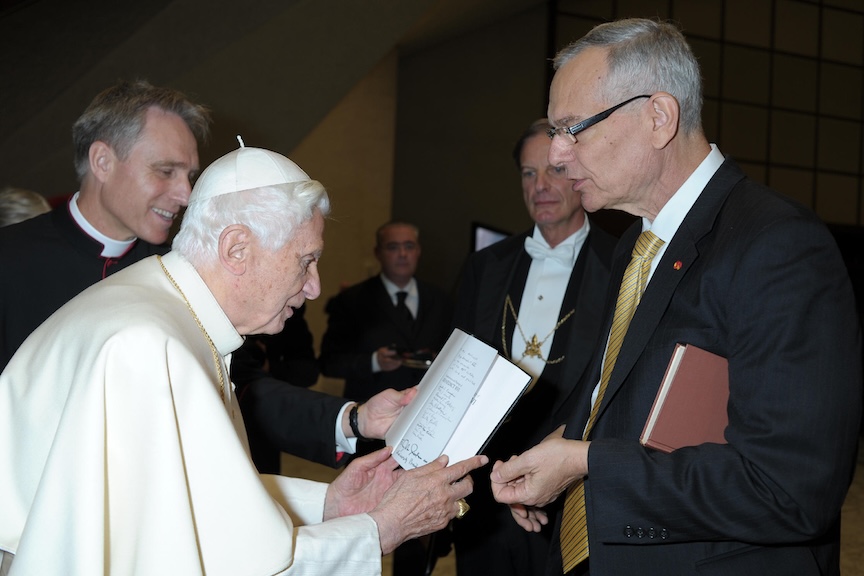
Pope Leo XIV has approved the awarding of the Ratzinger Prize 2026 to John C. Cavadini, professor of Theology at the University of Notre Dame and specialist in Saint Augustine, and will present it to him on December 19 at the Apostolic Palace. The Joseph Ratzinger-Benedict XVI Vatican Foundation presents him as what he is in the classroom: a first-rate patrologist. What the Foundation does not say is that Cavadini is co-author and host editor of the academic series that in 2022 stated in no uncertain terms that Benedict XVI was wrong with Summorum Pontificum. The prize that bears Ratzinger’s name goes to the theologian who challenged Ratzinger’s most personal liturgical decision. And it is signed by the Pope.
It is worth first saying who the recipient is, because his biography strengthens the thesis rather than weakening it. Cavadini is not a campus progressive. He is a creature of Benedict XVI: in November 2009 the German Pope appointed him a member of the International Theological Commission for a five-year term and made him a Knight of St. Gregory the Great at the request of the then bishop of Fort Wayne-South Bend, John D’Arcy, who praised him for recruiting solid theologians to Notre Dame. He has been a consultant to the Committee on Doctrine of the United States Conference of Catholic Bishops since 2006. As head of the department between 1997 and 2010, he hired specialists in Newman, Balthasar, Ratzinger, Irenaeus, and Gregory Nazianzen and straightened out a faculty that until then had looked toward Canterbury. In 2006 he wrote to rector Jenkins reproaching him that his defense of The Vagina Monologues barely mentioned the Church. And the Foundation itself had already distinguished him in 2018, along with three colleagues, with the Open Reason Award in the teaching category. No one can accuse him of heterodoxy. That is why the case is more serious than if the recipient were a Jesuit from the magazine America.
Between September and November 2022, in Church Life Journal, the journal of the McGrath Institute for Church Life that he himself directs, Cavadini published with Mary Healy and the Capuchin Thomas Weinandy five installments on the successes and failures of the post-conciliar liturgical reform, later collected in a single text. The declared target was what the authors call the traditional Mass movement, and the timing was no coincidence: Traditionis custodes was just over a year old. The three theologians wrote that, by normalizing the Tridentine Mass, Benedict “undermined the principle by which, as he himself insists, Vatican II must be interpreted,” the hermeneutic of continuity. In plain Spanish: Summorum Pontificum was a mistake by Ratzinger against Ratzinger himself. The traditionalist reply was immediate, from Joseph Shaw in the Latin Mass Society to Peter Kwasniewski, and later crystallized in a collective volume, Illusions of Reform, which accuses the series of idealizing the Liturgical Movement, caricaturing pre-conciliar faithful, and harshly dismissing those who pray with the 1962 Missal.
What Benedict intended with Summorum Pontificum he himself wrote in the 2007 letter to the bishops: an interior reconciliation within the Church, based on the principle that what was sacred for previous generations “remains sacred and great” also for us. And what he felt when Francis dismantled it was recounted by Georg Gänswein to Die Tagespost in the interview published on the day of his death: he read Traditionis custodes “with pain in his heart,” because his intention had been that those who had their home in the ancient Mass would find peace, also liturgical peace, and be kept away from Lefebvre. That liturgical peace is exactly what Cavadini’s series declares a mistake.
Here the Foundation comes in. Nominations for the Prize are proposed to the Pope by a scientific committee of five members appointed by the pontiff, currently Cardinals Kurt Koch and Ángel Fernández Artime, Archbishops Rino Fisichella and Bruno Forte, and the Bishop of Regensburg Rudolf Voderholzer, all appointed by Leo XIV. The board of directors that endorses the communiqué includes Gänswein himself, now nuncio to Lithuania, who this summer again called for a review of Traditionis custodes and presided over the Mass for the 2025 prize ceremony. In other words: the witness to Benedict’s pain is part of the institution that honors the man who maintained that that pain was the price of a mistake.
The prize does not come in a vacuum. The liturgy was left out of the January consistory, where Cardinal Roche distributed to the cardinals a paper defending Traditionis custodes, and was again left out of the June one. On July 29 Roche himself stated in The Tablet that Leo “is not going back to Summorum Pontificum.” On August 2 La Razón added, citing anonymous Vatican sources, that that paper was drafted at the Pope’s request, that he supervised it and “did not change a single comma.” Against that backdrop, the audiences granted to Burke, Sarah, Müller, Zen, and Schneider, and the one granted in March to sociologists Bullivant and Cranney, authors of a study on the faithful of the ancient Mass in the United States, had fueled the hypothesis of a Pope seeking a way out. The Ratzinger Prize to Cavadini is the latest signal, and it points in the same direction as Roche.
It will be said that the prize recognizes patristics and not liturgy, that Cavadini signed the series with two others, and that the authors argue from Ratzinger’s hermeneutic of continuity, not against it. All of that is true and nothing changes the substance. A Foundation whose statutory purpose is to promote the study of Benedict XVI’s thought has decided that challenging his liturgical peace is no impediment to bearing his name on a diploma, and the Pope has approved it. That an Augustinian should award an Augustinian scholar is a pleasant coincidence. The news is the other part: on December 19, in the Apostolic Palace, Leo XIV will present the Ratzinger Prize to the man who wrote that Ratzinger was wrong.
Read also