


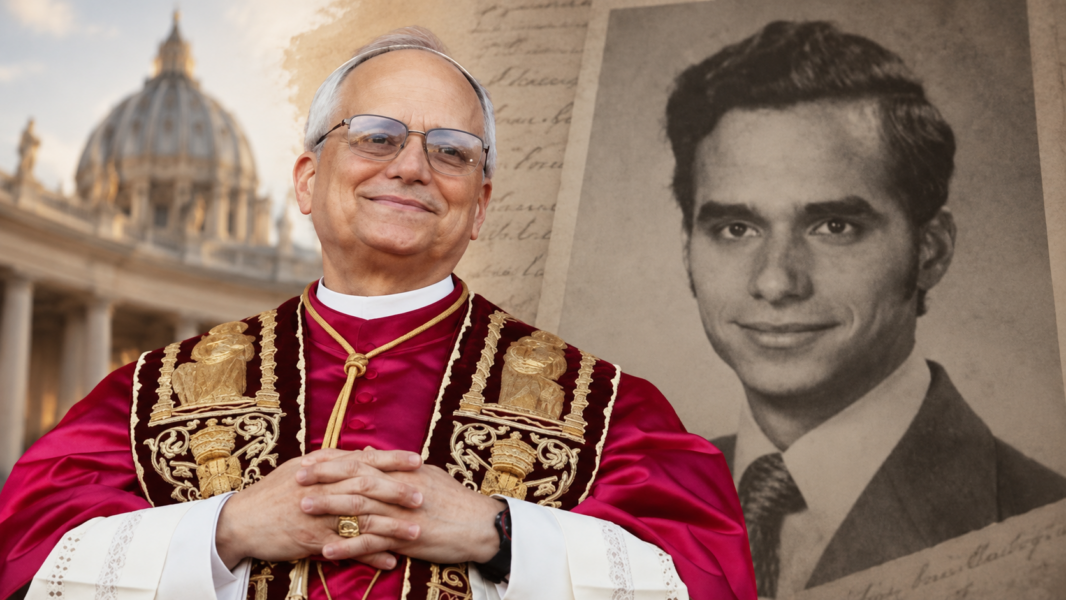
Pope Leo XIV turns 71 this Monday, September 14. Robert Francis Prevost thus celebrates his second birthday as Pontiff, sixteen months after the conclave elected him as Francis’s successor on May 8, 2025.
Born in Chicago in 1955, his career brings together elements that are uncommon in the recent history of the papacy: university training in Mathematics, an Augustinian vocation, many years of mission and ecclesiastical governance in Peru, twelve years as superior general of his order, and a brief but decisive period in Rome as prefect of the Dicastery for Bishops. Today he is the first American and the first Augustinian to occupy the See of Peter.
From Chicago to the Order of Saint Augustine
Robert Francis Prevost was born on September 14, 1955, in Chicago, Illinois. He is the youngest of the three children of Louis Marius Prevost and Mildred Agnes Martínez, both born in Chicago and later settled in Dolton.
His father served in the U.S. Navy during the Second World War before becoming a teacher and eventually a school principal. His mother worked as a librarian. Both were actively involved in the parish of Saint Mary of the Assumption, where the future Pontiff grew up.
Prevost studied at Villanova University, an institution linked to the Augustinians, and earned a degree in Mathematics in 1977, as well as completing studies in Philosophy.
That same year he entered the novitiate of the Order of Saint Augustine. He made his first vows in 1978 and his solemn profession in 1981. He was ordained a priest on June 19, 1982.
Sent to Rome, he studied Canon Law at the Pontifical University of Saint Thomas Aquinas, the Angelicum, where he obtained a licentiate and later a doctorate with a thesis on the role and authority of the local prior in the Order of Saint Augustine.
Peru, the country that shaped his priesthood
Prevost’s relationship with Peru began shortly after his ordination and would become one of the fundamental chapters of his life.
In 1985 he was sent to the Augustinian mission in Chulucanas, in northern Peru. After completing his doctorate, he returned to the country in 1988 and spent more than a decade in Trujillo, where he directed the common formation project for Augustinian candidates from the vicariates of Chulucanas, Iquitos, and Apurímac.
There he served, among other responsibilities, as community prior, director of formation, professor of the professed, judicial vicar of the Archdiocese of Trujillo, and professor of Canon Law, Patristics, and Moral Theology at the major seminary of San Carlos and San Marcelo. He also carried out pastoral work in parishes on the outskirts of the city.
In 1998 he returned to the United States after being elected prior provincial of the Augustinian Province of Our Lady of Good Counsel, based in Chicago. Three years later, on September 14, 2001—the day he turned 46—he was elected prior general of the Order of Saint Augustine.
He was re-elected in 2007 and remained at the head of the Augustinians for twelve years.
The return to Peru as Bishop of Chiclayo
Francis returned Prevost to Peru in November 2014 by appointing him apostolic administrator of Chiclayo and titular bishop of Sufar. He received episcopal ordination on December 12 of that same year, and in September 2015 he was named bishop of Chiclayo.
Shortly before, he had obtained Peruvian nationality. His bond with the country went so far that, in his citizenship application, he wrote that he intended to “remain in Peru for the rest of my life.”
Read also: Leo XIV expressed in 2015 his intention to “remain in Peru for the rest of my life”
Prevost remained at the head of Chiclayo until 2023. During those years he was also second vice-president of the Peruvian Episcopal Conference and apostolic administrator of Callao between 2020 and 2021.
His Peruvian episcopal period was also linked to allegations of abuse against priests of Chiclayo and the way they were handled. One of the cases that has continued to raise questions concerns the priest Eleuterio “Lute” Vásquez. Canonist Giampiero Gambaro, who later became involved in the case, acknowledged before the complainants deficiencies in the investigation carried out during Prevost’s episcopate and even described it as “a mockery.”
Chiclayo continues to occupy a prominent place in the Pope’s relationship with Peru. Preparations for the next papal trip to the country have once again placed his former diocese at the center of attention.
From Chiclayo to the heart of Church governance
Prevost’s definitive leap to Rome took place in January 2023. Francis appointed him prefect of the Dicastery for Bishops and president of the Pontifical Commission for Latin America.
The first responsibility placed him in one of the most influential positions in the Curia: the body participates directly in the process by which candidates for a large part of the Latin Church’s dioceses are studied and presented to the Pope.
Francis created him cardinal in the consistory of September 30, 2023, assigning him the deaconry of Santa Monica. In February 2025 he promoted him to the order of cardinal bishops, assigning him the suburbicarian see of Albano.
When Francis died on April 21, 2025, Prevost had been a cardinal for less than two years.
May 8, 2025: “Peace be with you all”
The conclave began on May 7. The next day, the white smoke announced that the cardinals had reached an agreement.
Robert Francis Prevost was elected the 267th Pope of the Catholic Church and chose the name Leo XIV, reviving a name that had not been used by a Pontiff since the death of Leo XIII in 1903.
His first appearance from the central loggia of St. Peter’s Basilica began with a simple phrase: “Peace be with you all.”
The election made history in two ways. Prevost became the first Pope born in the United States and the first member of the Order of Saint Augustine to reach the pontificate.
His profile, however, can hardly be reduced to his American origin. He also holds Peruvian nationality, speaks Spanish fluently, and spent a substantial part of his priestly and episcopal ministry in Latin America.
A change of style without a break in governance
The first sixteen months have made it possible to distinguish some distinctive features of the new pontificate.
Leo XIV has restored papal forms, vestments, and symbols that had disappeared or lost prominence during Francis’s years. He has also shown a more restrained communicative style, with fewer improvised statements and greater attention to institutional language.
On moral issues he has reiterated Catholic doctrine on matters such as abortion, euthanasia, marriage, and the family. At the same time, on many of the major issues inherited from the previous pontificate, he has so far opted for continuity or gradual changes rather than a break.
The liturgical question is probably one of the most visible examples. Traditionis custodes, promulgated by Francis in 2021 to restrict celebration according to the 1962 Missal, remains in force. However, during the new pontificate there have been successive meetings, permissions, and gestures that have fueled expectations of a less restrictive application.
Read also: The “liturgical limbo” of Leo XIV
In March, Leo XIV asked the French bishops to seek “concrete solutions” to attend to the faithful linked to the Vetus Ordo. Four months later, representatives of these communities warned that the appeal had still not translated into substantial changes.
The first doctrinal controversies
The first sixteen months have also left doctrinal debates that have directly involved decisions approved by Leo XIV.
One of the most recent revolves around the cooperation of the Virgin Mary in the Redemption. In October 2025, Leo XIV approved the note Mater Populi fidelis, from the Dicastery for the Doctrine of the Faith, which discouraged the use of the title “Co-redemptrix,” despite recognizing that it had been used by some pontiffs and on several occasions by Saint John Paul II.
Read also: The controversy over co-redemption sparked by Fernández becomes an open wound
These episodes show a pontificate that, after sixteen months, is already beginning to have its own decisions to be evaluated, although many of the issues received from Francis—from the liturgy to China and the configuration of the Curia—remain open.
71 years on the feast of the Exaltation of the Holy Cross
Robert Prevost’s birthday coincides every year with one of the great feasts of the liturgical calendar: the Exaltation of the Holy Cross, which the Church celebrates on September 14.
Leo XIV turns 71 after more than four decades of priesthood, twelve years as superior general of the Augustinians, nearly a decade as a bishop in Peru, two years in one of the main positions of the Curia, and sixteen months as Successor of Peter.
His biography unites Chicago, Rome, and Peru; religious life and episcopal governance; mission and the Curia. A little over a year after his election, some features of his pontificate are already recognizable, while other decisions—especially on matters that remain open in the Church—will reveal more about the profile of the Pope who turns 71 on September 14.